Zucchini Steaming Time Calculator
Estimate zucchini steaming time from slice thickness, rounds or spears, batch load, steamer type, salt timing, doneness target, fresh or frozen state, lid recovery, and carryover.
🍲 Zucchini Steaming Presets
Choose a common zucchini setup, then fine tune the cut, batch load, steamer, salting plan, fresh or frozen state, target bite, and carryover rest.
⚖ Zucchini and Steamer Details
Zucchini Steaming Plan
Enter your zucchini setup to calculate a steaming window.
Timing Breakdown
Steam Steps
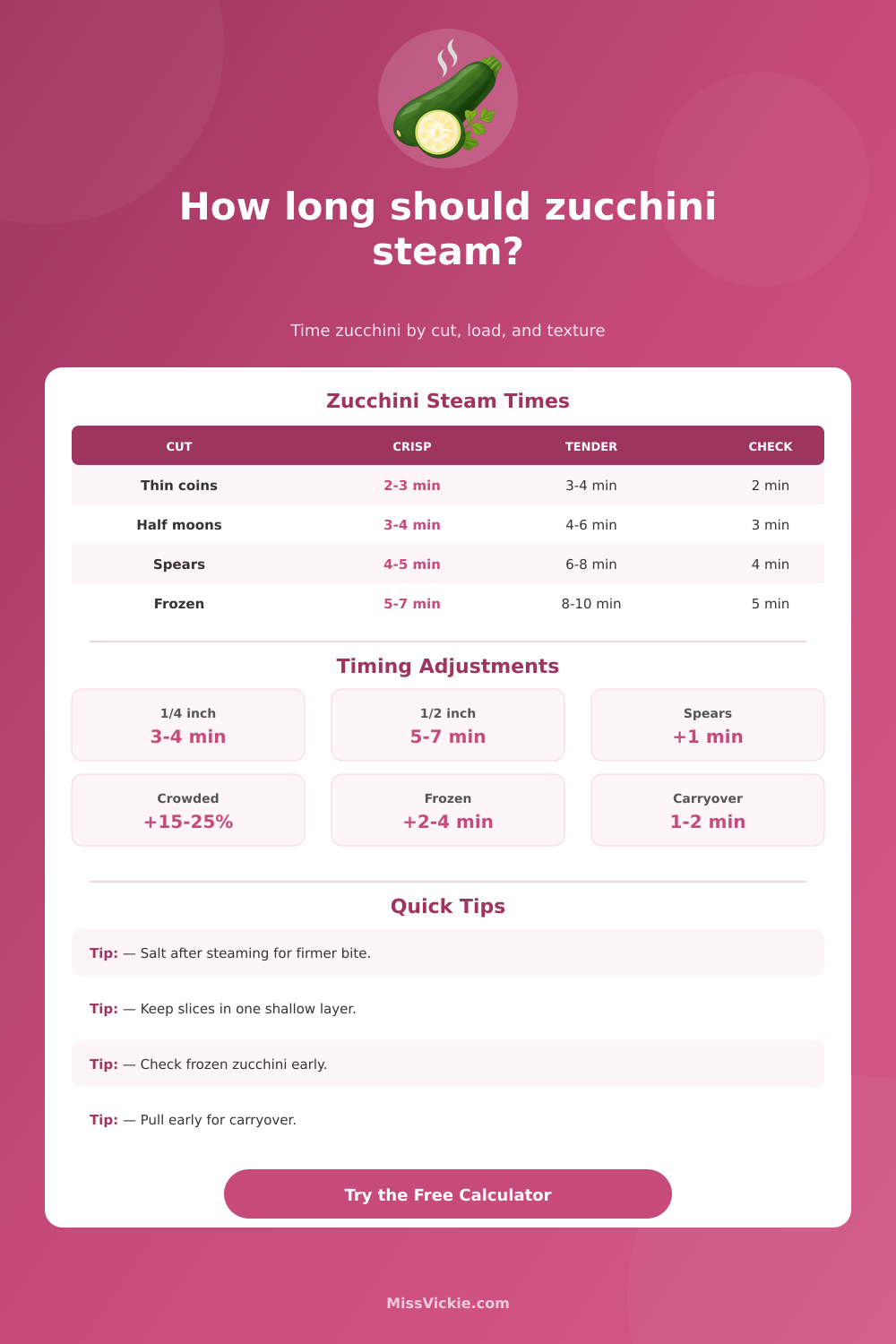
📌 Quick Zucchini Timing Benchmarks
Best for warm salads and very crisp texture.
Classic side-dish timing for 1/3 to 1/2 inch cuts.
Lengthwise pieces need heat to reach the center.
Frozen clumps take longer but soften quickly at the end.
🔪 Slice Thickness and Cut Table
| Zucchini Cut | Best Thickness | Steam Window | Texture Cue |
|---|---|---|---|
| Thin rounds or coins | 1/8 to 1/4 inch | 2 to 4 minutes | Hot through, still snappy at the peel. |
| Standard half-moons | 1/3 to 1/2 inch | 4 to 6 minutes | Fork enters with a little resistance. |
| Thick rounds | 5/8 to 3/4 inch | 6 to 8 minutes | Center turns translucent but not mushy. |
| Lengthwise spears | 1/2 to 3/4 inch | 5 to 8 minutes | Peel holds shape while cut side softens. |
| Zoodles or spirals | Thin strands | 1 to 2 minutes | Warm, flexible strands with no watery pile. |
| Whole baby zucchini | 3/4 to 1 inch wide | 7 to 10 minutes | Knife slides in at the blossom end. |
🧺 Steamer and Batch Load Table
| Setup | Adjustment | Why It Changes | Best Use |
|---|---|---|---|
| Stovetop basket, tight lid | Baseline | Direct steam reaches the slices quickly. | Everyday side dishes |
| Bamboo steamer | Add 5 to 10% | Gentler steam and slight venting slow the center. | Spears and delicate coins |
| Electric countertop steamer | Add 8 to 18% | Recovery can lag after cold zucchini is loaded. | Hands-off family batches |
| Microwave steamer bowl | Subtract 5 to 12% | A small covered bowl traps steam quickly. | One or two servings |
| Overlapping shallow mound | Add 10 to 18% | Coin centers shield one another from steam. | Medium batches |
| Deep pile or two tiers | Add 18 to 30% | Moisture pools while the middle catches up. | Large platters |
❄ Fresh, Frozen, and Salt Timing Table
| Condition | Timing Effect | Moisture Effect | Best Move |
|---|---|---|---|
| Fresh room-temperature zucchini | About 5% faster | Less steam recovery shock. | Check near the early end. |
| Fresh refrigerator-cold zucchini | Baseline | Normal moisture release. | Spread in one layer if possible. |
| Salted and drained before steaming | 5 to 10% faster | Firmer bite, less interior water. | Pat dry before loading. |
| Lightly salted just before steaming | Nearly baseline | Can weep on the tray. | Use for immediate serving. |
| Frozen loose slices | Add 25 to 40% | Thaws, then softens fast. | Stop before fully soft. |
| Frozen icy clump | Add 45 to 70% | Uneven watery pockets. | Break up halfway if needed. |
⏱ Doneness and Carryover Table
| Target | Pull Cue | Carryover | Serving Style |
|---|---|---|---|
| Warm crisp | Peel is bright, center still opaque. | 0 to 1 minute | Salads, vinaigrette, cold plates |
| Tender-crisp | Fork enters with light resistance. | 1 minute | Buttered side dish |
| Tender | Center is translucent and bends. | 1 to 2 minutes | Pasta, rice bowls, vegetable plates |
| Soft | Fork slips in without pressure. | 2 minutes | Casseroles and younger diners |
| Very soft | Pieces mash under a spoon. | 2 to 3 minutes | Puree, mash, blended soup |
| Cold salad shock | Stop while still slightly firm. | 0 minutes | Drain, cool, then dress |
Zucchini keeps softening after steaming because the watery center holds heat. The calculator subtracts a pull-early allowance when the carryover setting calls for it.
📊 Texture Comparison Grid
Bright peel, just-warmed center, and the least moisture loss.
The classic steamed zucchini target for butter, lemon, or herbs.
Soft center that still holds a round or spear shape on the plate.
Useful for casseroles, mash, puree, or frozen zucchini batches.
💡 Zucchini Steaming Tips
Even with just-right-looking tops, inside may be mush. Why? Usually, it’s about thickness and density of steam, not your timing. Zucchini will get watery if cooked too long; if not cooked enough, it’ll taste bitter before it is done. Your solution: find the sweet spot between too-soon and too-long by considering cooking time.
Enter the basket load and cut style into the calculator above. Let the calculator do the math for you. No more guesswork about those spears needing an additional minute or two.
Why Zucchini Gets Mushy
Most folks treats all their zucchini the same, wrong! A fat, thick spear take twice as long as a slim slice. Surface area determine the rate of penetration of steam. Choosing a cut style in the tool tells it how far the heat needs to travel to get to the heart of the matter. A long spear is harder for heat to penetrate then a round slice. It require more time to reach its core. That difference make a big difference to your dinner menu.
We don’t talk about batch size enough. Slices create protection between them when crowded in steamer basket; they block steam from making direct contact with every slice. That leaves steam-cooked “pockets” of cold air, which slow down cooking. That’s why the tool accounts for this by adding more time when you select an overlapping pile or any deep pile. It’s not a huge change in input, but it avoids those telltale signs of a raw center and soft edges. Ideally, you want a single shallow layer whenever possible so steam has some breathing room to circulate. Otherwise, there’s no space for it to cook the zucchini from beneath; instead it just condenses on top of it.
There is another issue: frozen zucchini. Like any vegetable, when ice turns into water, it expands the cell walls and causes the vegetable to lose its moisture much faster than unfrozen ones. When you’re using frozen sliced zucchini, therefore, you’ll need to consider the thawing period before it even starts to cook. And that’s why the calculator tacks on some additional time; the ice has to melt first, which creates steam, which softens the fiber. Rushing it with a still-frozen timer is pretty much guaranteed to produce a soggy dish. Patience is your friend, it’ll keep things more intact than high heat ever would of.
Most home cooks mess up on this one: When they add salt before steaming, the salt sucks the moisture from the vegetable via osmosis. Then the zucchini release large amounts of water in the basket, which turns into steam clouds. Those clouds don’t cook nearly as efficiently, they’re more prone to boiling the veggies rather than steaming them. Usually, it’s best to salt either just before plating or after steaming. That way, the structure isn’t ruined in the cooking process; and you have control over how moist the final product will be. (It sounds counterintuitive to wait until then to season, but remember: once the fibers soften, the flavor penetrates just as well.)
A lot of great vegetables get ruined on the stove top, carried over too far. Because the inside doesn’t cool as fast as the exterior, zucchini will continue cooking once it’s off the heat. If I take it off when my fork goes through with no resistance, guess what? By the time we’re at the table, it’s been overcooked! To compensate for the carry-over cooking, the tool advise removing it a little early. This means taking it out an extra minute or two before the outside gets tough while the inside is still warm. It might sound silly but it can make all the difference between a crispy side and a pathetic lump of greener mush.
It’s also affected by altitude, particularly if you live above sea level. Because water boils at a lower temperature as you ascend into the mountains, your steam will be less aggressive (and cooler). By entering your elevation, the calculator accounts for this with added time. This one is a simple mistake that results in undercooked food for mountain dwellers everywhere. The air is thinner, there is less heat, and you need patience.
Steaming zucchini boils down to controlling heat transfer and moisture carefully. How? All those vegetables want to let go of water and get soft, fast. Control is reached through knowing the relationship between batch density, cut size, and rest time. While the calculator provides a baseline (based off sound averages), your fork and eyes are the ultimate confirmation. Believe in the process. Check frequently. Pull slightly before it appears finished. That’s the key to maintaining that bright green color and pleasant snap from first bite to last.