MissVickie roast dinner batter planner
How Much Yorkshire Pudding Batter In Muffin Tin Calculator
Estimate batter per muffin well, total jug volume, egg-milk-flour mix, oil depth, rise room, and overflow risk for crisp Yorkshire puddings.
Choose a tin scenario, then adjust the well size, fill level, batter ratio, oil depth, rest time, and oven heat for your pan.
Calculation Breakdown
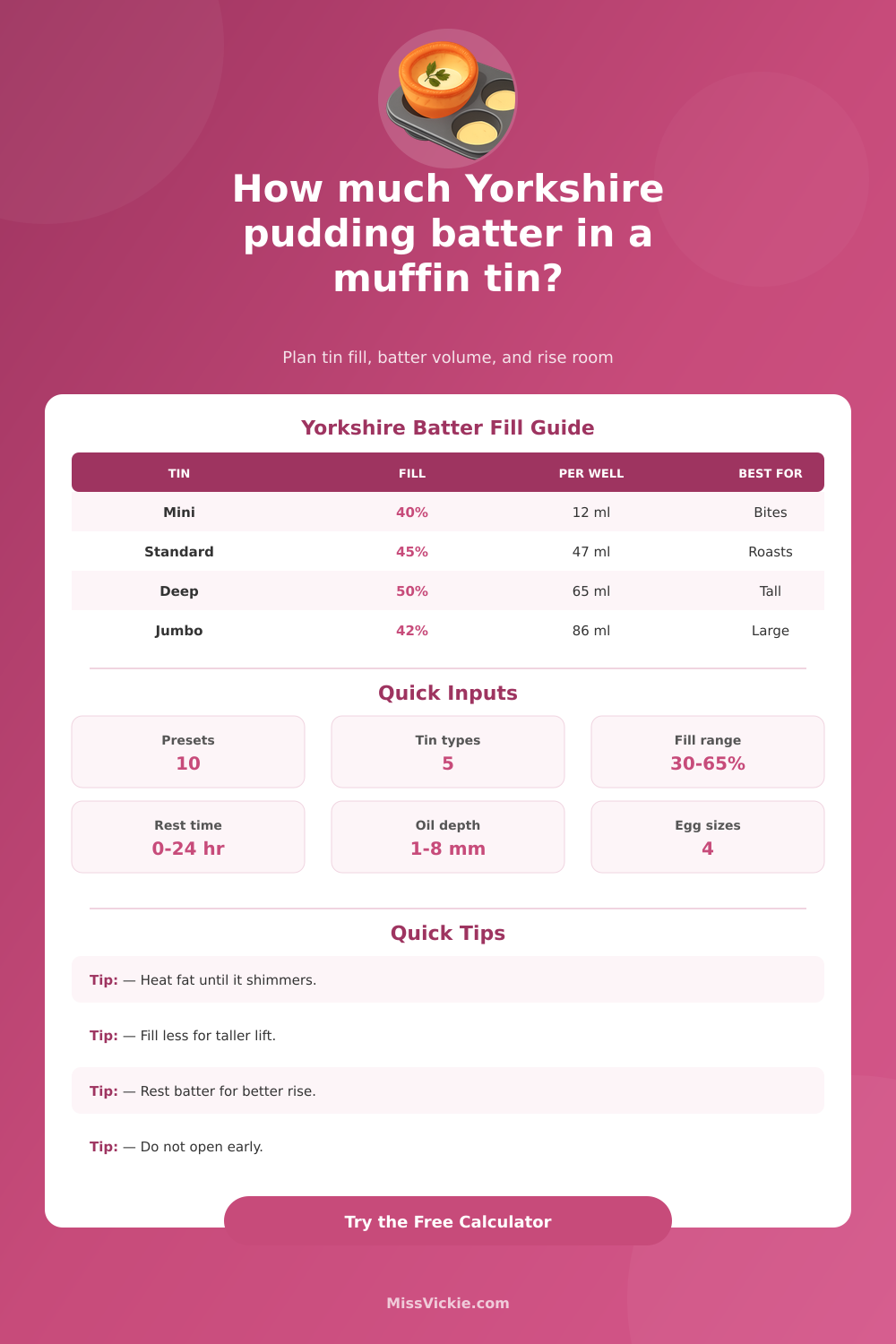
| Tin Type | Rim Capacity | Classic Fill | Batter Per Well | Best Use |
|---|---|---|---|---|
| Mini muffin tin | 25 to 35 ml | 35 to 45 percent | 9 to 16 ml | Bite-size roast snacks and party canapes |
| Standard muffin tin | 100 to 110 ml | 40 to 50 percent | 40 to 55 ml | Most roast dinner Yorkshire puddings |
| Deep standard tin | 120 to 140 ml | 45 to 55 percent | 54 to 77 ml | Taller sides and more gravy capacity |
| Jumbo muffin tin | 190 to 220 ml | 35 to 45 percent | 67 to 99 ml | Large pub-style puddings with hollow centers |
| Batter Style | Egg Share | Milk Share | Flour Share | Texture Tendency |
|---|---|---|---|---|
| Equal-volume classic | 1 part | 1 part | 1 part by volume | Balanced rise, crisp edges, reliable hollow |
| Egg-rich tall-rise | 1.15 parts | 0.95 part | 0.95 part | Stronger lift and more custardy center |
| Thin crisp batter | 1 part | 1.15 parts | 0.9 part | Thinner shell, fast expansion, crisp finish |
| Thicker soft-center | 1 part | 0.95 part | 1.12 parts | More body with a slightly softer middle |
| Gluten-free blend | 1.05 parts | 1 part | 1.05 parts | Needs careful fill and strong preheat |
| Fat Depth | Standard Well Volume | Effect On Batter Space | Typical Result | Calculator Treatment |
|---|---|---|---|---|
| 1 to 2 mm | About 4 to 8 ml | Small reduction | Crisp bottom with modest sizzle | Low displacement and low oil overflow risk |
| 3 to 4 mm | About 12 to 16 ml | Moderate reduction | Classic fried edge and good lift | Default hot-fat displacement range |
| 5 to 6 mm | About 20 to 24 ml | Large reduction | Very crisp base but easier spillover | Raises overflow score and lowers batter room |
| 7 to 8 mm | About 28 to 32 ml | Heavy reduction | Best only for deep cups or small pours | Flags high total fill when batter is also high |
| Planned Wells | Standard 45 Percent Fill | Approx Eggs | Approx Milk | Approx Flour |
|---|---|---|---|---|
| 6 standard wells | About 285 ml batter | 2 large eggs | 95 ml milk | 50 to 55 g flour |
| 12 standard wells | About 570 ml batter | 4 large eggs | 190 ml milk | 105 to 115 g flour |
| 18 standard wells | About 855 ml batter | 6 large eggs | 285 ml milk | 160 to 170 g flour |
| 24 standard wells | About 1140 ml batter | 8 large eggs | 380 ml milk | 215 to 230 g flour |
Best for very hot fat, tall lift, and hollow centers in standard tins.
Balanced pour for roast dinners when the tin is deeply preheated.
Works well in deeper wells where extra side height can contain the rise.
Gives more pudding mass but needs careful oil depth and oven heat.
In order to make Yorkshire puddings, it is necessary to determine the amount of batter that should being poured into each well of a muffin tin. The amount of batter that goes into each well will determine whether the resulting Yorkshire puddings will rise high above the surface of the oven baking tray, or whether they will remain relatively dense. Many cooks struggles with this aspect of preparing Yorkshire puddings due to the number of different variable that can impact the results of the recipe.
One of the variables to consider is the size of the muffin tin that you are to use to cook the puddings. Not all muffin tins is of the same size; the amount of batter that can be poured into each well of a muffin tin with deep wells will be different than those with shallower well depths. Furthermore, the amount of fat that you place into each well of the muffin tin before adding the batter will also reduce the amount of space that the batter can take up within the well.
How Much Batter to Put in Each Muffin Tin Well
Each of these variables will impact the amount of space that the batter can occupy within the well. The fill percentage of each well will impact both the height and the shape of each resulting Yorkshire pudding. For instance, if the percentage of the well that you are to fill with batter is 35%, that will provide space for the pudding to rise within the well.
However, using a 35% fill will require the Yorkshire puddings to be baked in a very hot oven in order to achieve the desired height of the puddings. Using a 50% fill will provide more batter to the well, which may be better for deep well muffin tin pan. Each variable that impacts the amount of space within the well of the muffin tin, the percentage of the well that is to be filled with batter, and the composition of the batter will affect the rise of the resulting Yorkshire pudding.
For instance, each additional millimetre of fat that you place into each well will reduce the amount of space that is available to the batter. Furthermore, each additional percentage point of the well that is filled with batter will increase the likelihood that the puddings will be too large and may lead to overflowing wells. The ingredients that you use to make the batter will also impact the rise of the Yorkshire pudding.
For instance, using an equal amount of each ingredient will produce different results then using an egg-rich recipe. Additionally, thin batters will rise more quickly than thick batters, which can impact how long the puddings are cooked. The resting period of the batter can also have an impact upon the rise of the pudding.
If you allow the batter to rest for only thirty minutes, it will not have time to hydrate the flour within the batter to create a smooth batter. However, if the batter is allowed to rest overnight in the refrigerator, the proteins within the batter will relax, which can allow the batter to rise during cooking. However, the chilled batter should be allowed to warm slightly before being poured into the hot fat within the well of the muffin tin; otherwise, the edges of the puddings may set prior to the center of each pudding.
The temperature to which you will heat the muffin tin, as well as the heat of the tin itself, can also impact the rise of the Yorkshire pudding. A very hot muffin tin will allow the resulting puddings to steam and rise, but if the tin is too hot, the puddings may overflow from the wells of the muffin tin. The risk of overflow of the wells can be calculated by determining the rise of the batter relative to the size of the well of the muffin tin.
If the calculated rise of the batter is too high relative to the size of the well, you can reduce the fill percentage of the well. Many cooks may make mistakes when attempting to create a Yorkshire pudding with a muffin tin. For instance, one might use the same amount of batter to fill a jumbo muffin tin as that which is used for a standard muffin tin.
Furthermore, one might forget to account for the depth of the oil within each well of the muffin tin. To avoid these types of mistakes, it is important to measure the amount of space that each well of the muffin tin can take up with batter, and to use that measurement for each batch of batter that is prepared. If you are to prepare a recipe for a large number of people, arithmetic can be used to calculate how much of each ingredient is required.
It is impossible to simply double the recipe for a number of individuals; the chemical reactions of the ingredients may differ from those that are used in the original recipe. Using the calculator that is used to calculate the amount of batter that is required for a number of individuals, it is possible to measure the amount of oil that will be needed for the recipe, to whisk the eggs, and to pour the batter into the well of the muffin tin. Youll need to be careful with the measurements of your ingredents because its important to get it right.
You should of checked the size of the tins too.