🧉 Yerba Mate Caffeine Calculator
Estimate caffeine in your yerba mate by cup size, leaf amount & strength
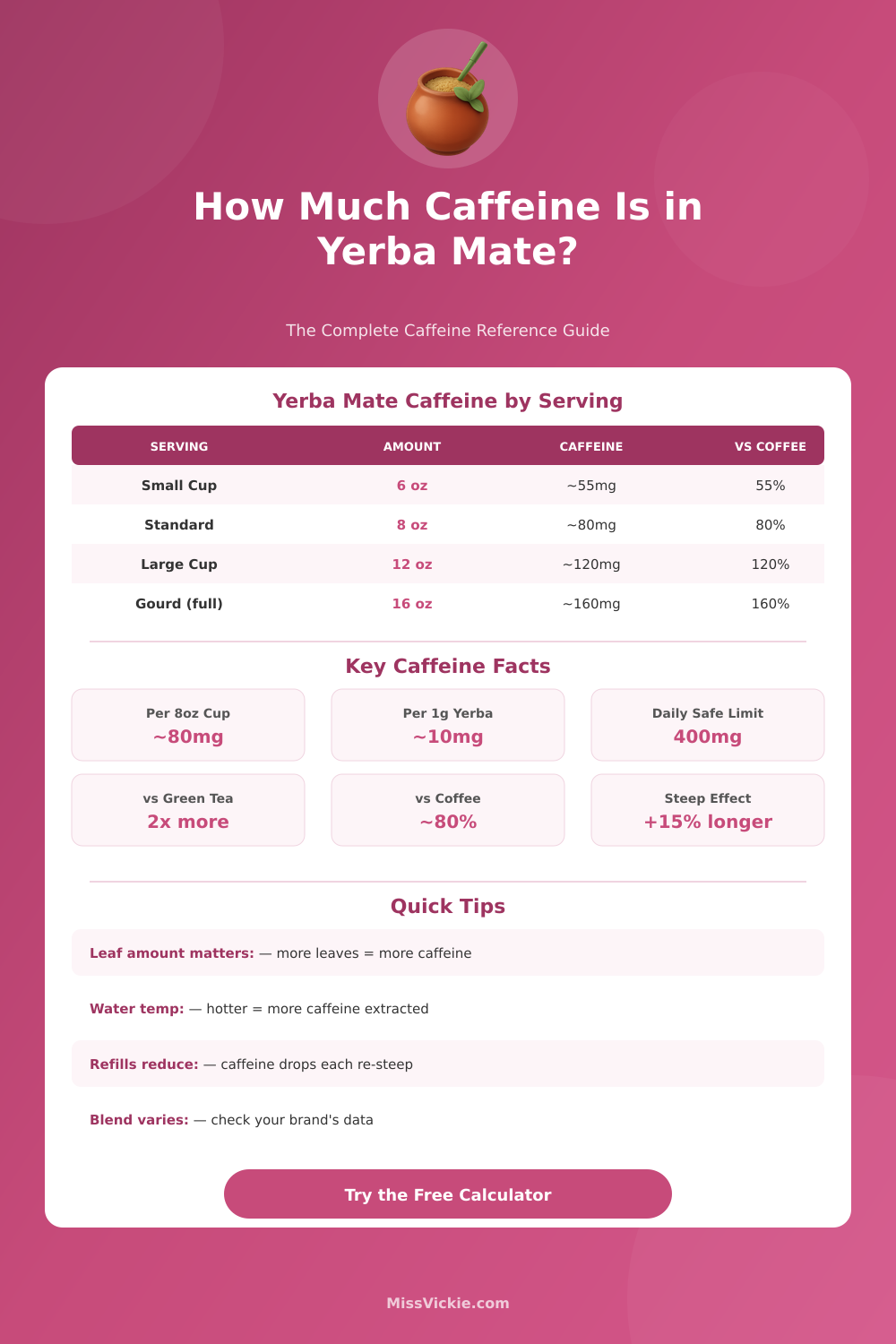
| Serving | Volume | Leaves | Caffeine (est.) | vs Coffee |
|---|---|---|---|---|
| Small Cup | 6 oz / 177ml | 1.5 tbsp / 4g | 45–65mg | ~55% |
| Standard Gourd | 8 oz / 237ml | 2 tbsp / 6g | 65–90mg | ~80% |
| Large Gourd | 12 oz / 355ml | 3 tbsp / 9g | 90–135mg | ~110% |
| Traditional Gourd | 16 oz / 473ml | 4 tbsp / 12g | 120–180mg | ~150% |
| Bagged Tea | 8 oz / 237ml | 1 bag (~2g) | 30–50mg | ~40% |
| Cold Brew Mate | 16 oz / 473ml | 4 tbsp / 12g | 80–120mg | ~90% |
| Round | Caffeine Retained | Flavor | Notes |
|---|---|---|---|
| 1st Infusion | 100% | Full-bodied | Peak caffeine & flavor |
| 2nd Infusion | ~65–75% | Smooth | Most popular round |
| 3rd Infusion | ~35–50% | Mild | Less bitter |
| 4th+ Infusion | ~10–25% | Very mild | Low caffeine |
| Beverage | Serving | Caffeine | Caffeine/oz |
|---|---|---|---|
| Yerba Mate (standard) | 8 oz | ~80mg | ~10mg/oz |
| Drip Coffee | 8 oz | ~95mg | ~12mg/oz |
| Espresso | 1 oz | ~63mg | ~63mg/oz |
| Black Tea | 8 oz | ~47mg | ~6mg/oz |
| Green Tea | 8 oz | ~28mg | ~3.5mg/oz |
| Matcha | 8 oz | ~70mg | ~9mg/oz |
| Energy Drink | 8 oz | ~80mg | ~10mg/oz |
| Decaf Coffee | 8 oz | ~5mg | ~0.6mg/oz |
| Strength | Leaves per 8oz | Caffeine Modifier | Best For |
|---|---|---|---|
| Light | 1 tbsp / 3g | –30% | Sensitive to caffeine |
| Medium (Traditional) | 2 tbsp / 6g | Baseline | Everyday use |
| Strong | 3 tbsp / 9g | +40% | Energy boost |
| Extra Strong | 4 tbsp / 12g | +75% | High tolerance |
Yerba mate is a grassy tea with caffeine that enjoys big popularity in South America. One dries the leaves and later soaks them in warm water to prepare the drink, that one can serve warm or cold according to desire. The plant belongs to the holly family and gives a strong bitter taste, similar to green tea.
Ilex paraguariensis, or yerba mate, comes from South America. It ranks between the only four plants of the Americas that has caffeine. The taste mix blends bittersweet with roughness and mineral notes together with hints of olive and eucalyptus.
What is yerba mate?
Yerba mate stores some useful plant substances, between that xanthines work as stimulants. Between them is caffeine and theobromine, that also appears in tea, coffee and chocolate. Moreover it has theophylline, although this usually happens only in small amounts or even lacks a bit.
The level of caffeine adjusts from 0.7% until 1.7% according to the dry mass. Compared to many speices of tea, yerba mate has more caffeine. Similarly as with coffee, the actual amount depends on the way you prepare it.
The usual mode of brewing it is very different to that of average teas. One pours small portions of water in a cup full of leaves of yerba mate tea. By means of a metal straw called bombilla one drinks it directly.
Later one adds more water and passes the cup to another person, what makes it truly social. Rather then with tea or coffee, one does not remove the grasses from the water. First one pours a bit of cold water, so that the grasses can absorb it.
Then one pours warm water, never boiling, above the grasses to fill the cup.
During centuries the tribe of the Guayakí consumed yerba mate because of its refreshing effects, better focus and nutritious value. The custom of friends drinking from the same cup truly explains, why this tea received the name “grassy friend”. In the last years mixes from yerba mate became always more liked between top sportsmen and folks caring about health.
Yerba mate has huge diversity. One can prepare it with warm or cold water, milk or fruit juice. The most usual and ancient mode is obviously with warm water.
Mate cocido presents an alternative method, where one boils the yerba and later extracts it. A French press works well for that. Here mixes of yerba mate commonly include grasses like mint, marked “con hierbas“, or orange hints called “naranja“.
Also a roasted variant exists for those, that do not like the usual taste. Packets for tea give less strong focus than the classical cup with bombilla. By means of the traditional process, even in one single occasion, the taste adjustsa lot, causing three or four different drinks from one portion of yerba.