
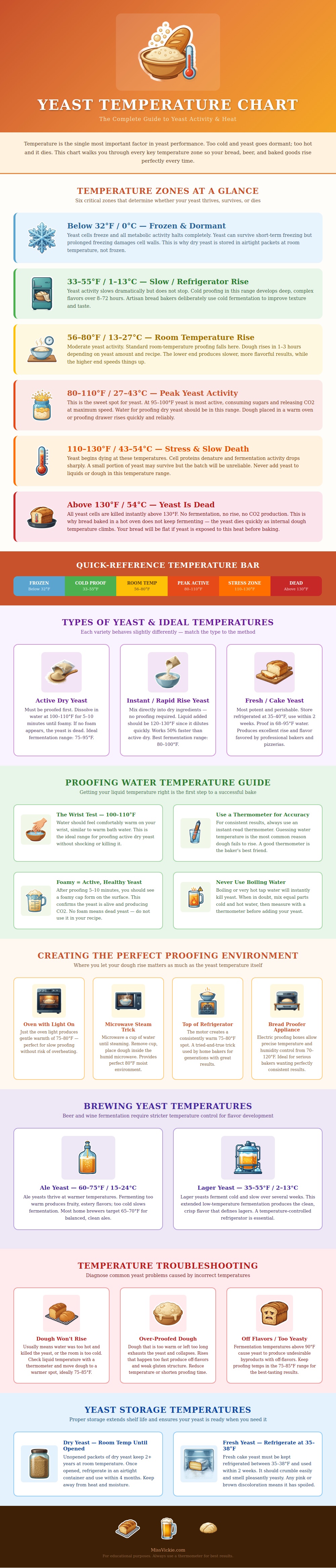
Heat; not necessarily stale water or poor flour, is typicaly why you end up with a brick of baked bread rather than light loaves. Because the yeast is a living creature, it’s sensitive to temperatures and will respond accordingly. To succeed, you need to handle your yeast propery. In the following chart, notice that each condition has its own effect. The yeast respond to these conditions, ranging from dormant to dead.
Think of yeast as your employee, treat him/her right, and he/she’ll do their job right. Treat him/her wrong, and he/she won’t be able to function. Make it too hot, and he/she’s dead. Make it too cold, and he/she doesn’t want to work. Just right, and he/she’s productive.
Why Temperature Is Important For Yeast
Typically, that’s somewhere around 95 degrees Fahrenheit. This is the best temperature for yeast. At 95 degrees, the yeast rapidly digest any sugar you have added, while emitting CO2 quickly. That means you get a risen dough, but don’t pick up off-flavors from the proofing process. The infographic highlights this as the sweet spot for proofing liquids. If you can get your water into this narrow little window of opportunity, youre on your way to success.
Many home bakers make a fatal error by trusting their instincts rather than tools. You’re going to grab some tap water that’s warm to your touch and think “good enough.” But what feels comfortable to your hand isn’t naturaly comfortable for yeast cells. What’s nice to the back of your wrist could be scorching-hot to them. We humans overtrust our feelings… Not data!
Save yourself dough (pun intended) with an inexpensive instant-read thermometer. No more guessing games. Here’s the visual guide: notice how quickly things get wonky when you hit a given threshold. It’s a cliff; there is no slow-and-steady loss of effectiveness here.
Preparation is only part of the equation; where you keep things is equally important. Once that package of yeast has been pried open, moisture is an issue, as is keeping it warm and dry until your ready to use it. Once opened, refrigerate it, which will extend the shelf-life a lot. Even fresh cake yeast is more picky, and should of been stored in the refrigerator immediately after purchase. Don’t throw out good money on something you can’t use: if the yeast smells sour or starts to turn a little gray, its time for a new one. Heat doesn’t resurrect dead yeast cells.
This chart differentiates between fermentation temps and storing temps for all your ingredients. Half the battle is having your ingredients alive by the time they meets the flour. The same should be said of proofing environments. Keeping the dough too cold will also slow the process and lengthen rising time, translating into some serious yeast notes in your bread (since you’ve let it sit longer then necessary).
On the flip side, it can be too hot, like sitting next to a window in the sun or next to a radiator. The dough expand too quickly, which weakens the gluten structure and causes the bread to collapse before hitting the oven. The solution? Locate a dependable warm space; a place where there’s both warmth and humidity, such as a lightly preheated oven. Think of it as a pro-style drawer for proofing but without the need for fancy equipment. That’s how you create a steady atmosphere where yeast do its job, not run around like crazy.
Similarly, brewers has the same problems, only on a narrower scale. For example, ale yeasts like things warm just like people do, whereas lager yeasts likes to be kept in refrigerator-like temps for weeks. Too hot will lead to “fruity” flavors, which is the last thing you want in a clean-tasting lager. Whether it’s baking or brewing, the temperature determines how the final dish tastes. Knowing where your ingredients are helps determine taste and texture. As the visual aid shows, these concepts apply to different industries. The end result doesn’t change how yeast behaves; you just use it differently depending on what you are making.
Knowing this makes baking less guess work and more scientific. So next time you take out that measuring cup, take another second or two and read that thermometer. Respect that little organism working hard in your bowl. The rise will take care of itself if you match the temperature with what yeast needs. It’s only an extra half minute, but it’s worth it for that wonderful smell of warm bread.