MissVickie dough rescue math
Yeast Fix for Dough Calculator
Estimate the yeast gap in a bread, pizza, roll, or enriched dough, then choose a practical rescue based on flour weight, yeast already added, intended yeast, dough temperature, fermentation time, sugar, salt, fat, and proof condition.
🍞Pick a rescue scenario
Use a preset when you know the dough story. The calculator still lets you fine-tune flour, yeast type, temperature, timing, and proof state.
⚖Choose units
🦫Dough and yeast inputs
Yeast rescue plan
Run the calculator to compare added yeast with intended yeast and choose a rescue.
📊Live dough diagnostics
These cards update with the calculator and help separate a real yeast shortage from a cold, salty, sweet, or fatty dough that simply needs time.
🧪Yeast type conversion table
| Yeast type | Recipe equivalent | Best rescue use | Mixing note |
|---|---|---|---|
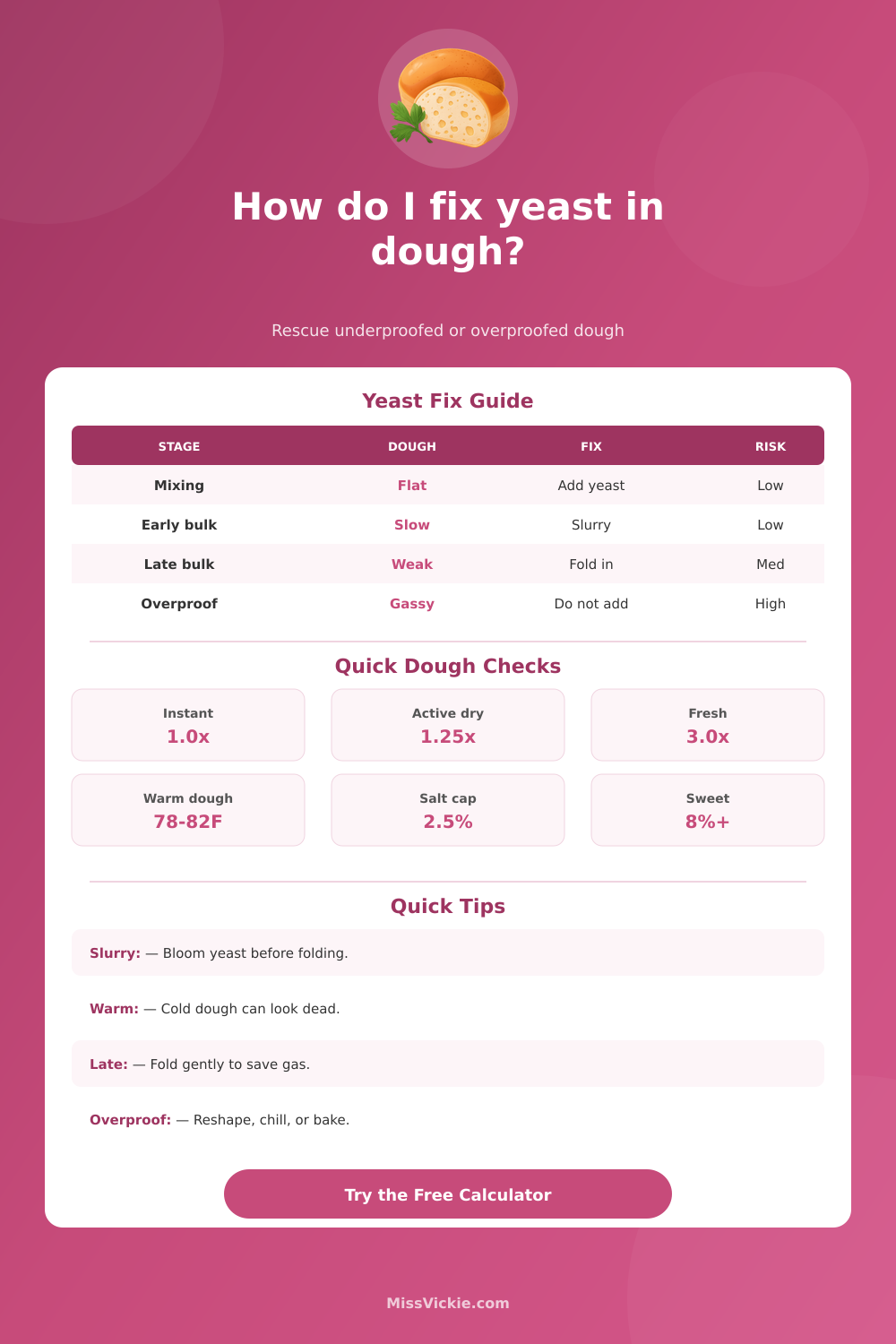
| Instant yeast | 1 g instant equals 1 g instant target | Best all-purpose dough rescue | Whisk with a spoonful of water before folding into dough. |
| Active dry yeast | About 1.25 g active dry equals 1 g instant | Good if bloomed first | Bloom in warm water, then smear and fold until fully distributed. |
| Fresh yeast | About 3 g fresh equals 1 g instant | Gentle rescue for soft dough | Crumble into a thin slurry; avoid dry pockets. |
| Rapid-rise yeast | Usually close to instant yeast by weight | Useful early in bulk | Use a small slurry so it reaches the center of the dough. |
| Osmotolerant yeast | Use like instant for sweet dough planning | Best for high sugar dough | Helpful when sugar is above 8% of flour weight. |
⏲Rescue timing table
| Dough stage | Typical sign | Yeast add-in choice | Handling method |
|---|---|---|---|
| Just mixed | No rise yet, dough still rough | Add most or all of the missing yeast | Dissolve yeast, knead briefly, then restart bulk timing. |
| Early bulk | Some elasticity, little gas | Add the missing yeast if the gap is meaningful | Laminate or fold the slurry through the dough in two passes. |
| Late bulk | Gas present but dough lags | Add only if the gap is large | Use gentle folds and expect uneven acceleration. |
| Ready to shape | Dough has risen and holds bubbles | Usually avoid adding yeast | Shape, proof warm, and watch dough instead of the clock. |
| Overproofed | Collapsing, fragile, sour, or slack | Do not add yeast | Degas lightly, reshape, chill, or bake as a flatter loaf. |
🌡Formula drag reference
| Factor | Low drag | Moderate drag | Strong drag |
|---|---|---|---|
| Dough temperature | 76F to 82F rises predictably | 68F to 74F may need more time | Below 65F can look stalled |
| Sugar | 0% to 5% is easy for yeast | 6% to 12% slows ordinary yeast | Above 12% often needs osmotolerant yeast |
| Salt | 1.8% to 2.2% is normal | 2.3% to 2.7% slows fermentation | Above 2.7% can taste salty and rise slowly |
| Fat | 0% to 5% blends easily | 6% to 15% slows gluten and rise | Above 15% makes late rescue difficult |
| Hydration | 60% to 75% folds well | 50% to 59% needs kneading | Below 50% resists slurry distribution |
💡Practical rescue notes
This calculator estimates kitchen rescue quantities for dough already in progress. Flour strength, yeast age, water temperature, kneading, pan size, and room humidity can change the final proof.
Baking doughs can be difficult if the dough dont rise as expected. Even if you follow the recipe and measure the flour corectly, the dough may end up as a dense slab due to the dough failing to rise. Several factor impact how much yeast the dough will require to achieve a proper rise.
The factors include the temperature of the kitchen in which the dough is rising, the amount of salt in the dough, the amount of sugar in the dough, the amount of fat in the dough, and the amount of time the dough has been rising. If the kitchen in which the dough is rising to is particulary cool, the dough will take longer to rise. Additionally, the more higher the percentage of salt in the dough, the more it will slow the activity of the yeast.
Why Dough Won’t Rise and How to Fix It
Using the calculator can help to determine if the dough will require more yeast than has been added to the dough. To use the calculator, you will need to enter the weight of the flour, the type of yeast to be used, the temperature of the dough, the length of time for which the dough will rise, and the current proof condition of the dough into the calculator. The calculator will need the weight of the flour because the percentage of yeast that you will add will be calculated based on the weight of the flour.
Furthermore, you will need to enter the type of yeast that will be used into the calculator because instant yeast, active dry yeast, and fresh yeast is not all the same in relation to the weight of yeast to be added. The temperature of the dough will impact how fast the yeast will rise the dough; for instance, dough that is rising at 65 degrees may appear to be stalled in rising, while dough that is rising at 82 degrees will begin to rise faster. The amount of sugar, salt, and fat in the dough will also impact the rise of the dough because high level of sugar will require the yeast to be osmotolerant.
If the level of salt in the dough is above 2.5 percent, it will slow the yeast. If the amount of fat in the dough is above 15 percent, it will be difficult for the dough to evenly distribute the yeast throughout the dough. The calculator will provide a pace rating of the rise of the dough as well as a rescue window indicating whether adding yeast will be of more use to the dough at this point in the rising process.
Adding yeast during the early bulk phase of the dough will be different than adding yeast during the late stage of the fermentation process. While many may think adding more yeast is the solution to increasing the rise in the dough, adding yeast to overproofed dough will not necesarily restore the structure of the dough. If the dough is overproofed, adding yeast may lead to an uneven crumb of the dough.
Instead of adding yeast to overproofed dough, it is better to degas the dough, shape it again, and allow it to proof for a shorter time. If the dough is cold, it may appear that the dough is not rising due to the yeast, but the amount of yeast may be the correct amount for that dough. In this case, warming the dough will reveal whether or not the dough will require the addition of yeast.
These reference tables will provide information regarding the different yeast ranges for different types of dough. The reference tables will also explain how to convert one type of yeast to another, such as converting active dry yeast to instant yeast. Additionally, the reference tables will provide information regarding the different rescue choices that can be made based on the fermentation stage of the dough.
The fermentation stage will have an impact on the outcome of adding yeast to the dough. For instance, there will be different results to adding yeast to the dough during the early bulk stage compared to the late stage of fermentation. Finally, the calculator will allow bakers to see how the local temperature and the strength of the flour impact the rising of the dough.
Bakers can use this information to gain a better understanding of the dough and to decide what small adjustment will have the greatest impact on the rising of the dough.