Yeast Per Pound Of Flour Calculator
Calculate yeast by flour pounds, yeast type, baker's percentage, dough style, rise time, dough temperature, enrichment, cold ferment, salt percentage, and packet size.
Start with a common dough plan, then adjust flour weight, yeast type, fermentation time, temperature, enrichment, salt, and packet size.
Your Yeast Amount
Yeast amount and packet conversion are ready.
Formula Breakdown
Dough Context
| Dough Plan | Instant Yeast Per Pound Flour | Active Dry Per Pound Flour | Fresh Yeast Per Pound Flour |
|---|---|---|---|
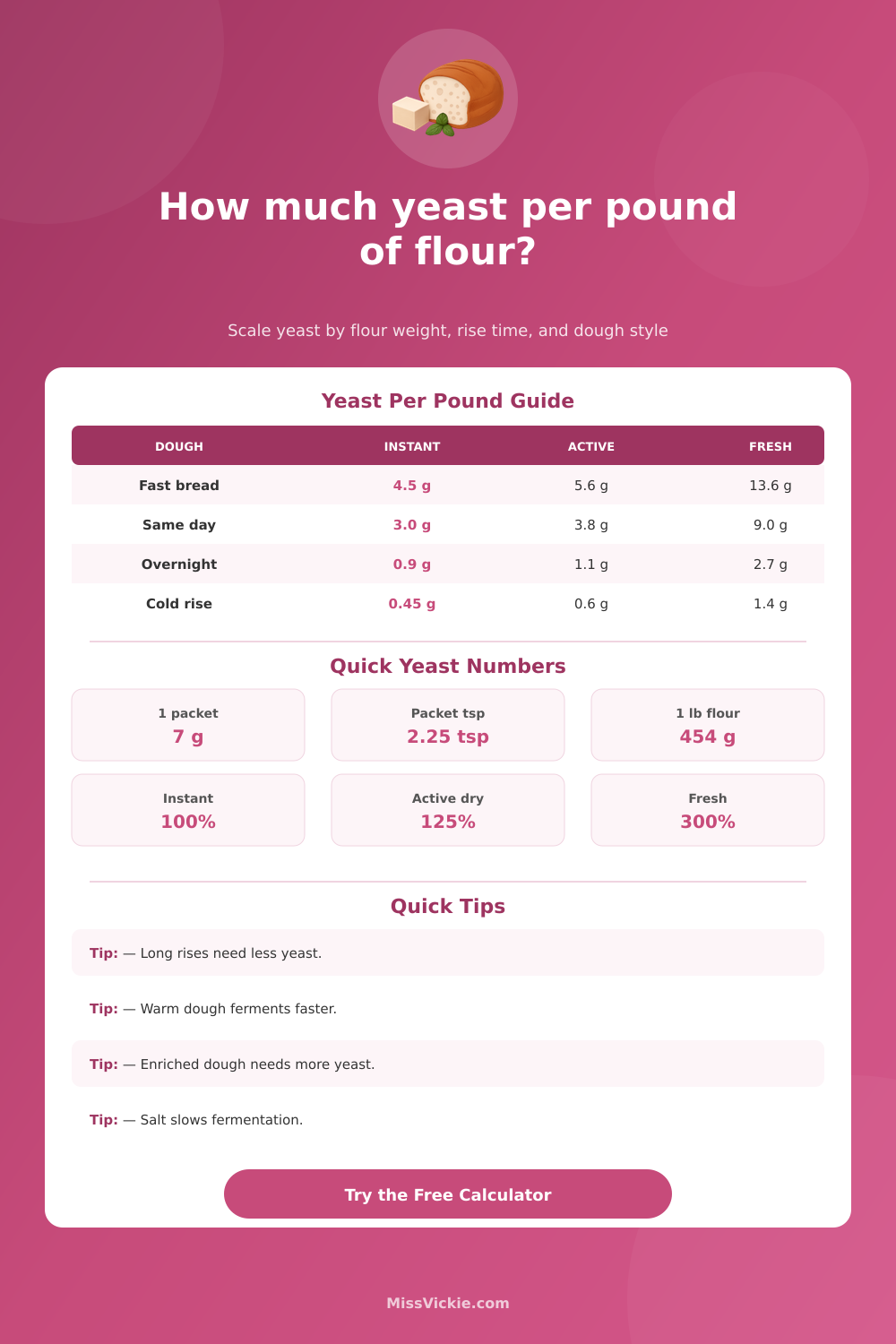
| Quick bread, about 1 to 2 hours | 4.5 to 6.8 g | 5.6 to 8.5 g | 13.5 to 20.4 g |
| Same-day bread, about 3 to 5 hours | 2.3 to 4.5 g | 2.9 to 5.6 g | 6.8 to 13.5 g |
| Overnight room temperature dough | 0.7 to 1.6 g | 0.9 to 2.0 g | 2.1 to 4.8 g |
| Cold ferment pizza or focaccia | 0.2 to 0.9 g | 0.3 to 1.1 g | 0.6 to 2.7 g |
| Sweet enriched rolls | 4.5 to 9.1 g | 5.6 to 11.4 g | 13.5 to 27.3 g |
| Yeast Type | Use This Multiplier | Best Use | Kitchen Note |
|---|---|---|---|
| Instant yeast | 1.00 times instant baseline | Everyday bread, pizza, rolls | Can mix directly into flour |
| Active dry yeast | 1.25 times instant baseline | Classic home bread recipes | May be bloomed in warm water |
| Fresh cake yeast | 3.00 times instant baseline | Bakery-style doughs | Crumble and dissolve before mixing |
| Osmotolerant instant yeast | 0.90 times instant baseline | Sweet and enriched dough | Useful when sugar is high |
| Rise Time And Temperature | Yeast Direction | Typical Adjustment | Fermentation Note |
|---|---|---|---|
| Under 2 hours at warm room temperature | Use more yeast | About 1.4 to 1.9 times | Fast rise with milder flavor |
| 3 to 6 hours near 72 to 78 F | Use a moderate amount | About 0.8 to 1.2 times | Balanced for everyday bread |
| 8 to 16 hours at room temperature | Use less yeast | About 0.35 to 0.7 times | More flavor and easier scheduling |
| 24 to 72 hours in the refrigerator | Use much less yeast | About 0.12 to 0.4 times | Slow rise with stronger flavor |
| Baker's Percent Item | Lean Bread | Pizza Dough | Enriched Rolls |
|---|---|---|---|
| Flour | 100 percent | 100 percent | 100 percent |
| Water or liquid | 58 to 72 percent | 58 to 75 percent | 50 to 65 percent |
| Salt | 1.8 to 2.2 percent | 2.2 to 3 percent | 1.5 to 2 percent |
| Instant yeast | 0.2 to 1 percent | 0.05 to 0.8 percent | 0.8 to 2 percent |
| Sugar and fat | 0 to 5 percent | 0 to 8 percent | 15 to 45 percent |
Reliable all-purpose dry yeast that can be mixed with flour.
Use a little more than instant yeast for the same lift.
Moist yeast cakes need a larger gram amount.
Strong option for sweet dough with higher sugar.
Yeast amounts are practical starting points for home baking. Flour strength, water temperature, mixing intensity, and room temperature can change the exact rise time.
There comes a moment in baking when it becomes more than just a recipe; it becomes a physics problem. There’s a bag of yeast on the counter without an explanation of how much you need for one loaf, and there are two pounds of flour begging to be turned into something. And the day of the week determine the rising schedule. It’s convenient to take a packet of home-baking yeast when you’re shopping; but convenience isn’t precision. Too little and you wait by the oven for the dough to wake up (it won’t). Too much and your bread taste bland, with a fast rise.
Plug in your flour weight and your fermentation goals into the calculator above and let it do the math. Avoid having to guess at coefficients each time you decide what you want for dinner.
How Much Yeast Do You Need?
“Yeast isn’t always used,” you say, “like salt.” Yeast isn’t a fixed quantity like salt. Yeast is a living thing. It react differently to stress, time, and temperature. A standard packet contains seven grams of dry yeast, which is enough for two pounds of flour if you want a quick rise in a warm kitchen. That’ll do it, at room temperature or warmer, to leaven two pounds of flour, pretty fast. This is great for making sandwich loaves on a busy weeknight. But it’s way too much yeast (by a factor of ten) if what you’re baking is refrigerated pizza dough.
If you’ve got all day, then you don’t need as much yeast; in fact you needs less. And this device knows that: it tacks down how much yeast to use based off how long the dough will ferment. Less for slower rises in cooler temps; more for faster rises in hotter ones. But so does temperature, which plays an unpredictable role here as well. When it’s warm, the yeast goes into hyperdrive. In an eighty degree kitchen, the yeast will burn through its fuel fast. What happens? Alcohol and carbon dioxide production accelerates rapidly. It will rise but it loses flavor because there isn’t enough time for the flavor and the gluten to develop together. A cooler dough progresses more slowly. Enzymes has time to do their work breaking down starch into sugar. This adds color and depth to the crust. The calculator accounts for dough temp so you don’t feed the beast too much, or not enough. It’s a subtle tweak but one that separates open crumb from flat bread.
But add enrichment and it all starts to change. Flour proteins gets coated in fat. Gluten development is interrupted. Osmosis pulls sugar-water from yeast cells, stressing them out. In a lean baguette dough, the yeast has an easy time. It is a simple environment where yeast thrives easy. In a rich brioche or sweet roll dough, things become a difficult environment for yeast and will need either a higher dose of yeast or something more tough in order to reach the same level of rise. With the interface, you can indicate if your dough is lean, lightly enriched, or very rich. That moves the recommendation based on those chemical barriers. If the ingredients makes it harder for the yeast to work, you are essentially just using more yeast to get the job done.
Not all yeasts are made equal, either. Active dry yeasts are less strong than instant (finer granules don’t have to bloom). Fresh yeast has three times the water weight. Weigh out three times as much by mass to get the same amount of living cells. In the pro baking world, these ratios is consistent. About one part instant = 1.25 parts active dry (or about three parts fresh). If you know that, you can sub with ease and maintain dough balance. You won’t have to remember to modify your recipe for each kind of yeast in your cupboard. Have a formula in your head; let math do the rest when it comes to converting units.
Salt is another inhibitor worth noting. It slows fermentation while strengthening gluten. Two percent of flour weight is a common recommendation in most recipes, sufficient to preserve flavor without impeding the rise. Departing from the norm will change how it affects yeast activity. The calculator compares your chosen salt level with the accepted range and cautions you if your dough may be overly salty or too bland to form a good structure.
But really, this is all about managing expectations. As much as it’s about throwing together a few ingredients. Once you learn how your chosen temperature and time impact yeast, you begin to see what makes sense, rather than just following along with whatever recipe you read. It goes like this: You follow the numbers, but let your senses be the judge. Check if there has been an increase in volume. Does it smell fermented? Do you touch your dough? If so, you have a place to start, a starting line. Now your kitchen will let you know when you’re good to go into the oven.