
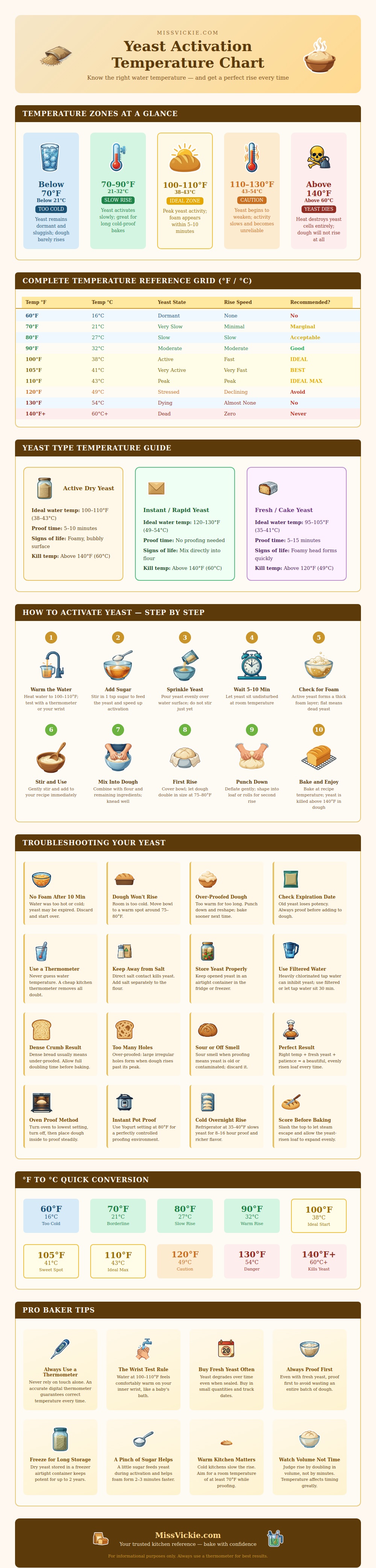
Wrong temperatures make a dense loaf. Yeast is a living organism; it need certain conditions in order to do its job. To get the yeast going correctly, you need to control the temperature (read: heat).
As you can see on the visual guide, less than seventy degrees Fahrenheit are too cold for yeast to do anything but be dormant. Your dough won’t rise much at all as the cells remain sluggish. More than one hundred and forty degrees is too hot for yeast. It’s essentially murder. The cells dies completely, so there will be no rising.
The Right Temperature for Yeast
For most recipes, you’ll want to use water between one hundred and one hundred and ten degrees. This will warm up the yeast without killing it. Within five minutes or so, you should of notice some foaming action. If you do, it means the cells is awake and ready to go.
Proofing
While many baker avoid it, there’s a reason for proving your dough: With active dry yeast, proofing gives you an opportunity to check your yeast’s viability. Does it foam within ten minutes? Then the yeast is still good; if not, it’s probably out of date. Proofing it first will save you time and flour.
Potency is also influenced by how you store your yeast. Even in sealed packets, yeast eventualy breaks down over time. Exposure to warmth speeds up that breakdown so be sure to include that in your water temperature. Cake yeast, especially fresh yeast, is more fragile than its dry counterparts. Exposed to heat, it begin to die quickly. Proving it is a simple way to determine freshness. If no foam develops, throw the yeast away.
Environmental factors also affect fermentation speed in the kitchen: A cold room will slow it way down. Too warm of a room means your dough will be gassed out and over-proofed too fast. Over proofing results in an under-structured dough since the gluten network becomes weak. Having a stable environment is key and you have that if you use the oven. Preheating briefly or just turning on the oven light creates a constant microclimate for the dough to rise evenly.
When measuring your water temperature, don’t rely on touch. Hands cannot accurately show exact degrees. Lukewarm water could actualy be too cold for you. Invest in a digital thermometer. It will always give you the same reading. This eliminates any guesswork.
Avoid getting salt into your yeast when mixing it up. The salt will pull moisture from yeast cells via osmosis and hinder its activity. Add the salt to the flour first and incorporate the yeast after. That will keep cells functioning propery.
“With baking, you’re working with biology. It is the biology of heat. You want the cold to stop it. If you have too much heat, the yeast will die. So knowing about those temperatures gives you power over what happens. If you use warm water, you’re going to create an environment for life in the bowl. And when you do that, if you respect the temperature, then you get a good rise on the bread; you get the right kind of aroma and crumb. This is a science to trust, so you know how to get a loaf to be right.”