Liquid volume, viscosity target, hot or cold use, acidity, sugar and fat load, blender shear, hydration time, clump risk, and sauce style
Xanthan Gum to Thicken Liquid Calculator
Estimate xanthan gum for drinks, sauces, dressings, glazes, and cold-prep liquids by volume, target viscosity, temperature, acidity, sugar or fat load, blender shear, hydration time, and clump risk.
Choose a real kitchen starting point, then adjust the liquid volume, target texture, temperature, acidity, sugar, fat, shear, hydration time, and clump risk.
Calculation Breakdown
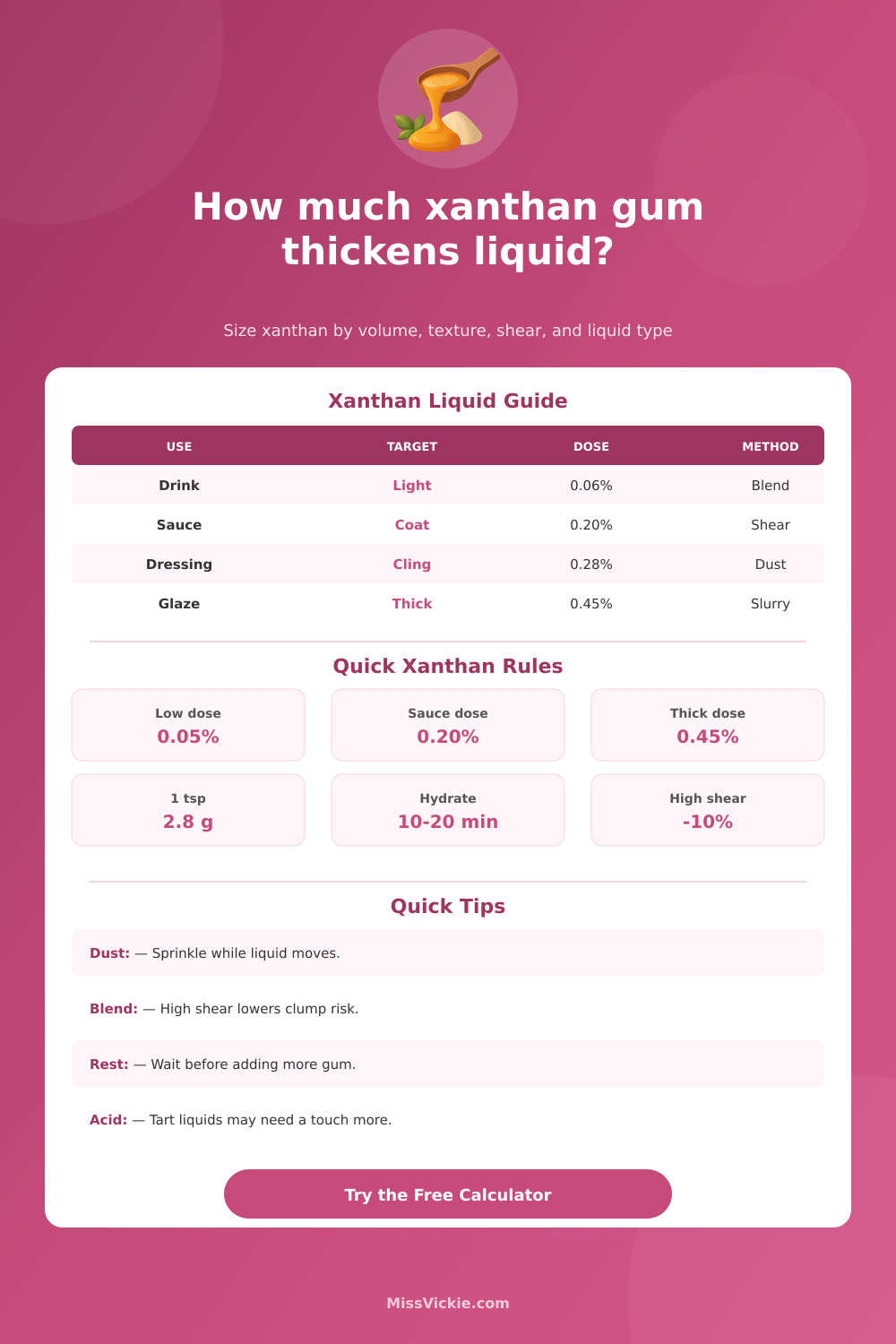
| Liquid style | Useful xanthan range | Texture goal | Best mixing method | Watch point |
|---|---|---|---|---|
| Drink, juice, tea, or cocktail base | 0.03% to 0.12% | Smoother sip with light suspension | Blend briefly, then rest | Too much feels slick or stringy. |
| Thin sauce, broth, or pan jus | 0.10% to 0.25% | Light spoon coating without flour taste | Immersion blend into moving liquid | Hot sauces look thinner until cooled slightly. |
| Vinaigrette and pourable dressing | 0.15% to 0.35% | Stable emulsion and leaf cling | Disperse into vinegar or water phase first | Oil can hide clumps until resting. |
| Glaze, coulis, dip, or clingy coating | 0.30% to 0.60% | Gloss, cling, and slow flow | High shear or slurry into sugar | Use staged additions to avoid a gummy finish. |
| Adjustment | Why it matters | Calculator direction | Practical move | Kitchen check |
|---|---|---|---|---|
| Cold liquid | Texture develops more slowly | Small upward dose and longer rest | Blend, chill, then recheck | Do not add more before hydration catches up. |
| High acidity | Sharp liquids taste thinner | Slight increase | Use tiny additions and taste | Citrus and vinegar can make over-thickening obvious. |
| Sugar or syrup | Solids add body before gum | Small reduction | Premix xanthan with sugar when possible | Let syrup stand to see true thickness. |
| Fat or oil | Fat changes mouthfeel and emulsion | Small reduction or neutral shift | Hydrate in water phase before adding oil | Dressings thicken more after emulsifying. |
| High shear blender | Better dispersion and hydration | Lower clump risk and modest dose cut | Blend 15 to 30 seconds | Avoid overheating delicate drinks. |
| Batch size | 0.10% light | 0.20% sauce | 0.30% dressing | 0.50% thick |
|---|---|---|---|---|
| 1 cup / 237 ml | 0.24 g | 0.47 g | 0.71 g | 1.18 g |
| 2 cups / 473 ml | 0.47 g | 0.95 g | 1.42 g | 2.37 g |
| 1 quart / 946 ml | 0.95 g | 1.89 g | 2.84 g | 4.73 g |
| 1 liter / 1000 ml | 1.00 g | 2.00 g | 3.00 g | 5.00 g |
| 1 gallon / 3.79 L | 3.79 g | 7.57 g | 11.36 g | 18.93 g |
Use the lowest dose that keeps pulp, cocoa, or spice suspended without a slick finish.
Good for pan sauces, broth reductions, and light gravies when you want gloss without starch.
Helps vinaigrettes stay emulsified and cling to greens without turning into a gel.
Best for fruit sauces, glazes, and dips where a thicker spoon trail is expected.
Kitchen note: this calculator gives a test-batch starting point for food-grade xanthan gum. Brands, particle size, blender power, temperature, dissolved solids, and resting time can change the final texture.
Xanthan gum is an tool that you can use to thicken a sauce, a drink, or a dressing, but without the use of starch or flour. Xanthan gum work in very small amounts. Furthermore, xanthan gum is stable when expose to heated liquids or cooled liquids.
Xanthan gum also retains its texture when expose to liquids that contain a high amount of sugars or are acidic in nature. Because there is no uniformity in the ingredients in different batch of liquids, it can be dificult for cooks to understand the correct amount of xanthan gum to add to a liquid. This calculator is a tool that will allow cooks to determine the starting dose of xanthan gum based off these vary variables.
How Much Xanthan Gum to Use
Xanthan gum is a fermented carbohydrate. When a cook introduce xanthan gum to a liquid that contains water, the xanthan gum will swell. The amount of xanthan gum that is necessary for a given liquid depend upon the type of liquid.
For instance, the amount of xanthan gum necessary for create a thin juice will be less than the amount of xanthan gum necessary for creating a heavy glaze, since the glaze already contain solids. Acidity can influence the way that xanthan gum perform in a liquid. For instance, liquids that contain sharp citrus flavors or vinegar may feel thinner to the individual than liquids with a more moderate acidity level.
Additionally, both sugar and fat tend to coat the tongue, which may allow for the reduction of the amount of xanthan gum that is necessary for a given liquid. Finally, the temperature of the liquid also influence the amount of xanthan gum that is necessary for a given batch of liquid. For instance, since xanthan gum hydrates in cold liquids at a slower rate than hot liquids, the amount of sauce that appears to have the proper thickness when simmering on the stove may appear to be more thick after the sauce has cooled.
The calculator begins to ask the cook about the batch of liquid being treated one variable at a time. The type of liquid will provide information about the percentage of xanthan gum that is required for the batch of liquid. The target thickness will allow the calculator to understand whether the target liquid should be drinkable or cling to the spoon.
The temperature, acidity, sugar load, and fat load of the batch of liquid will allow the calculator to find the multiplicative factor for the percentage of xanthan gum that will be required. Additionally, the amount of shear that a blender or whisk will place on the batch of liquid will impact the amount of xanthan gum require. Finally, the amount of time that the batch of liquid will be hydrated and the risk of creating clump will influence the staged additions of xanthan gum that are recommended for the batch of liquid.
Due to the difficulties of adding xanthan gum according to eye rather than measurement, cooks often make mistakes when adding xanthan gum. Adding too much xanthan gum may lead to a slick texture to the liquid. Adding too little xanthan gum may lead to the sauce not properly coating the food that is dressed with the sauce.
The reference tables will provide information for cooks about the recommended amounts of xanthan gum to add to different types of liquids to create a desired thickness. While the reference tables are not exact requirement for the amount of xanthan gum that must be added to a batch of liquid, the tables provide guardrails for cooks so that they dont add too much or too little of the ingredient. In order to properly understand how a batch of liquid will thicken with xanthan gum, cooks must read the liquid while it rests for a period of time.
Xanthan gum continues to thicken a batch of liquid for several minutes after it has been blended with the xanthan gum. Because of the continued thickening of the liquid, cooks is required to wait before adding more xanthan gum. The high-shear blending of a batch of liquid will reduce the risk of creating clumps of xanthan gum.
The risk of creating clumps of xanthan gum is reduced because a small amount of xanthan gum can create clumps of powder. While many cooks may think that xanthan gum is for modernist kitchen or for large batches of products, xanthan gum is also a useful ingredient in everyday cooking. For instance, those cooks who would like to add a gloss to their drinks without the use of flour may use xanthan gum.
Additionally, xanthan gum may be useful for those cooks who would like to ensure that their sauces do not separate once the sauce is reheated. A small amount of xanthan gum may be able to suspend the pulp of fruit within a juice. Additionally, a larger amount of xanthan gum may transform a thin pan sauce into a sauce that adhere well to roasted vegetables.
Xanthan gum is useful for these different tasks because the cook can adjust the calculator to the specific situation that is being create in the cooks kitchen. Once a cook has found the correct amount of xanthan gum for a batch of liquid of a specific type, it is a good idea for the cooks to write down the amount of xanthan gum that was found to work best for that batch of liquid. In the future, if that batch of liquid is prepared again with a different amount of sugar, the cooks can use the amount of xanthan gum that was written down to prepare the batch of liquid with accuracy.
The calculator will make it easy for cooks to perform the math necessary to calculate the correct amount of xanthan gum for any batch size or sugar content.