How Much Xanthan Gum Per Cup of Flour Calculator
Scale xanthan gum for gluten-free cakes, cookies, muffins, pastry, pizza dough, and bread by flour weight, cup count, recipe style, hydration, and desired texture.
Pick a common gluten-free recipe style, then adjust flour amount, blend type, hydration, starch load, eggs, and texture.
Xanthan gum amount
Your adjusted gum amount will appear here.
Measurement Breakdown
Recipe Adjustment
Enough gum to hold crumbs without making the slice springy or gummy.
Lower gum keeps edges crisp and prevents a bendy cookie texture.
More structure helps shaping, stretching, and holding sauce weight.
Bread needs the strongest network, especially when sliced after cooling.
| Recipe Type | Typical Per Cup | Baker's Percent | Best Texture Goal | Use Less When |
|---|---|---|---|---|
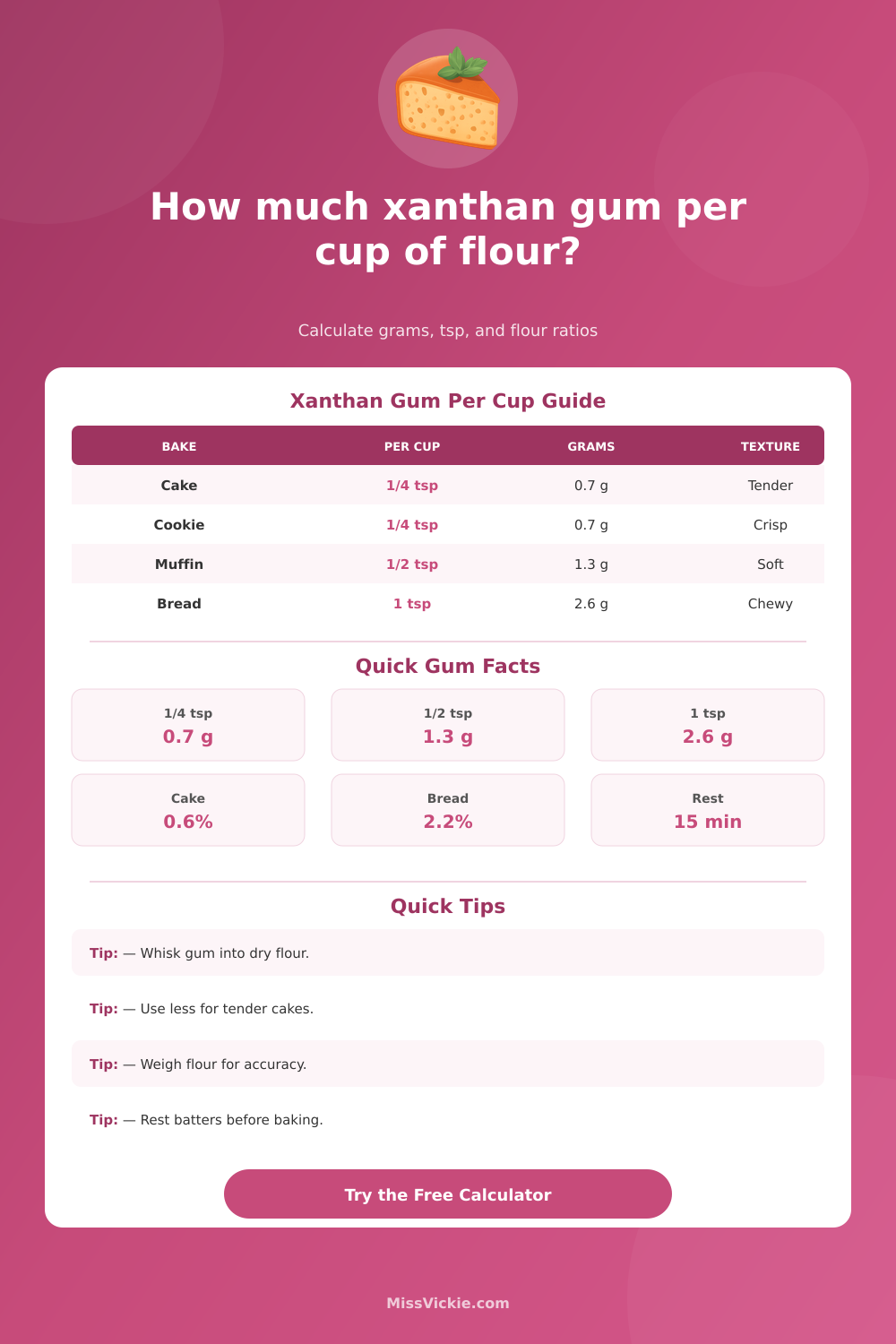
| Cakes and cupcakes | 1/4 teaspoon | 0.5% to 0.8% | Soft crumb that slices cleanly | The batter has eggs, yogurt, sour cream, or a long rest. |
| Cookies and bars | 1/8 to 1/4 teaspoon | 0.3% to 0.7% | Crisp edge with light chew | The cookie is shortbread, sandy, or intentionally crumbly. |
| Muffins and quick bread | 1/2 teaspoon | 0.9% to 1.2% | Moist slice without collapse | The blend already contains xanthan or guar gum. |
| Pie crust and pastry | 1/4 to 1/2 teaspoon | 0.6% to 1.0% | Rollable dough with tender bite | The dough is chilled well and handled lightly. |
| Pizza crust | 3/4 teaspoon | 1.2% to 1.8% | Flexible dough and chewy crust | You also use psyllium husk or chia gel. |
| Yeast bread and rolls | 3/4 to 1 teaspoon | 1.8% to 2.5% | Sliceable crumb and rise support | The formula includes psyllium, gelatin, or a gum-added bread blend. |
| Blend Type | Common Cup Weight | Gum Behavior | Calculator Adjustment | Kitchen Note |
|---|---|---|---|---|
| Gluten-free all-purpose blend | 120 g per cup | Balanced starch and grain structure | Baseline | Check the label; many cup-for-cup blends already include gum. |
| Rice flour heavy blend | 125 g per cup | Can bake sandy or brittle | Slight increase | Resting helps rice flour hydrate before baking. |
| Almond flour blend | 96 g per cup | Fat and moisture soften structure | Lower increase | Too much gum can make nut-flour cakes rubbery. |
| Oat flour blend | 92 g per cup | Natural beta-glucan adds some binding | Slight decrease | Use moderate gum for muffins, bars, and pancakes. |
| High-starch blend | 115 g per cup | Sets light but can feel tacky | Decrease | Good for cakes when gum stays conservative. |
| Bread flour style mix | 130 g per cup | Built for elastic dough | Moderate decrease | Often paired with psyllium or protein-rich flour. |
| Flour Amount | Tender Cake | Muffin / Quick Bread | Pizza Dough | Yeast Bread |
|---|---|---|---|---|
| 1 cup flour | 1/4 tsp / 0.7 g | 1/2 tsp / 1.3 g | 3/4 tsp / 2.0 g | 1 tsp / 2.6 g |
| 2 cups flour | 1/2 tsp / 1.4 g | 1 tsp / 2.6 g | 1 1/2 tsp / 3.9 g | 2 tsp / 5.2 g |
| 3 cups flour | 3/4 tsp / 2.1 g | 1 1/2 tsp / 3.9 g | 2 1/4 tsp / 5.9 g | 1 Tbsp / 7.8 g |
| 4 cups flour | 1 tsp / 2.6 g | 2 tsp / 5.2 g | 1 Tbsp / 7.8 g | 4 tsp / 10.4 g |
| 500 g flour | 2.8 g | 5.0 g | 7.5 g | 10.5 g |
| Measure | Approx Grams | Good For | Risk If Overused |
|---|---|---|---|
| 1/8 teaspoon | 0.3 g | Small cookie batches or 1/2 cup flour | Usually mild, but may not bind bread dough. |
| 1/4 teaspoon | 0.7 g | One cup cake flour blend | Can firm delicate sponge cakes. |
| 1/2 teaspoon | 1.3 g | One cup muffin or quick bread flour | Can make pancakes slightly stretchy. |
| 3/4 teaspoon | 2.0 g | Pizza, rolls, enriched dough | Can make pastry tough. |
| 1 teaspoon | 2.6 g | One cup gluten-free bread flour | Can make cakes gummy or elastic. |
Xanthan gum density varies by brand and how tightly it is scooped. For small batches, weighing to the nearest tenth of a gram is steadier than spoon rounding.
Xanthan gum is an binding agent used in gluten-free baking. Gluten-free baking recipes use xanthan gum to replace the structure that gluten normal provides to wheat-based baking products. In wheat-based baking products, the gluten strands within the wheat proteins stretches and hold during the baking process to create chewiness in bread products or a delicate crumb in cake baking products.
Gluten-free baking products doesnt contain these gluten strands. To compensate for the lack of these gluten strands, an alternative ingredient to xanthan gum is used in gluten-free baking recipes. Xanthan gum thicken when xanthan gum is hydrated and holds its shape once the baking product has been heat set.
How Much Xanthan Gum to Use in Gluten-Free Baking
Using too little xanthan gum will cause the baked good to either collapse into itself or spread too much when baking cookies. Using too much xanthan gum, however, will create a dense and elastic baked good. The amount of xanthan gum that should be used in baking products depends on several different variables.
These variables include the type of flour that will be used in the baking recipe, the type of recipe that will be prepared, and how much moisture will be in the batter. The type of flour will vary in how much moisture it absorbs and how much structure it adds to the baked product. For instance, baking recipes that use alot of rice flour will require more xanthan gum than recipes that use alot of almond flour.
This is because almond flour contains fat and protein that will soften the baked products. Similarly, oat flour contains the substance beta-glucan which will bind to the baked product and reduce the amount of xanthan gum that is required. Baking recipes that use a lot of starch will require reducing the amount of xanthan gum that is added because too much xanthan gum will make the baked product become too tackily.
Another variable to consider is the type of recipe that will be prepared. Recipes such as cakes will require less xanthan gum than bread recipes because cakes require a crumb texture that will break apart easy. Yeast bread recipes will require more xanthan gum than cake recipes because the bread needs to hold the gas that is created during the rise of the dough.
Pizza dough will require a different amount of xanthan gum than either cake or bread recipes because pizza dough needs to stretch without tearing during the preparation of the pizza. Moisture in the batter will require more xanthan gum to bind the structure together. The less moisture in a baked product recipe, the less xanthan gum that should be added.
The other ingredients in the recipe will also change the amount of xanthan gum that should be added. If other binders are used in a recipe, such as eggs or psyllium seed gum, then the baker will need to reduce the amount of xanthan gum. The resting of dough allows the flour to absorb the moisture and the xanthan gum to activate.
If the dough is allowed to rest for a longer period, the amount of xanthan gum will decrease because the xanthan gum will have more time to activate with the rest of the ingredients in the recipe. The baker should not estimate the amount of xanthan gum by eye when preparing gluten-free baking recipes. The amount of xanthan gum to be added should be very specific because too much or too little will change the texture of the baked product.
The bakers percent is one tool that can be used to indicate the proper amount of xanthan gum to add to gluten-free baking recipes. The bakers percent is based on the weight of the flour in the recipe. If the xanthan gum is to be 1% of the weight of the flour, the baking product will be suitable for muffins or quick bread recipes.
If it is to be 2% of the weight of the flour, the product will be better suited for sandwich bread recipes. The way that xanthan gum is incorporated into the bowl will also impact the texture of the baked product. If xanthan gum is added directly to wet ingredients, it will create gel pockets in the baked product that will lead to rubbery spots in the recipe.
To avoid these spots, xanthan gum should be whisked into the dry ingredients along with the flour. The temperature of the liquid ingredients may also have an impact on xanthan gum. Cold liquids will prevent xanthan gum from hydrating.
If the recipe allows for the batter to rest for 10 or 15 minute, this resting period will allow the xanthan gum to hydrate without needing to add more xanthan gum to the recipe. In addition to xanthan gum, there are other variables to gluten-free baking recipes besides the amount of xanthan gum that should be used. These other variables will impact the amount of xanthan gum that is needed.
If xanthan gum is used in a baked product that also contains eggs and psyllium gum, the baker can reduce the amount of xanthan gum. If more liquid is added to a recipe, more time will be required for the xanthan gum to hydrate. If the amount of flour in the recipe is doubled, it is not necessary to double the amount of xanthan gum, though it can be done.
The amount of xanthan gum that must be used is just one of several variable in determining the structure of gluten-free baked products. The other variables will include the amount of moisture that is in the recipe and the type of flour that is used. Using the correct amount of xanthan gum will ensure that the baked good holds together.
Using the correct amount of xanthan gum will result in a baked good that has a consistent texture.