How Much Xanthan Gum for Protein Ice Cream
Calculate xanthan gum for protein ice cream from mix volume, powder load, liquid type, freezing method, texture target, fat level, sweetener solids, and your chosen gum percentage.
Load a real batch style, then adjust the mix volume, protein powder, liquid, freezing method, texture, and gum percentage for your recipe.
Full Batch Breakdown
Xanthan gum is powerful in frozen desserts. Small changes matter, especially with whey powder, low-fat liquids, and low-sugar bases.
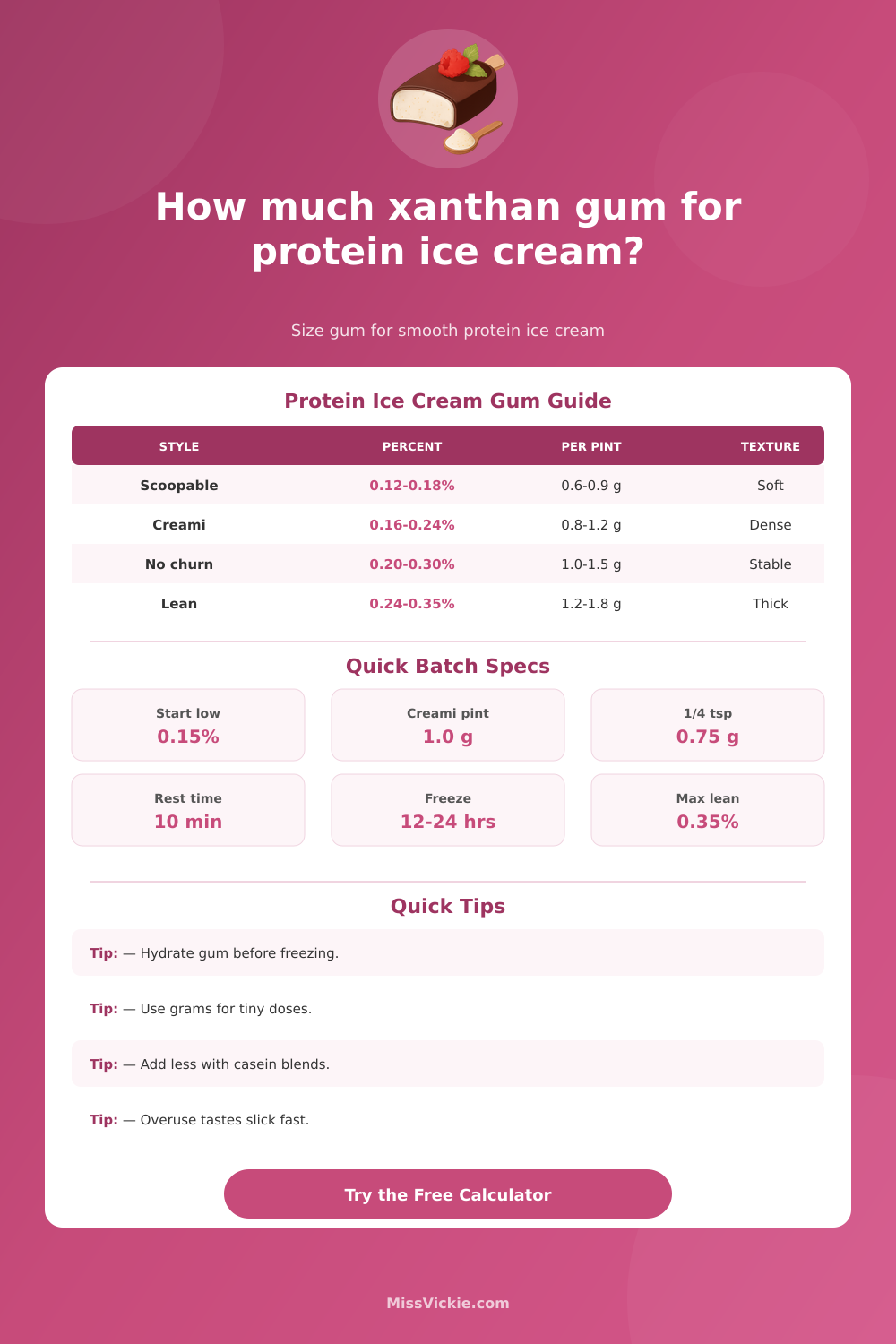
| Protein Ice Cream Style | Typical Gum Percent | Best Method | Texture Notes |
|---|---|---|---|
| Light dairy scoop | 0.10% to 0.16% | Churned machine | Enough body for smoother scoops without a gummy finish. |
| Standard Creami pint | 0.16% to 0.24% | Frozen pint spinner | Helps the respin turn icy crystals into a dense pint. |
| No-churn protein bowl | 0.20% to 0.30% | Freezer container | Needs more stabilization because it is not churned while freezing. |
| Very lean almond base | 0.24% to 0.35% | Creami or blender | Thin liquid and low fat usually need the strongest gum support. |
| Greek yogurt or cottage base | 0.12% to 0.20% | Creami or churned | Dairy proteins already thicken, so too much gum can feel pasty. |
| Ingredient Factor | Common Example | Gum Adjustment | Best Handling |
|---|---|---|---|
| Whey isolate | Chocolate or vanilla whey | Slight increase | Blend hard, rest, then freeze to reduce graininess. |
| Casein blend | Custard-style powder | Reduce slightly | Casein hydrates thick, so start with a lower gum ratio. |
| Pea protein | Vegan protein base | Moderate increase | Use enough liquid and avoid pushing gum too high. |
| Almond milk | Unsweetened lean base | Increase clearly | Thin liquids benefit from gum plus a short hydration rest. |
| Greek yogurt | High-protein dairy base | Reduce or hold | Yogurt solids already add body and creaminess. |
| Total Mix Weight | 0.15% Gum | 0.22% Gum | 0.30% Gum |
|---|---|---|---|
| 350 g snack pint | 0.5 g, shy 1/4 tsp | 0.8 g, about 1/4 tsp | 1.1 g, about 1/3 tsp |
| 500 g Creami pint | 0.8 g, about 1/4 tsp | 1.1 g, about 1/3 tsp | 1.5 g, about 1/2 tsp |
| 700 g family batch | 1.1 g, about 1/3 tsp | 1.5 g, about 1/2 tsp | 2.1 g, about 2/3 tsp |
| 1000 g quart batch | 1.5 g, about 1/2 tsp | 2.2 g, about 3/4 tsp | 3.0 g, about 1 tsp |
| 1 level teaspoon | About 3 g | Weigh when possible | Spoons vary by brand |
Good default for whey pints because the machine breaks the frozen block after the gum hydrates.
Needs less gum because air and agitation build body during freezing.
Benefits from extra stability because the base freezes still in the container.
Works best when the gum is fully blended before the base is frozen into cubes.
| Result in Bowl | Likely Cause | Next Batch Adjustment | Quick Fix |
|---|---|---|---|
| Icy after spinning | Very lean base or low solids | Raise gum 0.03% to 0.06% | Respin with a splash of milk. |
| Slick or stretchy texture | Too much xanthan gum | Lower gum 0.04% to 0.08% | Fold into a second ungummed batch. |
| Powdery or chalky finish | Protein not hydrated | Blend longer and rest before freezing | Thaw 8 minutes, then respin. |
| Hard frozen block | Low sugar and low fat | Add solids or choose soft-serve target | Temper on counter before serving. |
| Pasty cottage texture | Dairy solids plus high gum | Use the yogurt or cottage preset range | Add milk and spin again. |
The texture of protein ice creams is largely determined by the amount of stabilizer that is included in the recipe. The amount of stabilizers that you use in your recipe must be precisely in that using too much or too little of the stabilizer to your protein mixture will lead to protein ice cream that dont have the desired texture. Using too little of the stabilizer will lead to protein ice cream that is too grainily to scoop with a spoon, while using too much of the stabilizer will lead to protein ice cream that is too gummy when it is consumed on the tongue.
One of the main types of stabilizers that can be used is xanthan gum. Xanthan gum thicken the mixture when used in low doses, helps to hold the water in the mixture to minimize the amount of ice crystals that form in the protein ice cream, and helps to prevent the protein ice cream from melting too quickly. Because each recipe for protein ice cream may contain different ingredients, the amount of xanthan gum that should be used in the mixture will change with every recipe.
How Much Xanthan Gum to Add to Protein Ice Cream
The total weight of the protein ice cream mixture will determine how much xanthan gum is needed for that specific recipe. Protein ice creams that use a heavy base, such as one that contains milk and protein powder, will require less xanthan gum than those that use a light base, such as one that contains almond milk or water. You can use a calculator to determine the gram of xanthan gum that are needed for a given recipe.
The type of protein that is used in the recipe will affect the amount of xanthan gum that should be added. For instance, bases that use whey isolate will behave differently than those that use casein, and those that use pea protein will behave differently from those that use whey isolate. Bases that use whey protein may lead to a chalky texture if the whey protein powder did not fully hydrate prior to setting the mixture into the freezer; in such cases, you can add a small amount of extra xanthan gum prior to freezing to mask the chalky texture.
Protein bases that use casein naturally thicken the protein mixture over time, so using the same amount of xanthan gum as a base that uses whey protein may create a base that has a texture that is too gummy. In such instances, using the protein-type setting on the calculator will automatically adjust the percentage of xanthan gum that is recommended for that recipe. The type of liquid that is used in the recipe will impact the amount of xanthan gum that is needed in the recipe.
For instance, because skim milk contains more dissolved solids than almond milk, protein ice creams that use skim milk will require a different amount of xanthan gum than those that use almond milk. Because almond milk and other thin liquids do not contain the fat and protein that milk naturaly contains, extra xanthan gum will be required in those recipes to slow the growth of the ice crystals in the protein ice cream. The liquid portion of the xanthan gum calculator will account for these different types of liquid for the recipe.
The method that is used to freeze the protein ice cream will also impact the amount of xanthan gum that is required for the best texture. Protein ice creams that are prepared using a Creami-style machine, which breaks up the protein ice cream once it has frozen, will allow for the xanthan gum percentage to be slightly more higher than those protein ice creams that a traditional churner incorporates air into the mixture while it is still soft. No-churn methods will require the strongest stabilization to ensure that the protein ice cream set properly without being mixed by the machine during the freezing process.
Each of these different machines are accounted for in the xanthan gum calculator to ensure the calculated amount of xanthan gum will work with the machine that will be used to prepare the protein ice cream. The texture preference of the protein ice cream can also be used to determine the amount of xanthan gum that will be used in the recipe. For instance, protein ice creams may be prepared with a texture that is soft and similar to soft serve ice cream, or they may be prepared with a denser texture that maintains its shape on a cone of protein ice cream.
Each texture can be entered into the calculator to determine the percentage of xanthan gum that will need to change to attain that texture. For instance, a protein ice cream that should have a milkshake texture will require less xanthan gum than one that is prepared to have a firm pint texture, and these two textures may differ from one another by only a few hundredths of a percent. In addition to setting the amount of xanthan gum based off the other factors noted above, any changes to other ingredients to the recipe will require changes to the amount of xanthan gum that is used.
For instance, if whey protein is replaced with pea protein, the percentage of xanthan gum will rise. However, if whole milk is replaced with a cottage-cheese based protein mixture, the percentage of xanthan gum will drop. These changes occur with the change of other ingredients in that recipe.
However, xanthan gum can be incorrectly measured if the recipe uses teaspoons to measure the amount of xanthan gum. A teaspoon of xanthan gum will not lead to accurate results in the protein ice cream mixture; the weight of xanthan gum in a teaspoon can range by as much as half a gram. Measuring the xanthan gum in grams will ensure accuracy of the amount of xanthan gum used in the protein ice cream.
Furthermore, the xanthan gum should not be added after the protein ice cream mixture has begun to freeze. If xanthan gum is added to a cold protein mixture, the xanthan gum will clump together; you should blend or shake it with the portion of protein ice cream that is in liquid form prior to the freezing process. If the texture of the protein ice cream is incorrect, it may be necessary to add more xanthan gum to the recipe.
For instance, protein ice creams that are too icy may require more xanthan gum; however, the actual cause of the icy protein ice cream may be a lack of sweetener solids or dissolved protein powder. Thus, while the xanthan gum calculator accounts for most issues with protein ice cream recipes, there may be issues in other components of the protein base recipe. The goal of using the xanthan gum calculator is to find a percentage of xanthan gum to use with your protein, powder, and liquid mixture, protein type, liquid type, and machine methods to create a protein ice cream with the texture that you enjoy.