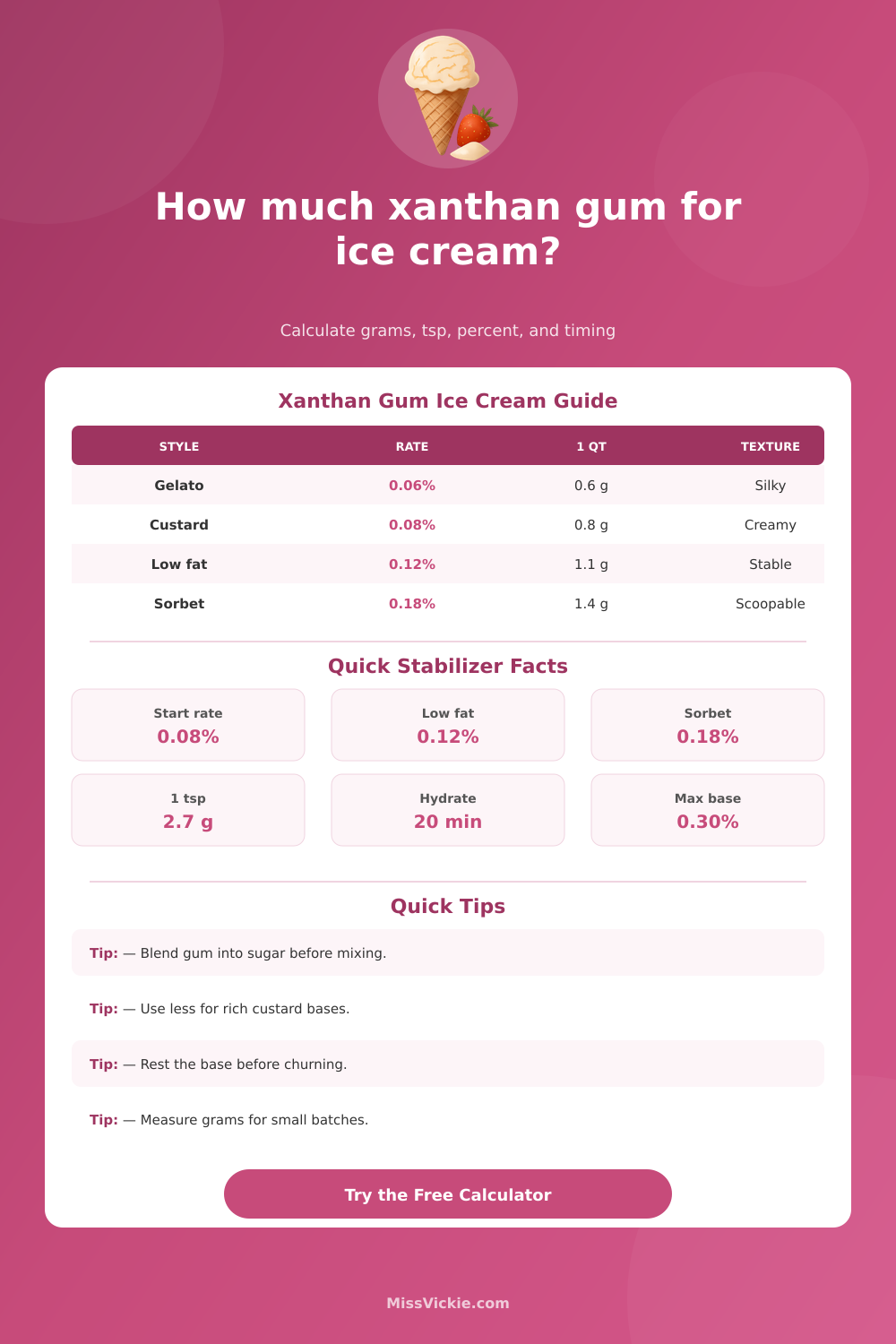
How Much Xanthan Gum for Ice Cream
Calculate xanthan gum by batch weight, dairy style, sugar, fat, churn method, and serving goal so your ice cream base gets structure without turning sticky.
Choose a real batch style to load typical weights, texture targets, fat levels, sugar levels, and churn conditions.
Detailed Breakdown
| Ice Cream Style | Typical Rate | Best For | Notes |
|---|---|---|---|
| Premium dairy ice cream | 0.06% to 0.10% | Classic scoopable pints | Start near 0.08% when fat is 12% to 16%. |
| Egg custard base | 0.04% to 0.08% | French vanilla, custard, yolk-rich bases | Yolk proteins already add emulsification and body. |
| Gelato | 0.05% to 0.09% | Dense, lower-overrun batches | Keep the dose restrained to avoid gummy melt. |
| Low-fat dairy base | 0.10% to 0.16% | Milk-forward or lighter formulas | Extra gum helps replace lost fat structure. |
| Fruit sorbet | 0.12% to 0.22% | Water-heavy fruit mixtures | Use sugar and puree solids to balance texture. |
| Vegan coconut or oat base | 0.08% to 0.15% | Dairy-free scoopable bases | Plant solids vary, so test the low end first. |
| Base Volume | Approx Mix Weight | 0.08% Xanthan | 0.12% Xanthan |
|---|---|---|---|
| 1 pint | 473 g | 0.38 g | 0.57 g |
| 1 quart | 946 g | 0.76 g | 1.14 g |
| 1.5 quarts | 1419 g | 1.14 g | 1.70 g |
| 2 quarts | 1892 g | 1.51 g | 2.27 g |
| 1 gallon | 3785 g | 3.03 g | 4.54 g |
| 5 liters | 5000 g | 4.00 g | 6.00 g |
| Xanthan Gum | Approx Teaspoons | Use Case | Kitchen Note |
|---|---|---|---|
| 0.25 g | About 1/10 tsp | Very small pint tests | A pinch spoon is easier than a regular teaspoon. |
| 0.50 g | About 1/5 tsp | Rich pint or light quart | Pre-mix with sugar to distribute evenly. |
| 0.75 g | About 0.28 tsp | Standard quart | Close to a scant third teaspoon. |
| 1.00 g | About 0.37 tsp | Low-fat quart | Use a scale when possible. |
| 1.50 g | About 0.56 tsp | Large or icy batch | Hydrate fully before churning. |
| 3.00 g | About 1.1 tsp | Gallon batch | Add slowly while blending. |
| Mixing Step | Minimum Time | What It Does | Best Practice |
|---|---|---|---|
| Dry blend with sugar | 1 minute | Separates fine gum particles | Whisk xanthan into at least 10 times its weight in sugar. |
| High-shear blend | 30 to 60 seconds | Disperses gum before clumps form | Blend while sprinkling in the dry mix. |
| Warm hydration | 10 to 20 minutes | Lets viscosity develop | Helpful for cooked custards and dairy bases. |
| Cold maturation | 4 hours or overnight | Improves body and melt resistance | Chill covered before churning. |
Clean flavor, but icier storage in many home freezers.
Good for rich custard or premium cream-heavy bases.
A dependable starting point for one-quart dairy batches.
Useful for low-fat, sorbet, or very icy fruit mixtures.
Making ice cream at home require people to focus on the textures of the ice cream since the texture is more important than the flavor. Although a person may use the best cream and the ripest fruit, the texture may be icese or chewy. Xanthan gums can fix these texture problem.
Xanthan gum help to hold the water in the ice cream and xanthan gum slows the growth of the ice crystals that form in the ice cream. Thus, xanthan gum create a smoother texture to the ice cream. Xanthan gum does not add flavor to the ice cream but the amount of xanthan gum that is used are important.
How to use xanthan gum in ice cream
Xanthan gum work on a very small scale in the making of ice cream. If the amount of xanthan gum is too little, then the base will weep or the ice cream will be icy after a day in the freezer. If the amount of xanthan gum is too high, then the ice cream will be gummy when it melt or the ice cream will create an elastic film.
To avoid these problems, one can calculate xanthan gum based off the size of the batch of ice cream that will be made, the fat level of the base, the sugar level of the base, and the method in which the base will be churn. The fat level of the base can change the amount of xanthan gum that is require. Fat will coat the ice crystals that may form in the base and xanthan gum will slow the growth of these crystals.
Thus, the rich custard base will require less xanthan gum then a low fat or dairy free base. The level of sugar can also change the amount of xanthan gum. Sugar will lower the freezing point of the base and the sugar will allow the water in the base to remain mobile.
Higher levels of sugar will require less xanthan gum. These variable can be accounted for in a calculator of the amount of xanthan gum that should be used in the ice cream base. The type of churn method and the amount of time that the base rest can change the amount of xanthan gum that is required.
If a compressor machine churns a base, the long maturation period that the base requires means that less xanthan gum is required. If the base does not have a chance to mature prior to churning it, more xanthan gum is required. Additionally, other ingredient that increase the thickness or viscosity of the base, such as egg yolks or gelatin, will mean that less xanthan gum is required.
Using a single number for each recipe for xanthan gum is incorrect. Each recipe have different ingredients. A recipe that contains 16% fat will require a different amount of xanthan gum than a recipe that contains 5% fat.
For instance, a quart of custard with 16% fat may require 0.06% xanthan gum while a quart of a nondairy base with only 5% fat may require twice as much xanthan gum for the same batch size. There is a difference in the amount of xanthan gum for each batch due to the different amount of water that the xanthan gum must hold in the base. The way that xanthan gum is measured is also important.
If you sprinkle xanthan gum directly into the liquid, the xanthan gum will not disperse well. Clumps of xanthan gum may be created if you sprinkle the xanthan gum directly into the liquid. These clumps will not hydrate and will leave rubbery pockets of xanthan gum in the finished ice cream.
To avoid these problem, blend the xanthan gum with the sugar prior to adding the dry ingredient to the liquid. The length of time that the base rest before being churned will also change the amount of xanthan gum that should be used. If the base rests for four hours or overnight prior to churning, less xanthan gum will be required since the xanthan gum will reach its full viscosity during this resting period.
If the base is to be churned on the same day that it is mix, more xanthan gum will be required. Sorbet and sherbet contain different amounts of fat than ice cream and they also contain a high amount of water. For these reason, sorbet and sherbet will require more xanthan gum than ice cream.
The calculator will increase the xanthan gum rate for sorbet and sherbet but will also lower that rate if the sorbet or sherbet contains high amount of solids or sugar. In this way, the least amount of xanthan gum will be used to prevent the sorbet from becoming a solid block of ice or a liquid mess. A gram scale can be used to measure the amount of xanthan gum to ensure accuracy.
Xanthan gum is a light and fluffy powder so volume measurement can be inaccurate. For instance, if a teaspoon of xanthan gum is used, the amount of xanthan gum may be added more or less than the amount required by the calculator. Thus, the calculator provide measurements in both grams and teaspoons so that the baker can decide which provides the best precision in the kitchen.
To ensure that the xanthan gum is working properly, a person can taste a batch of ice cream. If the batch of ice cream is too icy after being placed in the freezer for a day, the rate of xanthan gum should be increased. If the batch of ice cream melts to become too stretchy, the rate of xanthan gum should be decreased.
Thus, xanthan gum is a predictable ingredient in the making of ice cream if each of the variable to the recipe are accounted for. A calculator for xanthan gum creates these variable visible to those who prepare the recipe.