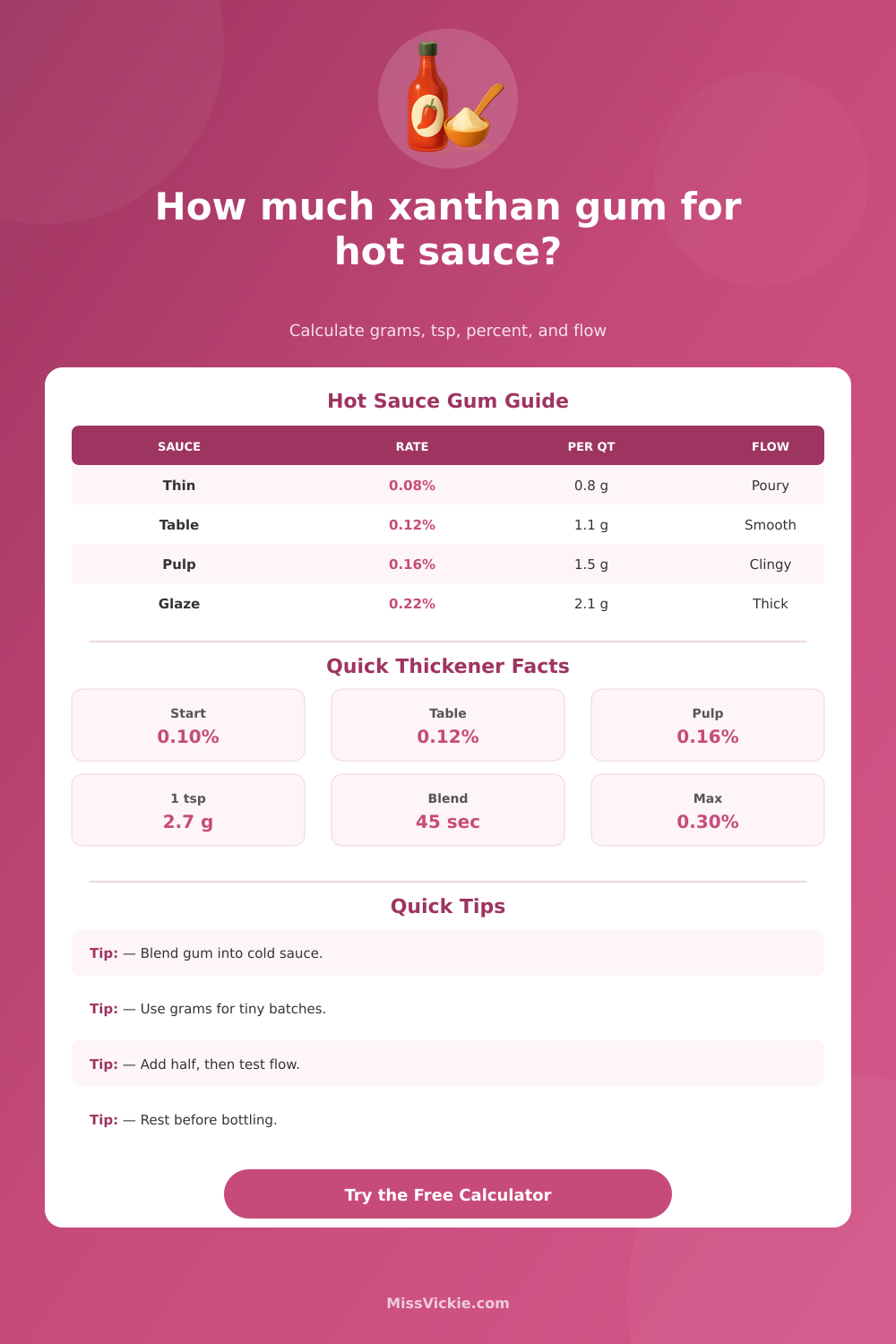
How Much Xanthan Gum for Hot Sauce
Calculate xanthan gum for hot sauce by batch size, sauce style, vinegar level, pulp solids, heat process, blender strength, bottle opening, and pour texture.
Choose a real sauce style to load typical batch volume, acid, solids, processing, blending, and bottle-flow targets.
This calculator estimates culinary thickening only. For shelf-stable hot sauce, confirm pH, thermal process, sanitation, and local food safety requirements separately.
Hot sauce thickener plan
Enter your batch details to calculate a xanthan gum range.
Batch Breakdown
Use and Safety Notes
Best for dasher bottles and vinegar-heavy sauces that should splash freely.
Fits most woozy bottles, fermented sauces, and smooth pepper blends.
Useful when pulp, seeds, or garlic need suspension and a slower pour.
For sweet chili, wing coating, and squeeze-bottle sauces, not dashers.
| Sauce Style | Typical Rate | Per Quart Estimate | Best Bottle | Texture Cue |
|---|---|---|---|---|
| Thin vinegar table sauce | 0.06% to 0.10% | 0.6 g to 1.0 g | Dasher or woozy | Shakes thin, slight suspension |
| Fermented pepper sauce | 0.08% to 0.14% | 0.8 g to 1.3 g | Woozy bottle | Smooth pour with pulp held evenly |
| Pulpy pepper sauce | 0.13% to 0.20% | 1.2 g to 1.9 g | Squeeze bottle | Clings to food without roping |
| Wing sauce or butter sauce | 0.14% to 0.22% | 1.3 g to 2.1 g | Wide neck or squeeze | Coats wings and resists splitting |
| Sweet chili glaze | 0.20% to 0.30% | 1.9 g to 2.9 g | Squeeze bottle or jar | Slow sheet, brushable surface |
| Batch Size | Approx Weight | 0.10% Gum | 0.15% Gum | 5 oz Bottles |
|---|---|---|---|---|
| 1 cup | 240 g | 0.24 g | 0.36 g | 1.6 bottles |
| 1 pint | 480 g | 0.48 g | 0.72 g | 3.2 bottles |
| 1 quart | 960 g | 0.96 g | 1.44 g | 6.4 bottles |
| 2 quarts | 1,920 g | 1.92 g | 2.88 g | 12.8 bottles |
| 1 gallon | 3,840 g | 3.84 g | 5.76 g | 25.6 bottles |
| Method | Blend Time | Rest Time | How To Add Gum | Risk |
|---|---|---|---|---|
| High-speed blender | 25 to 40 seconds | 10 minutes | Sprinkle into vortex | Over-aeration if too long |
| Countertop blender | 40 to 60 seconds | 15 minutes | Add slowly while running | Foam can hide thickness |
| Immersion blender | 60 to 90 seconds | 20 minutes | Dust across surface first | Small clumps near pot edge |
| Whisk only | 2 to 3 minutes | 30 minutes | Premix with salt or sugar | Highest clump risk |
| Commercial shear mixer | 20 to 35 seconds | 10 minutes | Feed powder steadily | Can thicken very quickly |
| Problem | Likely Cause | Quick Fix | Next Batch Change |
|---|---|---|---|
| Stringy or ropy pour | Too much gum or weak acid balance | Thin with vinegar, water, or puree | Reduce gum by 20% to 30% |
| Seeds settle after bottling | Too little gum or too much coarse pulp | Blend longer and rest again | Add 0.02% to 0.04% gum |
| Clumps or fish eyes | Gum hit still liquid too fast | Strain, blend hard, and rest | Premix gum with salt or sugar |
| Too thin after heating | Batch diluted or solids broke down | Cool sample before judging | Calculate by final cooked weight |
| Won't pass dasher cap | Target texture too thick | Switch cap or dilute slightly | Choose splash or table flow |
Xanthan gum is a thickener that helps you control the thickness of your hot sauce. Hot sauce thickness is important because thickness determine how the hot sauce coats food and how the hot sauce stays suspended in the bottle. Xanthan gum is a popular thickener for hot sauce because xanthan gum work in hot conditions, xanthan gum works in cold conditions, xanthan gum remains stable in high acidity, and because xanthan gum doesnt add any flavor to the hot sauce.
Using too much or too little xanthan gum will alter the texture of your hot sauce. The amount of xanthan gum that you need to add to your hot sauce depends upon a few different variable. The variables include the pulp content and the vinegar percentage and the pH level of the hot sauce.
How to Use Xanthan Gum to Thicken Hot Sauce
Any hot sauce that contains a high amount of pulp will naturaly contain thickness to the sauce, indicating that you will need less xanthan gum for those sauces compared to hot sauces with low pulp content. Additionally, sauces with high vinegar percentages and low pH levels will affect how much xanthan gum is needed due to the effect of pH on the stability of the xanthan gum in the hot sauce. The amount of heat in which the hot sauce simmers will also affect the viscosity of the sauce after simmering.
Finally, the type of bottle into which you will dispense the hot sauce will also impact the thickness of the hot sauce. These variables will affect the amount of xanthan gum that you need, so there is no universal rule for hot sauce thickness that applies to each batch of hot sauce that you prepare. For instance, hot sauces with high acidity levels may require more xanthan gum to maintain stability, but adding too much xanthan gum to sauces with high acidity levels can create a sauce that has a ropy texture.
The calculator will help you determine the math behind these variables, specifically your batch size, your acid share, your pulp solids and your processing method. Because the calculator accounts for these variables, the calculator allows you to eliminate guessing the amount of xanthan gum that you should add to your new recipe. In addition to the amount of xanthan gum that you use, you must also consider the blending technique that you use when incorporating the xanthan gum into your hot sauce.
If you add xanthan gum to hot sauce while the hot sauce is still, the xanthan gum will clump together. If you use a high-speed blender, you can incorporate the xanthan gum into your hot sauce in less than one minute. If you use an immersion blender, you will need to blend the sauce for a longer period of time.
If you use only a whisk, you will have to pre-mix the xanthan gum with salt or sugar before adding it to your hot sauce to avoid the xanthan gum creating clumps in contact with your hot sauce. These blending techniques will not effect the percentage of xanthan gum in your hot sauce, but will effect whether or not the xanthan gum can create the texture that you desire. After you have blended the xanthan gum into your hot sauce, you should allow the hot sauce to rest.
While blending, the hot sauce was hydrating the xanthan gum, but after blending is finished the hot sauce will continue to hydrate the xanthan gum, and the hot sauce will thicken as it cools. You should test the hot sauce by allowing it to cool and then observe the flow of the hot sauce off of a spoon. If you test the hot sauce while it is warm, you may find that you need to add more xanthan gum, but doing so may create a hot sauce that is too thick to pour.
Therefore, ensure that you test the sauce when it has had time to cool. Another consideration for hot sauce thickness is the type of bottle into which you pour your hot sauce. A hot sauce that is thick enough to coat a chicken wing may become too thick to successfully exit a dasher cap.
A hot sauce that is too thin may separate in bottles with high load of pulp. You can use the calculator to adjust the thickness of the hot sauce to account for these differences in bottle styles. This allows for the creation of a master mix that will be suitable for bottling and dispensing in either retail bottles or restaurant squeeze bottles.
Common problems with hot sauce usually have three common causes. The first of these problems is that you added the xanthan gum too quickly during the blending process. The second problem is that the hot sauce boiled during simmering, which will evaporate some of the liquids from the sauce.
The third problem is the target thickness of the hot sauce to not account for the type of bottle into which the hot sauce will be dispensed. The different texture ranges for hot sauce are listed in the comparison grid on this page. You can compare your sauce to the hot sauce texture standards to determine whether or not your hot sauce is correct.
While xanthan gum is an ingredient that can help with thickening your hot sauce, you must test the pH level of your hot sauce separately from the thickening process. Xanthan gum is a thickener, but it is not a substitute for acidifying your hot sauce. The pH level of your hot sauce must be below 4.2 to be safe to consume, and the xanthan gum calculator will remind you of this condition in the creation of the percentage of xanthan gum that you need for your hot sauce recipe.
Once you have confirmed that your hot sauce has the appropriate pH level and that you have dispersed the xanthan gum, you can taste the hot sauce. To become skilled in the creation of hot sauce with the appropriate thickness, you must learn to read your hot sauce when it is finished simmering. Hot sauce that naturaly slowly drips off of a spoon has successfully achieved the correct thickness, whereas hot sauce that creates a thick rope when pulled off of a spoon indicates that you used too much xanthan gum.
As you prepare more batches of hot sauce, the xanthan gum calculator will become a point of departure when you create your recipes, but you will find it easier to make slight adjustments to the amount of xanthan gum that you use.