Xanthan Gum for Bread Calculator
Estimate xanthan gum for gluten-free bread dough from flour weight, loaf count, bread style, hydration, preferment, binder support, proof time, pan size, and crumb goal.
Choose a real dough profile to load flour weight, loaf count, hydration, binder support, proofing, pan size, and gum percentage.
Full Dough Breakdown
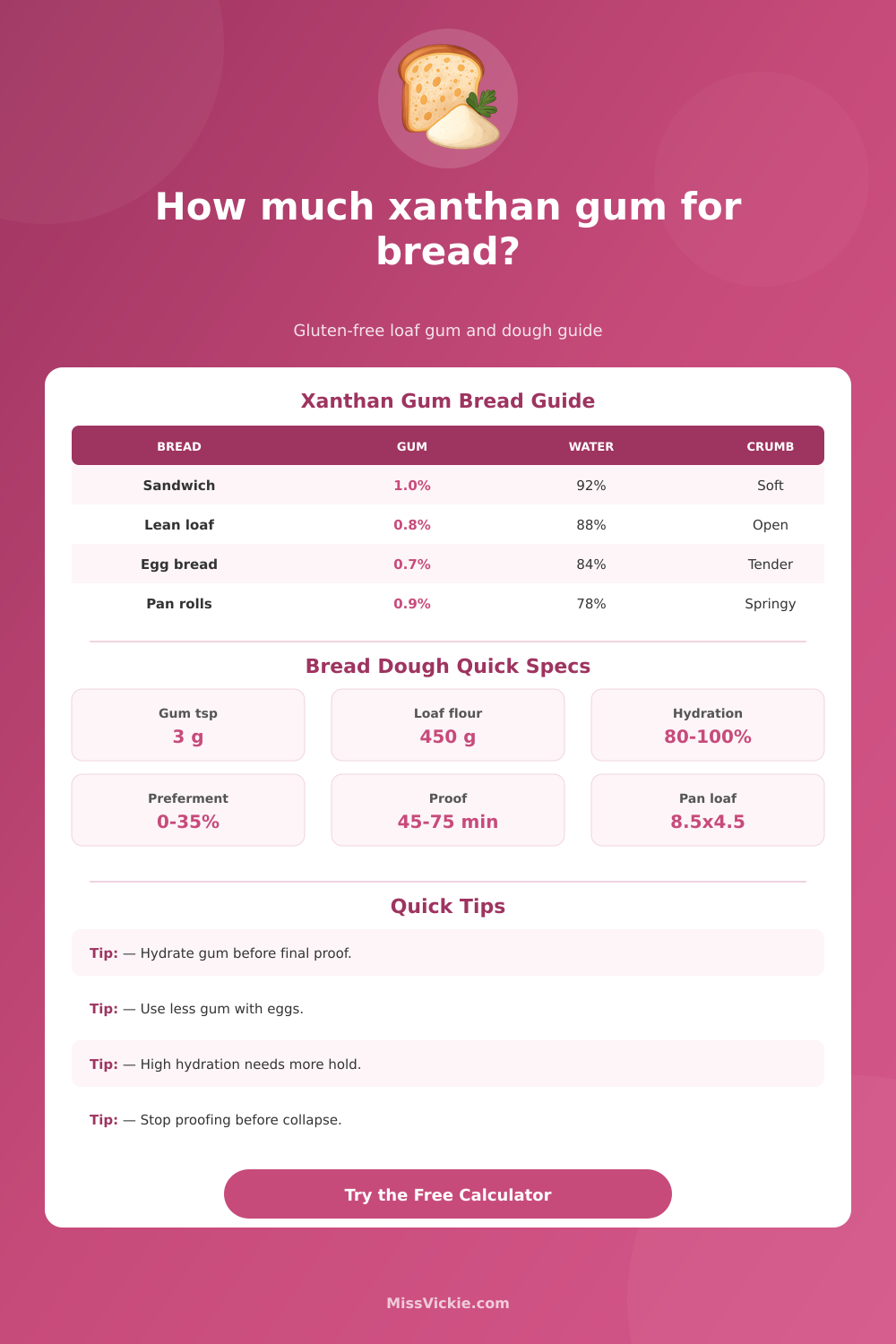
| Bread style | Typical gum | Best flour weight | Crumb cue |
|---|---|---|---|
| Sandwich pan loaf | 0.9% to 1.1% | 400 to 520 g | Soft slices with gentle spring. |
| Lean artisan-style pan bread | 0.7% to 0.95% | 450 to 600 g | More open crumb with less chew. |
| Soft pan rolls | 0.8% to 1.0% | 360 to 520 g | Springy pull-apart texture. |
| Egg-enriched loaf | 0.55% to 0.85% | 400 to 550 g | Tender crumb without gumminess. |
| Seeded multigrain loaf | 1.0% to 1.25% | 450 to 650 g | Extra hold for seeds and grains. |
| Hydration | Dough feel | Preferment effect | Gum note |
|---|---|---|---|
| 70% to 80% | Thick and scoopable | Low preferment works well | Use the low end. |
| 81% to 92% | Sticky but shapeable | Good for pan bread | Use middle range. |
| 93% to 105% | Batter-style dough | Preferment adds slack | Add a small bump. |
| 106% plus | Very loose batter | Needs pan support | Use careful support. |
| Binder support | Gum adjustment | Proof window | Watch for |
|---|---|---|---|
| No egg or dairy | Full recipe amount | 45 to 70 min | Ragged slice edges. |
| Dairy only | Slightly reduced | 45 to 75 min | Soft sides. |
| Eggs only | Reduced gum need | 40 to 65 min | Rubbery crumb. |
| Eggs plus dairy | Lowest gum need | 40 to 60 min | Over-tight crumb. |
| Psyllium support | Light xanthan only | 55 to 85 min | Heavy gel texture. |
| Pan or shape | Flour target | Hydration cue | Structure note |
|---|---|---|---|
| 8.5 x 4.5-inch loaf pan | 400 to 500 g | 85% to 100% | Best for sandwich bread. |
| 9 x 5-inch loaf pan | 475 to 600 g | 82% to 96% | Wider pan lowers height. |
| Pullman pan | 500 to 650 g | 80% to 92% | Great for tight slices. |
| 9 x 13-inch roll pan | 420 to 560 g | 72% to 84% | Proof rolls until touching. |
| Supported boule | 450 to 650 g | 85% to 105% | Needs strong binder system. |
Balanced xanthan level for flexible sandwich bread that bends without crumbling.
Lower gum lets bubbles expand, but the loaf usually needs pan support.
Higher gum gives cleaner slices, especially for toast and packed sandwiches.
Eggs, milk, and fat already add structure, so extra gum can turn chewy.
What is it like to bake gluten free bread? It’s different because of the lack of gluten, you need to learn how to control each ingredient, as gluten typicaly acts as the binder/structure. That means adding xanthan gum in place of structure, and the quantity change based on each variable. The calculator take all of those variables into account (flour, hydration, binders, proof time) to help give you precise recommendations. It is more helpful different than a static chart.
Flour weight are straightforward, yet it also set the scale for everything else. How much water is carried in the dough (hydration) are the second factor. More water equal more loose dough and therefore more gum needed to keep it from collapsing. The third is preferment percentage. The higher this number, the more enzymes and acid is added. This can have a slight softening effect on finished dough.
How to Use the Gluten Free Bread Calculator
The fourth consideration is binder support. Extra stabilizers like milk, eggs or psyllium helps hold up the structure. Compare the amount of gum needed for a dough made of rice and sorghum to one made with rice, sorghum, and milk or two egg. You would of needed less gum with second version.
The recipe for crumb: People often neglect it, but the crumb is not always consistent; a little more or less of it can change everything. You want an open airy slice? Less gum (because you’re leaving room for bubble expansion). Tight crumb? Better hold together after slicing. So a little more percent gum are good for this kind of pizza. The calculator does that math for you, given what you input.
You no longer have to guess at conversions or coefficients. Size of pan will shift the recommendation, too. A wider pan mean a thinner spread of dough. That alters the amount of support the sides give in proof.
A lot of folks eyeball their xanthan gum. That’s not good. Here is why: If you use too little, you get a torn or caved-in loaf, or your slice fail to hold together. If you use too much, your crumb turn to rubber. You think you’re eating undissolved chewing gum. A quarter-teaspoon difference could do that.
Scooping the ingredient will never be as consistent than weighing. This is also when people add the gum. You should actualy whisk the gum into your dry ingredients before any liquid goes in. The reason is because you want flour particles coated by the xanthan so they is evenly hydrated. When you get clumps, you end up with shiny streaks that don’t mix into the dough. Just whisk the gum through the dry ingredients before any liquid go in. That way it’s evenly distributed on the dough.
The interaction between gum and proof time are a subtle one. The longer you proof the dough the more it will stretch, it also has more time to weaken the structure. So if your dough fall apart at 70 minutes, decrease proof time. Decreasing proof time typicaly works faster than increasing the gum level. There is no need to jump right into altering the percentage of binder.
But here’s how running the numbers can help: They force you to start seeing patterns in what happens. Maybe 0.7 percent gum are all that an egg-enriched dough need. Maybe 1.15 percent is the sweet spot with a seeded loaf (the grains cut the network). Maybe a high-hydration rustic loaf, with preferment taken into account, hovers around one percent.
After a few bake, those kinds of patterns will turn into intuition. Then the calculator becomes not the main decider but instead a fast way to double-check your thinking. And understanding those tradeoffs mean you know where to expect XG to fall: predictable, unlike some mysterious powder. You treat it like any other ingredient; add or subtract based off the tradeoffs and structural results you want.