Flour cups, blend type, baked good, eggs, hydration, binder target, and gum percentage
Xanthan Gum for Gluten Free Flour Calculator
Estimate xanthan gum for gluten-free flour blends by flour weight or cups, blend starch level, baked good type, egg support, hydration, existing gum, and psyllium or guar alternatives.
Start with a real bake: each preset loads flour amount, blend type, baked good structure, eggs, hydration, and binder target before calculating xanthan gum.
Calculation Breakdown
| Gluten-Free Blend | Typical Cup Weight | Binder Behavior | Calculator Adjustment |
|---|---|---|---|
| Rice starch cup-for-cup blend | 125 to 135 g | Usually balanced but can feel sandy without enough rest. | Standard xanthan rate. |
| Sorghum millet whole-grain blend | 118 to 128 g | More bran and protein, often needs stronger binding. | Adds a small gum increase. |
| Oat flour blend | 105 to 120 g | Absorbs water slowly and softens during rest. | Uses moderate gum with rest credit. |
| Almond flour starch blend | 96 to 115 g | Fat and low starch make dough fragile but dense. | Keeps gum moderate to avoid rubbery texture. |
| Commercial blend with gum | 120 to 140 g | May already contain xanthan or guar. | Subtracts existing gum before final result. |
| Baked Good | Usual Gum Range | Hydration Cue | Texture Warning |
|---|---|---|---|
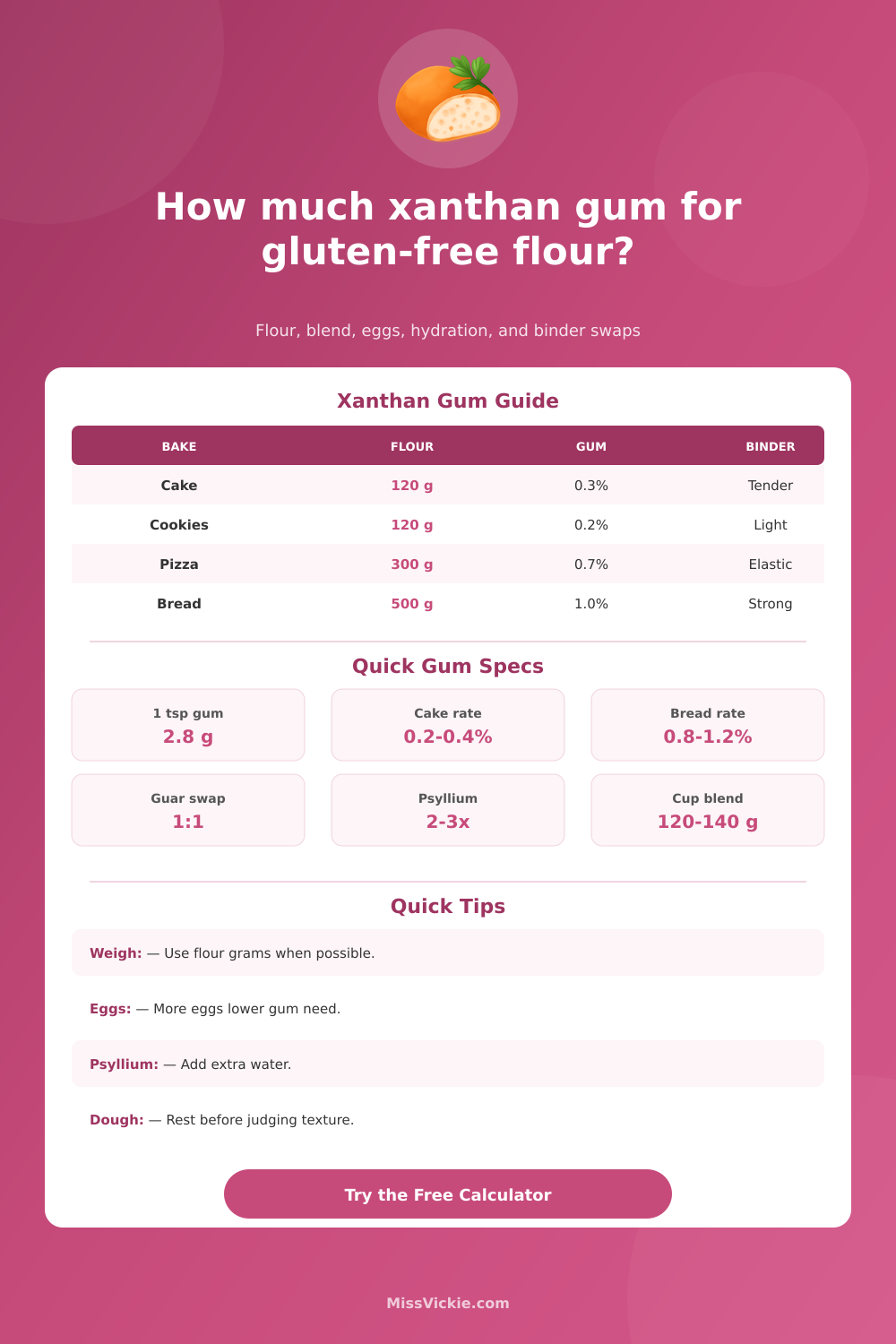
| Cakes and cupcakes | 0.20% to 0.40% | Loose batter, egg supported. | Too much gum can make a bouncy crumb. |
| Muffins and quick breads | 0.30% to 0.55% | Thick spoonable batter. | High gum plus low liquid can turn pasty. |
| Cookies and bars | 0.10% to 0.30% | Low hydration dough. | Use the low end for tender cookies. |
| Pizza and flatbread | 0.55% to 0.90% | Higher hydration dough. | Psyllium can improve stretch more than extra gum. |
| Yeast bread and rolls | 0.80% to 1.20% | Wet dough, rested before baking. | Too much gum can shrink and feel tacky. |
| Binder | Use When | Starting Swap | Water Note |
|---|---|---|---|
| Xanthan gum | Most cakes, cookies, muffins, and cup-for-cup blends. | Use calculator result. | Rest helps disperse gum. |
| Guar gum | Tender cakes, cold fillings, and cooks avoiding xanthan. | About 1:1 by weight. | Less elastic than xanthan in bread. |
| Psyllium powder | Bread, pizza, rolls, and doughs needing stretch. | 2 to 3 times xanthan weight. | Add 4 to 6 times its weight in water. |
| Whole psyllium husk | Rustic bread and doughs with longer rest. | 3 to 4 times xanthan weight. | Add 5 to 7 times its weight in water. |
| Chia or flax gel | Egg-free quick breads with softer texture. | Supports but rarely replaces all gum. | Count gel water in hydration. |
This calculator gives a practical starting dose for recipe testing. Gluten-free flour blends vary by brand, grind, starch ratio, and rest time.
Xanthan gum are an ingredient that provides structure to baked goods that is gluten-free. Xanthan gum perform the same role as gluten does in baked goods that contains wheat; it provides the structure that gluten give to baked goods that contain wheat. You should calculate the amount of xanthan gum that you add to a recipe according to the type of flour blends that will be used in the baked good, the amount of liquid ingredient in the recipe, and the texture that you would like to achieve in the finished baked good.
Too little xanthan gum will result in baked goods that crumble and break apart easy, while too much will create a texture that is somewhat rubbery. The xanthan gum calculator provide a specific measurement for the amount of xanthan gum that should be used in a batch of baked goods, based off the amount of flour that will be used, the type of flour blend, the type of baked good that will be produced, and the amount of egg in the recipe. The number of eggs in the recipe indicate how much structural protein will be added to the dough; more eggs means that less xanthan gum will be needed.
How Much Xanthan Gum to Use in Gluten-Free Baking
The hydration of the dough also have an impact upon the amount of xanthan gum; wet pizza dough require more xanthan gum than dry cookie dough. Xanthan gum calculator takes into consideration the weight of the liquid ingredient and the weight of the flour. The type of flour blend will impact the amount of xanthan gum needed to produce baked goods with the desired texture.
For instance, blends that contains rice starch behave different than blends that contain sorghum or oat flour; the sorghum and oat flour blends contains more protein and more bran than the rice starch blend. The xanthan gum calculator adjust the base rate of xanthan gum according to the type of flour blend that is to be used. Additionally, if the commercial blend of flour that is to be purchased already contains some amount of xanthan gum, you will need to account for that amount in the recipe; the xanthan gum calculator will allow for the amount of existing xanthan gum in the flour blend to be subtracted from the calculated amount.
While xanthan gum is the preferred binding agent for gluten-free baked goods, it is also possible to use alternative binders to xanthan gum. Alternative binders, however, requires adjustments in the amount of water in which the dough is mixed. For instance psyllium husk contain a type of stretch in the dough that xanthan gum does not provide, but psyllium husk require the addition of extra water to the dough.
Guar gum has a similar weight to xanthan gum, but it is less elastic when used in yeast doughs. These alternative binders can be accounted for in the xanthan gum calculator so that the baker can adjust for the additional liquid that will be required in the recipe in place of xanthan gum. Because xanthan gum and the other starches that are used in gluten-free baked goods need to be fully hydrated prior to baking, it is essential that the dough be rested prior to baking.
During this resting period, the xanthan gum and the starches will hydrate; at this point, less xanthan gum may be needed to produce the best results. Thus, the xanthan gum calculator account for the hydration of the xanthan gum. Many people make mistake when measuring xanthan gum; they measure it by volume or they simply eyeball the amount of xanthan gum that they add to their recipes.
Half a teaspoon of xanthan gum may be too much for a small cake recipe, for instance. Thus, it is best to calculate the amount of xanthan gum that is needed, based upon the weight of the flour that will be used in the recipe, and the percentage of xanthan gum that the xanthan gum calculator calculates. Once you have determined the amount of xanthan gum that is needed for your recipe, you should bake a small batch of your baked good.
It is important to judge the texture of the baked good after it has completely cooled. Gluten-free baked goods will feel different when they are warm compared to when they have set and finished baking; after the baked good has cooled, you can accurately judge the texture of the baked good, and adjust the amount of xanthan gum that you will use in your next batch of baked goods.