Wing Smoking Time Calculator
Plan smoked chicken wings by wing size, count, smoker heat, skin-dry time, target temperature, sauce timing, crisp finish, rack load, and rest.
📌Quick wing presets
Use presets as a starting point, then probe a flat or drumette. Poultry safety depends on measured internal temperature, not time alone.
⚙Wing smoke inputs
Your Wing Smoke Plan
Estimate updates after each input change.
Timing Breakdown
Batch Details
🍗Wing size quick cards
Cards show typical minutes before rest. Target temperature, sauce, airflow, and crisp finish can move the final plan.
📊Smoking time table
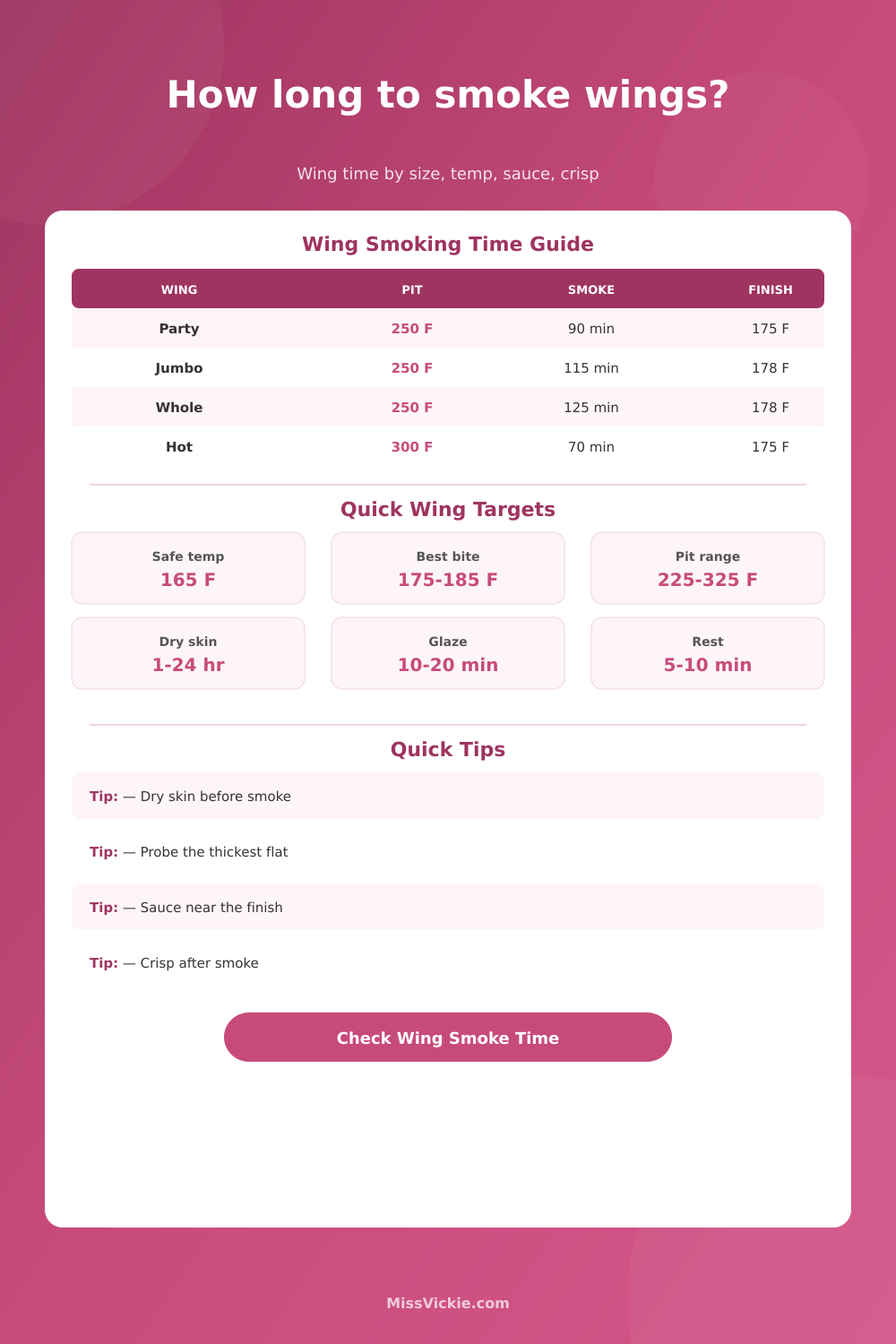
| Wing type | Typical raw size | 225 F smoker | 250 F smoker | 275 F smoker | 300 F smoker |
|---|---|---|---|---|---|
| Small split wings | 1.4 to 1.8 oz each | 100 to 120 min | 85 to 105 min | 70 to 90 min | 55 to 75 min |
| Party split wings | 1.9 to 2.5 oz each | 115 to 140 min | 90 to 115 min | 75 to 95 min | 60 to 80 min |
| Jumbo split wings | 2.6 to 3.4 oz each | 130 to 160 min | 105 to 130 min | 90 to 110 min | 70 to 90 min |
| Whole wings | 3.5 to 5.0 oz each | 140 to 170 min | 115 to 145 min | 95 to 120 min | 75 to 100 min |
| Drumettes only | 2.0 to 3.0 oz each | 120 to 150 min | 95 to 120 min | 80 to 105 min | 65 to 85 min |
| Flats only | 1.5 to 2.2 oz each | 105 to 130 min | 85 to 105 min | 70 to 90 min | 55 to 75 min |
🔥Finish method table
| Finish method | Added time | Best sauce timing | Skin result | Watch point |
|---|---|---|---|---|
| Smoke only | 0 min | Toss after cooking | Soft to tacky | Use higher target for bite |
| Raise smoker to 375 F | 12 to 18 min | Brush final 8 to 10 min | Moderately crisp | Rotate crowded racks |
| Grill heat | 6 to 10 min | Sauce after grilling | Charred edges | Flare-ups from fat |
| Hot oven | 10 to 14 min | Brush halfway through | Even browning | Use a rack over a pan |
| Air fryer | 5 to 8 min | Toss after crisping | Fast crisp | Work in small batches |
| Broiler | 2 to 5 min | Thin glaze only | Blistered spots | Sugar can scorch fast |
🍽Batch planning table
| Occasion | Pieces | Raw weight | Rack plan | Smoke note |
|---|---|---|---|---|
| Snack for 4 | 24 wings | 3 to 4 lb | Single rack | Quick probe at 70 min |
| Dinner for 6 | 42 wings | 5 to 6.5 lb | Single large rack | Rotate once if tight |
| Game night 10 | 70 wings | 9 to 11 lb | Two racks | Add recovery time |
| Party tray 18 | 120 wings | 15 to 19 lb | Two to three racks | Cook by zones |
| Potluck pan | 80 wings | 10 to 13 lb | Smoke on racks first | Pan only after sauce |
📐Comparison grid
More time in smoke, softer skin unless finished hot.
Good color, steady cooking, and predictable probe windows.
Shorter cook with less smoke but better browning.
Smoke ahead, then crisp close to serving time.
🧂Drying and sauce guide
| Prep choice | Timing effect | Texture effect | Good use |
|---|---|---|---|
| No dry time | Adds 5 to 10 min | Skin stays softer | Fast weeknight batch |
| 2 to 4 hour dry | Neutral | Better bite | Most smoked wings |
| Overnight dry brine | Can trim 3 to 6 min | Best browning | Party prep |
| Wet marinade | Adds 8 to 14 min | More tender, less crisp | Herb or citrus wings |
| Late sticky glaze | Adds 3 to 7 min | Shiny tacky finish | Honey, BBQ, teriyaki |
✨Wing smoking tips
There’s something about loading up your smoker with chicken wings that causes a certain type of anxiety. You’re aware that they need to get to 165 degrees Fahrenheit inside to be safe. But when it comes to poultry, safe doesn’t always mean tasty. Often times, even though wings appear done, the connective tissue hasn’t broken down enough to give you that good pull-and-pull satisfaction. That’s because if the meat isn’t cooked enough, it’ll spoil your dinner quicker then any dryness will.
Once you input the smoker temperature and size of your wings, the calculator above will do the rest of work for you. No more guessing at conversions or coefficients; just concentrate on what tastes good.
How to Cook Perfect Smoked Chicken Wings
The first thing most folks do is go by temperature alone. Stick a probe into a drumette and pull it out when it gets to the red zone. Wrong. The actual variable isn’t strictly temperature, its the time it took to get there (without steaming the skin). Because the tool considers wing size: Mass = Heat Transfer. The larger a split wing, the bigger the volume of meat between skin and heat source. That means longer time before the heat has penetrated enough. Do this and you’ll find your big wings has gone all rubbery and your little party wings are dry as dust. Look at the reference table on the page; it makes it clear that it’s about both time and temperature, which shift according to wing mass.
The other part of the equation is skin quality. No matter how hot something gets on the inside, wet skin doesn’t crisp; it steams. That’s why calculator includes inputs for skin drying times. Putting wings (or whatever) out in the fridge skin-side up overnight pulls moisture out of the interior and onto surface, where it dries away. The result is a tacky film that will brown like a dream. If you don’t bother with that, the tool adjust to match extra energy needed to blow off the water. Thermodynamics, not magic.
Timing your sauce matters. Sugar begins to burn at much lower temperatures before the chicken’s skin gets crispy. If you glaze it with honey or maple during the first hour of smoking, that gooey goodness will be dark and bitter long before your meat become tender. Pro tip: pros glaze their wings just before serving. The calculator accounts for this (and other) last-minute glazes. Smoke the wings ’til nearly tender, applying the sauce during the last fifteen minutes. Your sticky coating won’t scorch into bitterness; instead, it’ll shine as sweet as can be. Plus, it lets you crisp up your skin without trapping moisture inside.
Amateur smokers tend to underestimate importance of rack density. When wings is crowded on one grill grate, airflow gets restricted and each one sits in its own little environment, wrapped in steaming vapor. Because dense packing is like a lid, it slows down browning and drying; hence the inclusion of rack load as a factor in the tool. To cook up enough for a crowd, you need to spread ‘em out, or use several racks and rotate. Or else you’re simply braising your wings in their own rendered fat.
You’ll get your own crisp finish window and another for your smoke time. Smoking adds flavor, and then crisper adds crunch. Each needs its own profile of heat. Low and slow develops smoky flavor and some color, and a blast of high heat at the end gets it nice and crunchy. If you try to do both together, typically one will fail. When you separate, you gain control of results.
The final step is rest. It’s counter-intuitive when you think about it for something so tiny, but allowing those wings to rest five or ten minutes gives them time to redistribute their juices. Cut into them too soon and those juices will run right out onto your plate. Great cooking takes both fire and patience. And that’s why there’s a rest timer on the tool.
Get ‘em nice and dry; smok’em low and slow; get ‘em hot, and then make ’em breathe. You’ll have a memorable meal. Or not.