Wine Bottles Per Case Calculator
Estimate bottles in cases, pour capacity, event coverage, mixed red and white counts, extra buffer, and cases to buy from case count, bottle size, case format, guest count, pours per guest, and servings per bottle.
🍷Wine Case Presets
Pick a common wine planning situation, then adjust the case format, bottle size, event size, servings, buffer, and mixed case ratio for your table.
⚖Wine Case Inputs
Wine case plan
Your wine case estimate appears here.
Case Breakdown
Event Coverage
Buying And Mix Plan
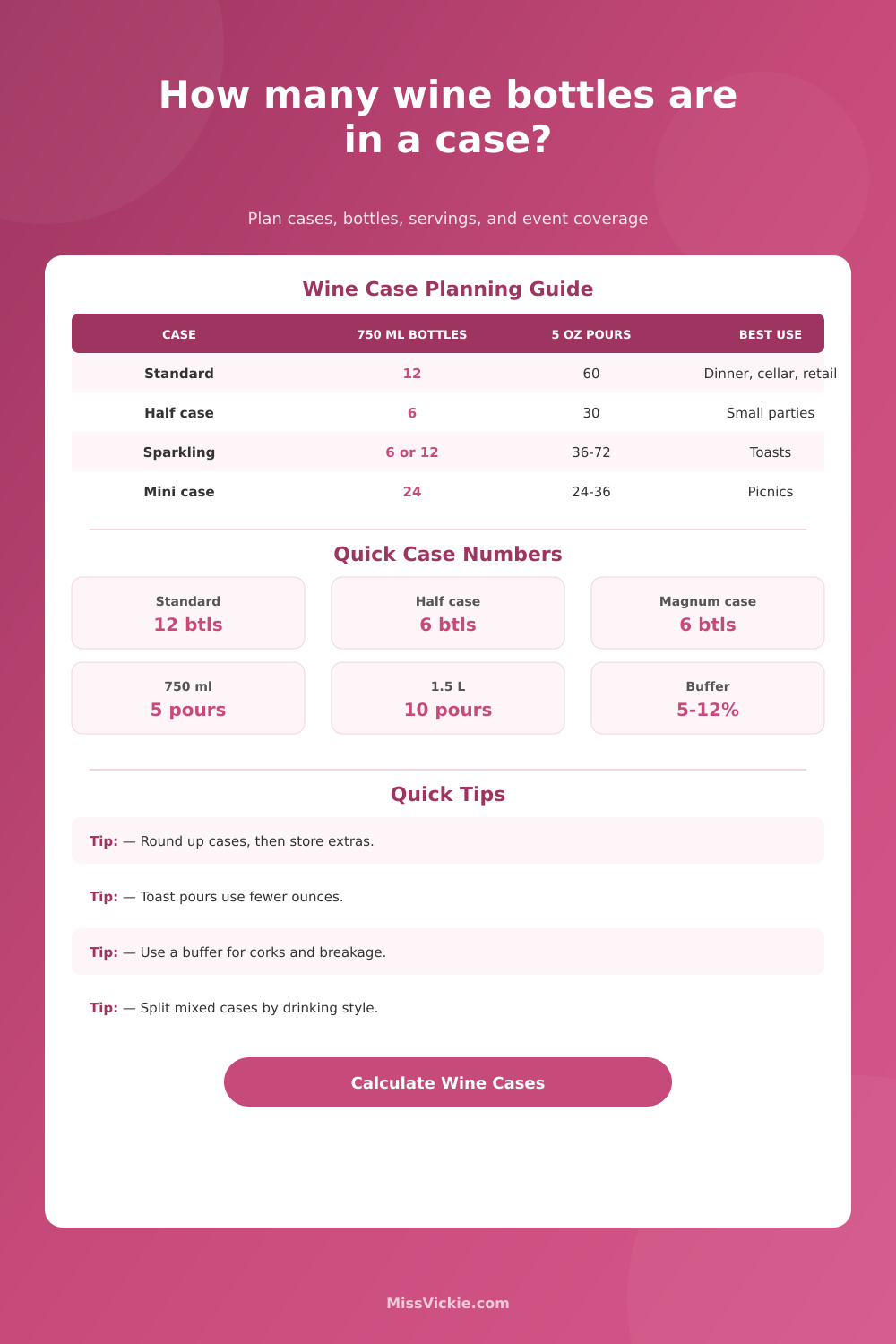
📌Quick Wine Case Numbers
🔍Case Format Comparison Grid
Best all-purpose planning unit for 750 ml bottles, home cellars, and dinner service.
Useful for small parties, mixed styles, special bottles, and magnum cartons.
Good for split bottles, picnic pours, outdoor service, and portion-controlled favors.
Buy by full cases after buffer, then use extra bottles for host stock or late additions.
📦Wine Case Format Table
| Case format | Bottles per case | Typical bottle size | Approx 5 oz pours | Planning note |
|---|---|---|---|---|
| Standard wine case | 12 bottles | 750 ml | 60 pours | Most common retail and cellar format. |
| Half case | 6 bottles | 750 ml or magnum | 30 pours for 750 ml | Good for variety and small groups. |
| Magnum case | 6 bottles | 1.5 L | 60 pours | Same pour count as a standard case of 750 ml bottles. |
| Mini split case | 24 bottles | 187 ml | 24 to 36 pours | Best for single-serve picnics and favors. |
| Cellar or import case | 15 bottles | 750 ml | 75 pours | Less common, so check the actual carton. |
🍷Bottle Size And Serving Table
| Bottle size | Volume | Suggested servings | Best service style | Case planning note |
|---|---|---|---|---|
| Mini or split | 187 ml | 1 to 1.5 servings | Single guest, picnic, welcome pour | Often sold 24 per case. |
| Half bottle | 375 ml | 2 to 2.5 servings | Pairing menus and dessert wine | Handy when guests get different wines. |
| Standard bottle | 750 ml | 5 servings | Dinner, bars, home stock | Use 12 bottles per case unless label says otherwise. |
| Liter bottle | 1 L | 6 to 7 servings | Casual table wine | Check carton count because formats vary. |
| Magnum | 1.5 L | 10 servings | Parties and sparkling service | Six magnums equal twelve standard bottles by volume. |
🍽Event Planning Table
| Event style | Pours per guest | 750 ml bottles for 25 guests | Full standard cases | Buffer note |
|---|---|---|---|---|
| Single toast | 1 to 1.25 | 5 to 7 bottles | 1 case | Use 8 to 12% if timing is tight. |
| Dinner party | 2 to 3 | 10 to 15 bottles | 1 to 2 cases | More red with meat-heavy menus. |
| Reception bar | 1.5 to 2.5 | 8 to 13 bottles | 1 to 2 cases | Adjust down if cocktails and beer are also served. |
| Tasting flight | 4 to 6 small pours | 10 to 15 bottles | 1 to 2 cases | Small pours can raise servings per bottle. |
| By-the-glass list | Order based | Depends on demand | Restock by case | Keep a lower buffer for fast-turn stock. |
🔀Mixed Case Ratio Table
| Menu or crowd | Red percent | Other wine percent | 12-bottle case split | Good fit |
|---|---|---|---|---|
| Seafood, lunch, warm weather | 25 to 40% | 60 to 75% | 3-5 red, 7-9 other | White, rose, and sparkling lead. |
| Balanced dinner | 45 to 55% | 45 to 55% | 5-7 red, 5-7 other | Good default when menu is mixed. |
| Steak, roast, winter table | 60 to 75% | 25 to 40% | 7-9 red, 3-5 other | Red wine gets the larger share. |
| Toast or brunch | 10 to 25% | 75 to 90% | 1-3 red, 9-11 other | Sparkling, white, and rose dominate. |
💡Wine Case Planning Tips
Wine service estimates vary with pour size, glassware, bartender style, guests who skip wine, guests who refill often, cork condition, storage temperature, and other beverages served at the same event.
It’s the time we’ve all been there: You’re in grocery store, staring down a six-pack of Chardonnay, while your spouse wonders if it’s enough for dinner service. It’s that moment, arithmetic overtakes intuition. Most people assume a case are twelve bottles, right? That’s what we’re used to seeing in stores, packaged up nice and retail-ready. But the real world doesn’t work that way; different-sized bottles, different pours, different levels of waste (broken glass! There is also bad corks.
This calculator on page does all math for you, instead of leaving you guessing if three cases can handles thirty people for an evening of serious sipping. By accounting for variables most hosts don’t think about till it’s too late, it help turn a vague sense of worry into a clear-cut shopping list.
How to Use the Wine Calculator
The first piece of information required to solve the problem, which affects all other variables, is what bottle size you’re dealing with. Five ounces per pour are a decent portion. If your bottle is a normal seven hundred fifty milliliter bottle, you’ll get roughly five nice-sized pours from it. But if you have a magnum (one point five liters) then you’ve got ten servings which, depending off where you buy them, might come in packs of six instead of a dozen. Unless you change the case format option in the calculator, plugging in magnums will result in half as much wine than intended. On page, there’s a handy table for how serving sizes corresponds to volume by format.
Depending on nature of the event, you can adjust number of pours per guest to match. A quick toast needs fewer drinks then a multi-course meal lasting four hours and featuring rich dishes that leave you thirsty.
A breakage buffer is something most casual hosts never plan for, but it’s another key variable. Glasses break by sharp coffee table corners. Bottles leaks during transport. Corks give way. An eight to twelve percent buffer will protect you from these minor screw-ups while only slightly padding your wallet. You can set this percentage according to how much risk you are willing to take. For example, you might want a higher buffer if you’re serving older vintages that might leak, or if you’ll be shipping bottles across state lines. Without a buffer, you may be forced to ask your guests to settle for sodas, a costly embarrassment, and one easily prevented with a few extra dollars’ worth of cheap insurance.
But it’s also worth remembering that red-to-white ratio won’t be 50-50 when entertaining mixed company, depending on the season and the menu. You might serve more red in winter for roasts, or more pink, lighter white, or rosé in summer for seafood lunches. You can adjust this on the calculator by adding a % for reds and watching how many bottles of what go into your case orders. You will no longer accidentally order too much full-bodied Cab for a small appetizer spread or run short of sparkling wine for that afternoon party.
Not everything is about quantity; it’s as much about choosing the right type of liquid for the occasion… And what happens to be on the plate. Knowing where to stop crunching numbers and trust my gut has always been the difficult aspect in planning wine. Wine numbers can be a comfort zone (and I’m going to use them), but what happen when someone throws back 3 more glasses? Or what if everyone wants beer?
We’re trying to land on a number that makes us feel good and then rounding it up to the next full case. Why? Because most retail stores don’t sell half cases and we would of rather have too much wine than not enough. Extra bottles are always great hostess gifts or for future dinners. At end of the day you want your guests to leave happy and a little bit buzzed, not concerned with who’s getting the last drop.
After all that’s been established, after inputting, seeing your suggested number of bottles… You can relax. You no longer need to freak out, you have a game-plan, and you can go mingle with your friends instead of hiding in the kitchen trying to do some mental math.