Whole Fish Cooking Time Calculator
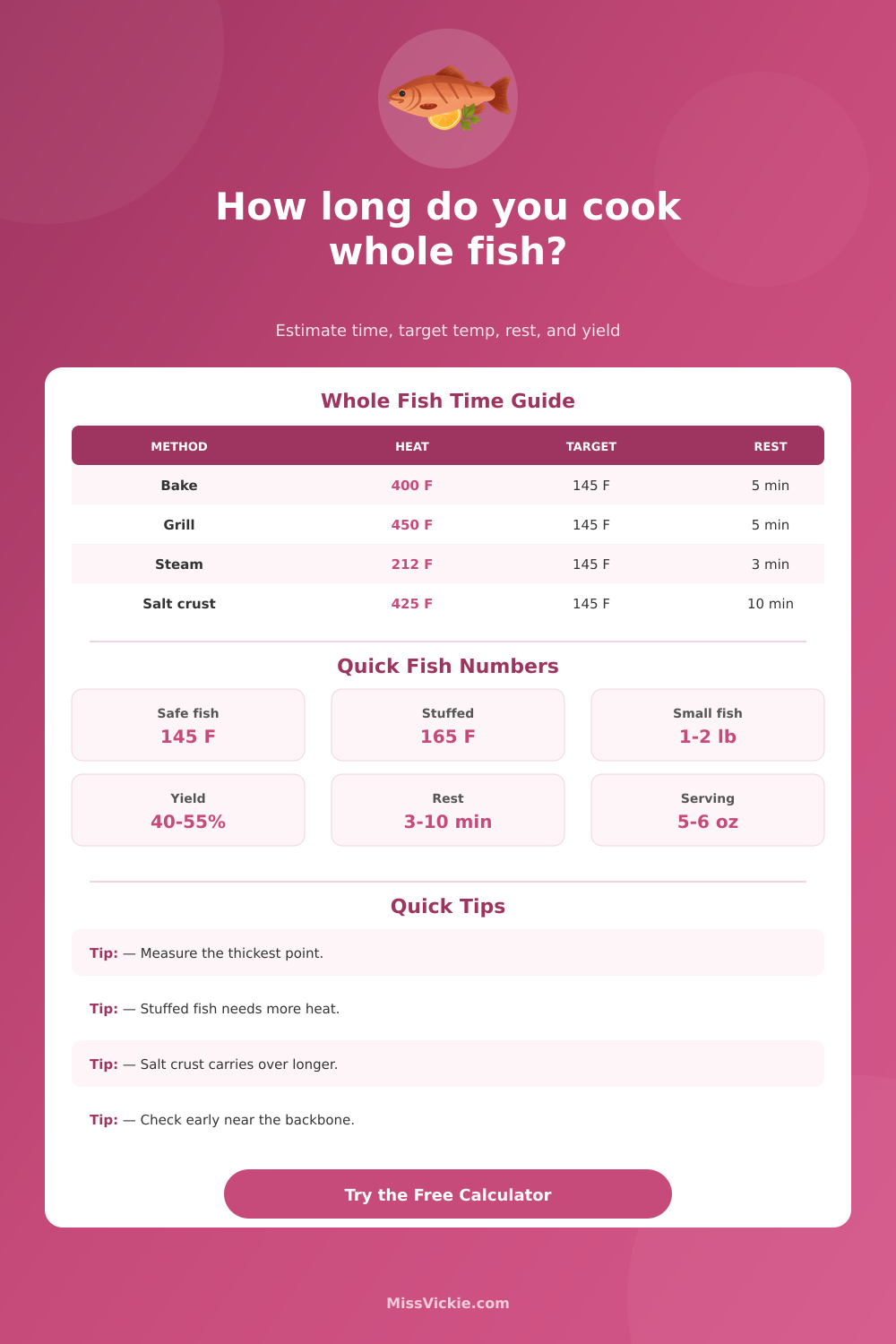
Estimate whole fish cooking time by weight, thickest point, oven or grill heat, cooking method, cavity fill, foil or salt crust, starting temperature, target internal temperature, rest time, and edible yield.
Choose a common whole-fish scenario, then adjust the exact weight, thickness, heat, target temperature, rest, and yield settings below.
Cooking Breakdown
| Method | Typical heat | Time behavior | Best for |
|---|---|---|---|
| Bake in oven | 375-425 F / 190-220 C | Moderate, even heat; thickness is the main driver. | Branzino, trout, snapper, bass, and weeknight whole fish. |
| High-heat roast | 425-475 F / 220-245 C | Faster surface browning with a slightly shorter cook window. | Scored fish, oiled skin, lemon, herbs, and crisp edges. |
| Direct grill | 425-500 F / 220-260 C | Fastest method; check early because grill heat varies. | Oily fish, trout, mackerel, snapper, and small bass. |
| Indirect grill | 350-425 F / 175-220 C | Slower but gentler; useful for heavier fish or covered grills. | Whole salmon, large snapper, party-size fish, and BBQ platters. |
| Steam | 212 F / 100 C steam | Moist, steady heat; cavity aromatics matter less than thickness. | Tilapia, trout, sea bass, ginger-scallion fish, and delicate flesh. |
| Poach | 175-190 F / 79-88 C liquid | Gentlest method; plan a longer window and verify near the bone. | Cod, haddock, lean white fish, and court bouillon service. |
| Broil finish | 500 F / 260 C element | Very fast top heat; best used for small fish or final browning. | Butterflied whole fish, crisping skin, or finishing after baking. |
| Setup | Time effect | Temperature note | Practical check |
|---|---|---|---|
| Empty cavity or light scoring | Baseline | Use the fish target temperature. | Probe thick flesh beside the backbone. |
| Herbs, lemon, garlic | Adds a little time | Moist aromatics slow heat in the cavity. | Do not pack tightly; steam needs space. |
| Vegetable-packed cavity | Adds moderate time | Dense vegetables insulate the center line. | Slice vegetables thin so the fish is not overcooked. |
| Bread, rice, or seafood stuffing | Adds the most time | Calculator uses 165 F / 74 C as the final target. | Measure the center of the stuffing and thick fish. |
| Loose foil tent | Slightly slower | Reduces browning but protects lean flesh. | Open near the end if skin needs drying. |
| Sealed foil or parchment packet | Slower but moist | Steam inside packet speeds gentle carryover. | Open carefully and check with a thermometer. |
| Full salt crust | Slower upfront | Carryover is strong after cracking the crust. | Rest longer, then crack and check thick flesh. |
| Seafood item | Reference temp | Visual cue | Calculator use |
|---|---|---|---|
| Fin fish, whole or fillet | 145 F / 63 C | Opaque flesh that separates easily with a fork. | Minimum final target for normal whole fish. |
| Stuffed whole fish | 165 F / 74 C | Stuffing is hot through the center. | Used when bread, rice, or seafood stuffing is selected. |
| Shrimp, crab, lobster | Opaque and pearly | Flesh turns firm and opaque. | Only relevant if seafood stuffing is inside the fish. |
| Clams, oysters, mussels | Shells open | Discard shells that stay closed after cooking. | Not used for whole fin-fish timing. |
| Fish type | Typical edible yield | Serving estimate | Notes |
|---|---|---|---|
| Branzino, sea bass, trout | 45-50% | 1 lb whole gives about 7-8 oz cooked meat | Good small-fish yield with easy bone lift when cooked properly. |
| Snapper and similar round fish | 48-53% | 2 lb whole gives about 15-17 oz cooked meat | Meatier shoulders and cheeks improve platter yield. |
| Whole salmon on bone | 55-60% | 5 lb whole gives about 44-48 oz cooked meat | Large fish usually produce higher edible portions. |
| Mackerel and oily small fish | 42-48% | 1 lb whole gives about 6-7 oz cooked meat | Rich fish serve smaller portions but lose less moisture. |
| Flatfish | 38-45% | 2 lb whole gives about 12-14 oz cooked meat | Bone structure lowers yield, though flesh cooks quickly. |
| Large round fish | 50-58% | 6 lb whole gives about 48-56 oz cooked meat | Best yield when carved cleanly after resting. |
| Serving plan | Whole fish weight | Approx. edible meat | Cooking note |
|---|---|---|---|
| Dinner for 2 | 1.25-1.75 lb / 0.6-0.8 kg | 9-13 oz / 255-370 g | Small whole trout, branzino, or snapper cooks quickly. |
| Family dinner for 4 | 2.5-3.5 lb / 1.1-1.6 kg | 18-26 oz / 510-735 g | Use a thermometer because the shoulder is thicker than the tail. |
| Grill platter for 6 | 4-5 lb / 1.8-2.3 kg | 30-40 oz / 850-1135 g | Indirect grill or roast gives the center time to catch up. |
| Holiday table for 10 | 7-9 lb / 3.2-4.1 kg | 55-75 oz / 1.6-2.1 kg | Consider two smaller fish for more even cooking. |
| Buffet for 20 | 14-18 lb / 6.4-8.2 kg | 7-9 lb / 3.2-4.1 kg | Cook multiple fish and hold loosely covered after resting. |
For me, there is no such thing as too heavy; I know that thickness is what really drives how long it takes to cook. However, just knowing weight of the fish isn’t enough to know how long to cook it. Time is a variable that trumps weight.
Timing depends more on thickness and method than a set amount of time, so if you just guess, well… You might get it wrong. The door closes.
How to Cook Fish Perfectly
Enter your measurements and the calculator figure out the rest. You no longer have to guess how much longer it takes for heat to reach the bone of a dense fish versus a slender one.
Home cooks think of the internal temp as an end-point, but that’s actualy variable based off content. A fish stuffed with nothing but a few lemon slices would follow normal safe rules. Stuffing with bread is different because starch must reach higher temperatures to be safe, but you don’t want to dry out the meat itself.
That’s why the tool vary the time and also the target temp accordingly. There are no different charts to memorize for each twist; you simply indicate your ingredients and it will adapt the base.
How attentive are you to the ticking clock? Do you grill… Fast, but with hot spots (the skin may burn before center heats up)? Do you bake; gentle heat distribution, so time is more of a sure thing? Do you poach or steam? These moisture-retaining methods requires slightly longer cook time because surrounding temperature is lower then that of a heated oven.
Compare what you plan to do to your gear; that’s where the chart comes into play. Remember foil packets. There’s trapped steam, so adjust accordingly. This method use gentle cooking and holds heat after leaving the oven. This one’s a dandy; it’s all too simple for most folks.
When you take that fish off of the heat, its internal temp keeps on going up. Carryover cooking is more important with bigger fish and especially with fish wrapped in insulating materials such as a salt crust. If your thermometer read correctly when you removed the fish but then you didn’t let it rest, you’ll have overcooked fish on your hands. Allow the fish to rest undisturbed. It will finish cooking using its own remaining heat and not end up drying out the flesh.
Plan ahead for parties by knowing how much to expect per serving so you can order the right amount. Bones = waste. One pound of raw is not going to equal one pound of cooked product when whole fish is involved. By accounting for skin, bone and head, you won’t run out of food. A couple pounds of snapper equals about a pound of meat, which means you’ll scale up (or down) your recipes appropriately without worrying about short-changing your guest. It’s just math, but it makes for practical party planning.
“Understanding fish form is key. Water conducts heat from outside in; energy is absorbed by thick parts (thermal reservoirs) and radiates from thin ones (like the tail). Fish are not uniform: check several spots instead of just one. Probe early along the estimated low end, not at zero. You’ll see opacity in meat which helps, but get certainty with a meter.
Scoring and seasoning do impact heat transmission, too. The deeper the cut the further it transfer heat into the meat’s fibers. This effectively shortens the cooking path. Herbs add moisture but minimal insulation, while oil on skin promotes conduction. Little tweaks like these are secondary to setting the core variables correctly at the start.
Start with precise measures of thickness and weight. Adjust from there according to what you prefer to do. Some fish are fattier than others, some more dense, some less so. Fish that are oily (like mackerel); hold up better to the heat. Delicate white fish need a little more care. Knowing this makes cooking less about feeling anxious and more about being in control.
You don’t fight the physics of heat anymore; you work with it. You prepare for variables ahead of time. This can make all the difference between a confident presentation and a stressful dinner. At the end of the day, cooking a whole fish is an exercise in precision and patience.
You should of know when to trust your tools and when to use your senses to double check. Resting can help if you take it out a bit too early, and aggressive broiling can make you leave it in longer. There’s not one ideal moment; there’s just a window that suits your particular situation. Perfect the inputs and you’ll never go wrong on the output.
The backbone is your last line to tenderness or toughness.