🍗 How Much Whole Chicken Per Person
Estimate whole birds for carved dinners, buffet pans, barbecue halves, shredded sandwich trays, and meal prep with guest mix, yield, bird size, and leftover goals built in.
| Meal Style | Cooked Meat / Adult | Typical Whole Bird Output | Best Fit |
|---|---|---|---|
| Carved Dinner Plates | 6.5 to 7.5 oz | 3 to 4 servings | Weeknight or family meals |
| Buffet Slices | 5.5 to 6.5 oz | 4 to 5 servings | Self-serve with multiple sides |
| BBQ Halves or Quarters | 8 to 9 oz | 2 adult servings | Bone-in plated service |
| Shredded Sandwiches | 4.5 to 5 oz | 6 to 7 sandwiches | Sliders, buns, and wraps |
| Chicken Salad or Wraps | 4 to 4.5 oz | 6 to 8 portions | Lunch prep and chilled trays |
| Soup, Stew, or Rice Bowls | 3.5 to 4 oz | 8 to 10 bowls | Stretch meat with broth or grains |
| Chicken Type | Avg Raw Size | Usable Cooked Yield | Best Use |
|---|---|---|---|
| Broiler or Fryer | 3.5 to 4.0 lb | 44% | Smaller dinners and fast roasting |
| Roaster | 4.5 to 5.5 lb | 47% | Most family dinner calculators |
| Air-Chilled Bird | 4.0 to 5.0 lb | 49% | Crisp skin and strong carve yield |
| Spatchcock Bird | 4.0 to 4.5 lb | 50% | Even cooking and clean pulling |
| Heritage Chicken | 4.5 to 5.0 lb | 43% | Flavor first, fewer servings |
| Stewing Hen | 5.0 to 6.0 lb | 41% | Soup, broth, and shredding |
| Raw Bird Size | Edible Cooked Meat | Carved Dinner Servings | Sandwich Servings |
|---|---|---|---|
| 3.5 lb / 1.6 kg | 1.5 to 1.7 lb | 3 servings | 5 to 6 |
| 4.0 lb / 1.8 kg | 1.8 to 2.0 lb | 3 to 4 servings | 6 to 7 |
| 5.0 lb / 2.3 kg | 2.2 to 2.5 lb | 4 servings | 7 to 8 |
| 5.5 lb / 2.5 kg | 2.4 to 2.7 lb | 4 to 5 servings | 8 to 9 |
| Adult-Equivalent Guests | Carved Dinner Raw Weight | Buffet Raw Weight | 5 lb Roasters |
|---|---|---|---|
| 6 guests | 10 to 11 lb | 9 lb | 2 birds |
| 12 guests | 19 to 20 lb | 16 to 17 lb | 4 birds |
| 20 guests | 33 to 34 lb | 28 to 29 lb | 7 birds |
| 30 guests | 49 to 50 lb | 42 to 43 lb | 10 birds |
| 40 guests | 65 to 67 lb | 56 to 58 lb | 13 birds |
Mixed Meat Dinner
Baseline carving where guests will take both breast and dark meat from the platter.
Mostly White Meat
Breast-first crowds burn through usable portions faster even when the total bird count looks generous.
Bone-In BBQ Halves
Expect one whole chicken to cover roughly two adults once halves or quarters hit the plate.
Pulled Sandwich Fill
Pulling every bit of meat from the carcass stretches each bird better than carved service.
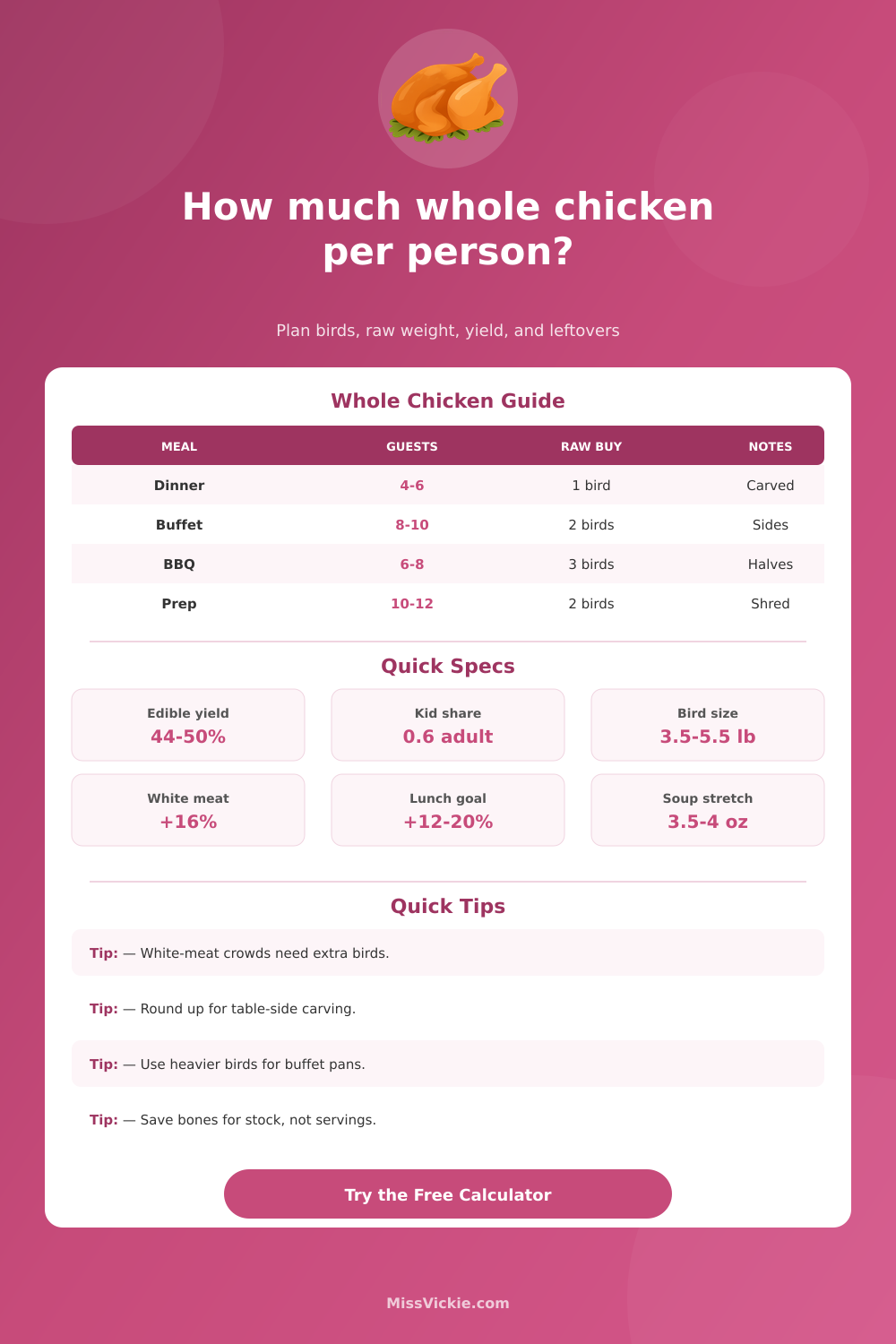
Calculating the correct amount of chickens for a group of people require an understanding of the amount of edible meat that come from a whole chicken and the amount of chicken that each guest will eat. A whole chicken contain bones, skin and fat that isnt edible. The portion of edible meat from a whole chicken weigh between 44 and 50 percent of the total weight of the whole chicken.
Because the amount of edible meat from a whole chicken is less than half of the total weight of the whole chicken, it is necessary to purchase more whole chickens than the total amount of cooked meat that guests desire to be served. If the weight of the bones in a whole chicken is not accounted for, it is possible that there will not be enough cooked chicken for each guest. The amount of chicken that will be needed for a group of guests also depend upon the style of the meal that will be served to the guests.
How Many Chickens to Buy
For formal dinners, where chicken is the main meal for the guests, 6.5 to 7.5 ounces of cooked chicken is required for each adult guest. Buffets may require 5.5 to 6.5 ounces of cooked chicken per guest, as most of the guests will eat the side dish with the chicken. For barbecues that include bone-in chicken, 8 to 9 ounces of chicken will be required per guest.
For sandwiches that include shredded chicken, only 4.5 to 5 ounces of cooked chicken will be required per guest. The style of the meal will determine the amount of cooked chicken that need to be prepared. The amount of chicken that will be needed can also be altered according to the age and appetite of the guests that will be served to the meal.
Younger children will eat less chicken than adults; the portion of chicken for a child can be calculated as 0.6 of the portion of chicken for an adult guest. Therefore, if the number of children is much greater than the number of adults, it will be necessary to purchase less whole chickens from the store. The eating appetite of the guests will also alter the amount of chicken that is needed.
Guests with a light eating appetite will require less chicken from the store than guests with a heavy eating appetite. Those with a heavy eating appetite will require 28 percent more chicken. Finally, the side dishes that are served with the chicken will alter the amount of chicken that is required.
If the side dishes contain heavy quantities of bread and vegetables, the guests will eat those sides and require less chicken (12 percent less chicken). The type of chicken that is purchased can also alter the amount of edible meat. A standard roaster chicken that weighs between 4.5 and 5.5 pounds will contain 47 percent of usable chicken meat.
Air-chilled chickens will yield 49 percent of usable meat. Air-chilling allows the skin of the chicken to separate from the meat. Spatchcocked chickens has the skin and the bones removed from the chicken, thus the chicken will yield 50 percent of usable meat.
If heritage breeds of chickens are purchased, the amount of edible meat will be less at 43 percent. Therefore, more chickens of this breed will need to be purchased. Stewing hens have more meat than other breeds of chickens, however they will only yield 41 percent of the chickens total weight as usable meat.
Besides the factors described above, it is also necessary to account for any potential leftovers, or alternate meals by the guests. If any sandwiches will be made the following day, the quantity of chicken will need to be 12 percent more than the amount of chicken that will be served to the guests. If lunches will be made for the guests, the quantity of chicken will need to be 20 percent more than the amount of chicken that will be served to the guests.
If chicken stock will be made from the carcasses of the chickens, 28 percent more chicken will need to be purchased than the amount of chicken that will be served to the guests. The dietary needs of the guests may also change the amount of chicken that is needed for preparation. If some of the guests prefer white meat, there will be a need for 16 percent more chicken than if all of the guests prefer dark meat.
However, if the guests prefer dark meat, there will be a need for only 6 percent more chicken than if the guests all prefer white meat. In order to purchase the correct amount of chicken, the recipe for preparing the chicken should be followed. The chickens will need to be fully thawed prior to cooking; if the chickens are frozen, the meat may dry out during the cooking process.
After roasting the chickens, they will need to rest for 20 minutes prior to carving; the meat will be fuller slices after resting. If barbecuing the chicken, the chicken will need to be spatchcocked so that it will cook even. Finally, when purchasing chickens, the total number of chickens should be rounded up to ensure that each guest receives enough chicken to eat.
You should of checked the amount of furnitures in the dining area too.