MissVickie whole bird brining calculator
Whole Chicken Brining Time Calculator
Estimate a whole chicken brining window from bird weight, cavity openness, wet or dry style, salinity, fridge temperature, container fit, skin drying time, and your maximum safe scheduling window.
Choose a full-bird scenario, then tune the salt target, cavity, container fit, and skin drying plan for your roasting, grilling, smoking, or frying schedule.
Whole bird brine plan
Your timing, salt, drying, and fit adjustments will appear here.
Whole-Bird Brine Breakdown
Good for juicy meat, but the skin benefits from a separate uncovered drying step.
Uses salt by bird weight and needs more time for the breast and cavity to season evenly.
Salt is based on bird plus liquid, so it is harder to oversalt during longer windows.
Dairy brines are softer and slightly slower, especially for a trussed whole bird.
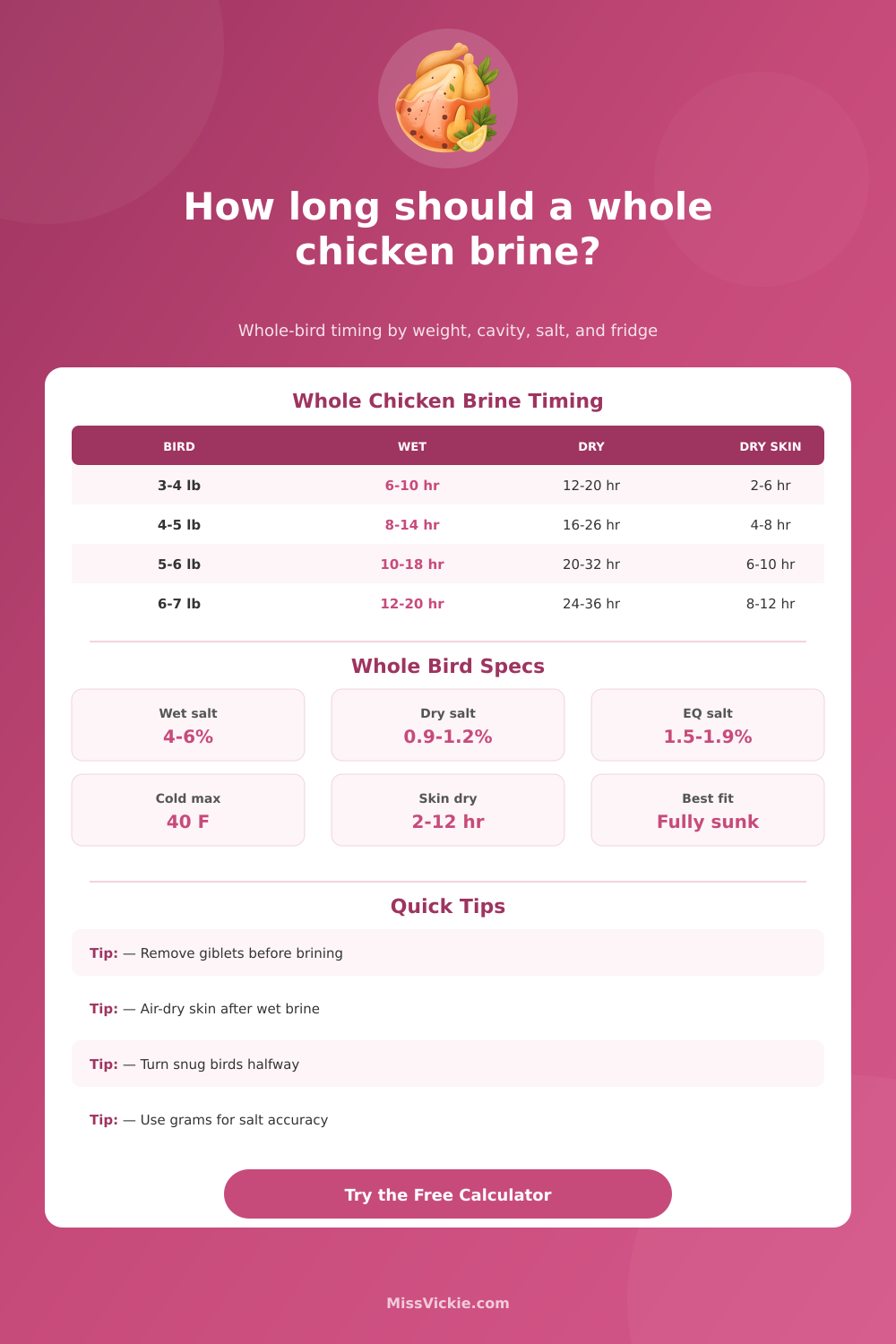
| Whole Chicken Weight | Wet Brine Window | Dry Brine Window | Skin Drying Note |
|---|---|---|---|
| 3 to 3.9 lb fryer | 6 to 10 hours | 12 to 20 hours | 2 to 6 hours uncovered after wet brine |
| 4 to 4.9 lb roaster | 8 to 14 hours | 16 to 26 hours | 4 to 8 hours gives better roasting skin |
| 5 to 5.9 lb large roaster | 10 to 18 hours | 20 to 32 hours | 6 to 10 hours helps the breast skin dry |
| 6 to 7 lb family bird | 12 to 20 hours | 24 to 36 hours | 8 to 12 hours is useful if the container was wet and snug |
These are starting points for raw whole chicken held under 40 F. The calculator adjusts for cavity openness, container fit, salinity, fridge temperature, and your chosen max window.
| Brine Style | Salt Basis | Typical Target | Whole-Bird Use |
|---|---|---|---|
| Classic wet brine | Liquid weight | 4% to 6% salt | Quick seasoning, best when the bird can be fully submerged |
| Dry brine | Chicken weight | 0.9% to 1.2% salt | Best for crisp skin and roast chicken texture |
| Equilibrium bag brine | Chicken plus liquid | 1.5% to 1.9% salt | Useful for a longer window without a harsh salty edge |
| Buttermilk brine | Dairy weight | 2.5% to 4% salt | Good for frying or gentle roasting, with a softer crust |
| Whole-Bird Detail | Timing Change | Salt Change | What To Do |
|---|---|---|---|
| Empty open cavity | Baseline | No change | Let brine flow through the cavity and drain well afterward |
| Trussed tight cavity | Add about 10% | No change | Loosen the legs if possible so the inner breast seasons evenly |
| Snug pot or bag crease | Add 8% to 15% | No change | Turn the bird halfway and check that breast skin is not pressed dry |
| Kosher or pre-salted bird | Shorten by 15% | Reduce salt 25% | Use a mild target and avoid a long salty hold |
| Fridge Temperature | Timing Effect | Safety Signal | Best Scheduling Move |
|---|---|---|---|
| 32 to 35 F | Seasoning is slower | Cold and firm | Use the high side of the window if the bird is large |
| 36 to 39 F | Calculator baseline | Normal refrigerator zone | Use the mid window and add planned skin drying |
| 40 F | No extra time | Upper safe refrigerator limit | Stay close to the low or middle recommendation |
| Above 40 F | Do not extend | Too warm for relaxed timing | Chill with ice or shorten the plan immediately |
To prevent dry, tasteless birds, simply brine your poultry first. Salt help retain moisture via osmosis and improves bird’s texture. What happens inside? How do those salt ions interacts with protein fibers? It all makes sense, and this simple calculator handles math for you.
Simply input the size of the bird and whether it have a cavity (a factor that impacts brining times). It also considers other factors that are often overlooked, like fridge temp or even snugness inside cooking vessel.
How to Brine Chicken Correctly
Why? Because brining needs exact timing, you want to get that salt into the muscle meat but not cure the bird. Too long, and a small chicken will gets stiff. Not long enough, and a big roast won’t have any flavor in breast.
The first step is to remove giblets from the cavity. That plastic bag is going to impede flow of liquids and also create a cold pocket where bacteria can linger. Next, an open cavity let the brining solution reach deep into meat much faster then if it could only enter from outside. (This will take longer with trussed birds; the tying up impedes flow.)
How long? That depends on how fast brine penetrates meat. This tool shifts time frame accordingly, taking into account that you’re not simply waiting for meat to absorb flavor but also to change structurally at molecular level (proteins).
Or there’s always dry brining. This technique doesn’t involve dunking the bird at all, but rather relies on pulling some moisture from meat. The moisture dissolves the salt, which then reabsorbs into the meat along with broken down proteins. Because there’s no buoyancy factor, surface area patterns differs, and thus the calculator considers dry-brining as a different animal altogether.
The window is generaly longer since the weight is the same but it takes more time to dry brine. Because water isn’t being rinsed away before roasting, the skin will be extra crispy.
Lots of folks are afraid of oversalting a piece of meat, so they water down the brine and end up with a bland one. For a classic wet brine, salt content should of been between four to six percent (of the liquid’s weight). That means the actual concentration in the bird isn’t so high that your finished dish is too salty, since the bird won’t absorb all the salt. The calculator will help you get it right without needing to try it out.
Equilibrium bag brining allow for longer time windows with a safer margin. The calculation is based off both the liquid weight and meat weight. This way, the solution gradually gets weaker as chicken gives off water, making it difficult to overdo the saltiness.
Brine: Let’s discuss the skin. Patting it very dry is important. It’s impossible for skin to crisp up if it remains wet from a brine. Letting the bird sit, uncovered, in the refrigerator for a few hours will dry the skin off. This is a key step that affects overall timeline. Because of this drying, the oven can brown the skin beautifully.
The beauty of brining isn’t magical ingredients, but physics. Myofibrils breaks down from the salt, which causes them to retain water during the cook. Once you know how it works, you don’t have to guess anymore. Weigh your meat. Salt it. Wait. Roast. Even if it is slightly overcooked, the chicken still stay juicy. That’s a margin of error worth the upfront prep work.