How Much Cornstarch to Stabilize Whipped Cream
Calculate a smooth cornstarch amount for whipped cream based on cream volume, fat percentage, sweetness, dessert style, room temperature, and how long the topping needs to hold.
Use a real dessert scenario to load cream volume, temperature, sweetness, and stability goals instantly.
Calculation Breakdown
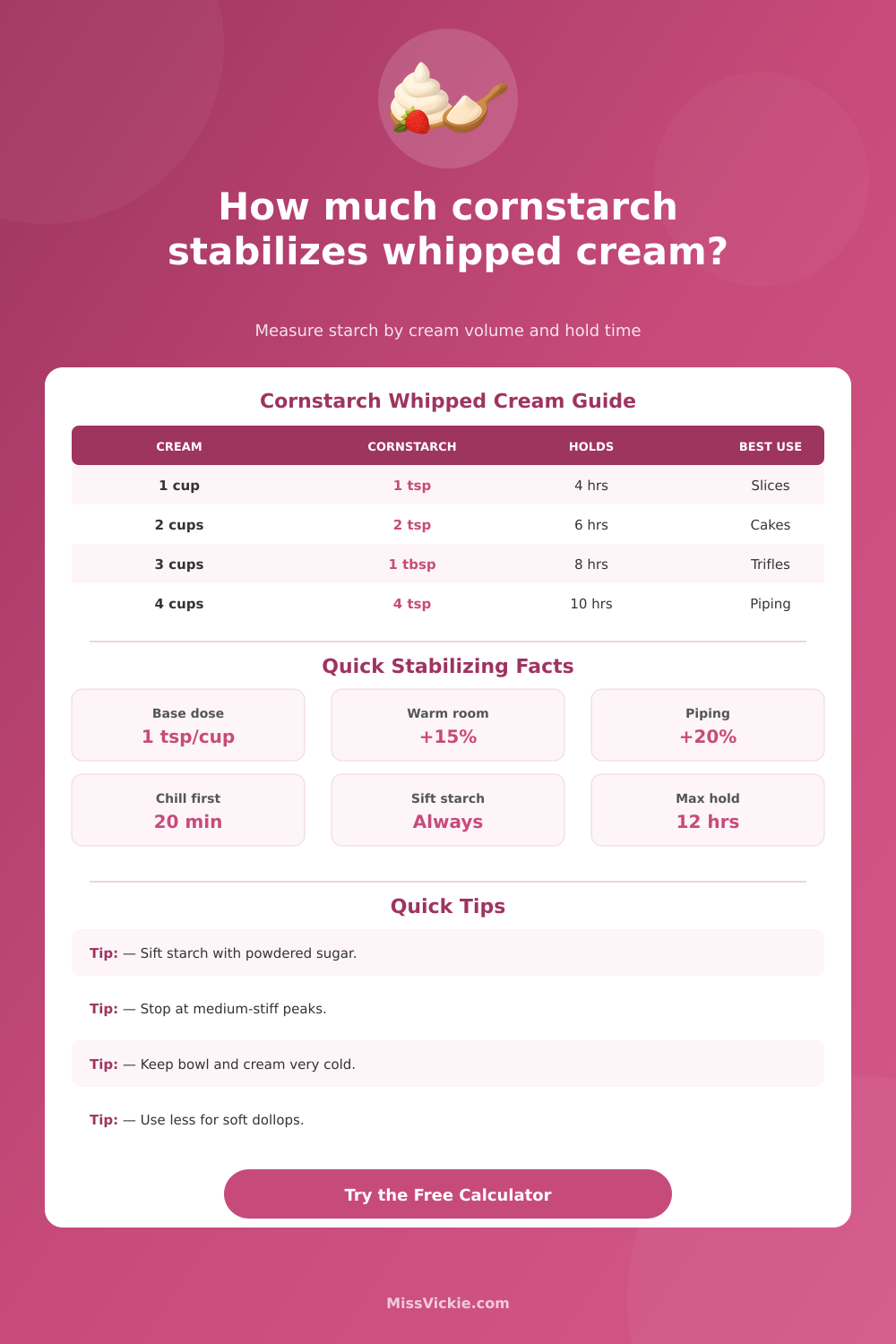
| Cream Volume | Soft Dollops | Cake Filling | Piped Topping |
|---|---|---|---|
| 1 cup / 240 ml | 3/4 tsp cornstarch | 1 tsp cornstarch | 1 1/4 tsp cornstarch |
| 2 cups / 480 ml | 1 1/2 tsp cornstarch | 2 tsp cornstarch | 2 1/2 tsp cornstarch |
| 3 cups / 720 ml | 2 1/4 tsp cornstarch | 1 tbsp cornstarch | 1 tbsp plus 3/4 tsp |
| 4 cups / 960 ml | 1 tbsp cornstarch | 4 tsp cornstarch | 5 tsp cornstarch |
| 6 cups / 1.4 L | 1 1/2 tbsp cornstarch | 2 tbsp cornstarch | 2 1/2 tbsp cornstarch |
| Serving Plan | Typical Hold | Cornstarch Adjustment | Texture Note |
|---|---|---|---|
| Serve immediately | 0 to 2 hours chilled | Use 70% to 85% of base | Softest mouthfeel and easiest spooning |
| Dinner dessert | 3 to 6 hours chilled | Use the base ratio | Good for pies, berries, and shortcakes |
| Make-ahead cake | 6 to 10 hours chilled | Add 10% to 20% | Better slice support between cake layers |
| Buffet display | 10 to 12 hours chilled | Add 20% to 35% | Best with colder storage and covered trays |
| Warm-room service | Short display plus chilling | Add 15% to 30% | Chill before and after decorating when possible |
| Cream or Room Condition | Stability Effect | Calculator Factor | Best Practice |
|---|---|---|---|
| 30% light whipping cream | Less fat means weaker foam | Add about 15% | Whip cold and avoid long display |
| 35% whipping cream | Moderate structure | Add about 5% | Works for dollops and simple spreads |
| 36% heavy cream | Standard reliable foam | Base amount | Good all-purpose choice |
| 40% double-style cream | Richer and more stable | Reduce about 8% | Watch closely to avoid over-whipping |
| Room above 75 F / 24 C | Softens faster | Add 10% to 25% | Use chilled bowl, whisk, and cream |
| Measure | Approx Weight | Whipped Cream Role | When to Use |
|---|---|---|---|
| 1 tsp cornstarch | About 2.7 g | Stabilizes 1 cup cream at base ratio | Sift before mixing to prevent specks |
| 1 tbsp cornstarch | About 8 g | Stabilizes about 3 cups cream | Useful for larger cake batches |
| 1 tbsp powdered sugar | About 7.5 g | Light sweetness and a little structure | Add with cornstarch before whipping |
| 1 cup heavy cream | About 240 ml / 238 g | Whips to roughly 2 cups | Serves 6 to 8 as small dollops |
| 1 cup whipped cream | About 120 ml liquid cream used | Finished topping volume | Plan piping coverage or layer depth |
Easy pantry option; best sifted with powdered sugar for short to medium chilled holds.
Firmer set for hot weather, long transport, or tall piped decorations.
Adds sweetness and flavor; useful when a thicker dessert-style cream is wanted.
Rich and smooth, with stronger body for fillings and layered desserts.
Whipped cream often has the tendencies to lose it’s shape and collapse. Additionally, whipped cream can turn into liquid puddle if whipped cream are not stabilized properly. One way to prevent whipped cream from collapsing is to add a measured amount of cornstarch to the whipped cream.
Cornstarch is able to stabilize whipped cream due to its ability to absorb excess liquid and to provide extra structure for the fats contained within the whipped cream to cling to. If too little cornstarch are added, the whipped cream will not be able to prevent it from softening. However, if too much cornstarch is added, the texture of the whipped cream will begin to feel pastily.
How Much Cornstarch to Add to Whipped Cream
The volumes of the batch of whipped cream that is to be prepared is another important factor in the amount of cornstarch that are required. The larger the batch of whipped cream that you prepare, the more cornstarch that will be required to stabilize the cream. This is due to the fact that the larger batches contains more air, and the more air that is contained within the whipped cream, the more likely that it will begin to break down once removed from the refrigerator.
Additionally, the fat percentage of the cream will change the amount of cornstarch that is required to stabilize the whipped cream. Cream that contains 35% fat will require more cornstarch to stabilize than cream that contains 40% fat, as the cream with 40% fat contains more fats that will assist in providing structure to the whipped cream. The temperature of the room in which the cream is to be prepared will also affect the stability of the whipped cream.
Whipped cream that is prepared in a warm room will break down at a faster rate then whipped cream prepared in a cool room. Thus, if the room in which the whipped cream is to be prepared is warm, the recipe will require more cornstarch to stabilize the cream. Additionally, the hold time of the whipped cream is another important factor in the amount of cornstarch that must be added.
If the whipped cream is to last for a longer period of time, more cornstarch will be required. For instance, if the whipped cream is to be used in a dessert that is to be transported or for an event that lasts for a long period of time, the amount of cornstarch will need to be increased. However, if the whipped cream is to be eaten immediately, less cornstarch will be required.
The ingredients that are added to the whipped cream will also change the amount of cornstarch that is required. Ingredients like powdered sugar will help to stabilize the whipped cream due to the crystals that will dissolve into the liquid ingredient. However, ingredients like cocoa powder and fruit puree will add moisture to the whipped cream.
Therefore, more cornstarch will be required if these ingredient are used in the whipped cream recipe. Vanilla extract will not require as much extra cornstarch as ingredients like citrus zest or espresso that also contains extra liquid that will be added to the whipped cream. The method in which the cream is whipped will also impact the amount of cornstarch that is required.
Whipping the cream with a hand mixer will incorporate less air than a stand mixer. Thus, more cornstarch will be required if the whipped cream is to be hand-whipped as opposed to whipped with a stand mixer. Additionally, depending on the texture to which the whipped cream will be whipped, the amount of cornstarch will change.
Whipped cream that is whipped to soft peaks will require less cornstarch than whipped cream that is whipped to stiff peaks, which are often whipped to allow whipping of borders on desserts. Many people makes mistakes in the addition of cornstarch to whipped cream. One mistake is to add cornstarch directly from the box to the whipped cream.
This can result in the whipping of whipped cream that contains white specks of cornstarch. Instead, the cornstarch should be sifted with the powdered sugar. Additionally, another mistake that people often make when preparing whipped cream is over-whipping the whipped cream after the addition of cornstarch.
Over-whipping will break the fat globules in the cream, which will release the liquid from the cream. This will defeat the purpose of the addition of cornstarch. In order to make whipped cream that contains cornstarch, it is also important to control the temperature at which the whipping occurs.
The cream, the bowl, and the whisk should all be cold in order to make smaller air bubbles within the whipped cream. Smaller air bubbles will help the whipped cream to maintain its shape for longer periods of time. Additionally, after whipping the cream, it is important to chill the whipped cream for twenty minutes to allow the cornstarch to hydrate.
Finally, different desserts will require different amounts of cornstarch. For instance, a pie that is to be eaten quickly will require less cornstarch than a layer cake that will be set out for many hours. Trifle layers will also require cornstarch to assist in the keeping of the layers distinct from one another.
However, the amount of cornstarch should not be so much that the whipped cream begins to feel unpleasant when eaten. The amount of cornstarch that will be added will be the minimum amount required for the amount of stability that is required for that specific dessert.