Whipped cream cake frosting, filling, piping, stabilizer, and reserve
How Much Whipped Cream To Frost A Cake?
Calculate finished whipped cream for round, square, sheet, tiered, and cupcake cakes by surface area, layers, filling, crumb coat, piping, stabilizer, sweetness, and extra reserve.
Choose a real cake setup, then adjust cake size, finish thickness, filling, piping, stabilizer, and recipe yield.
Whipped Cream Cake Breakdown
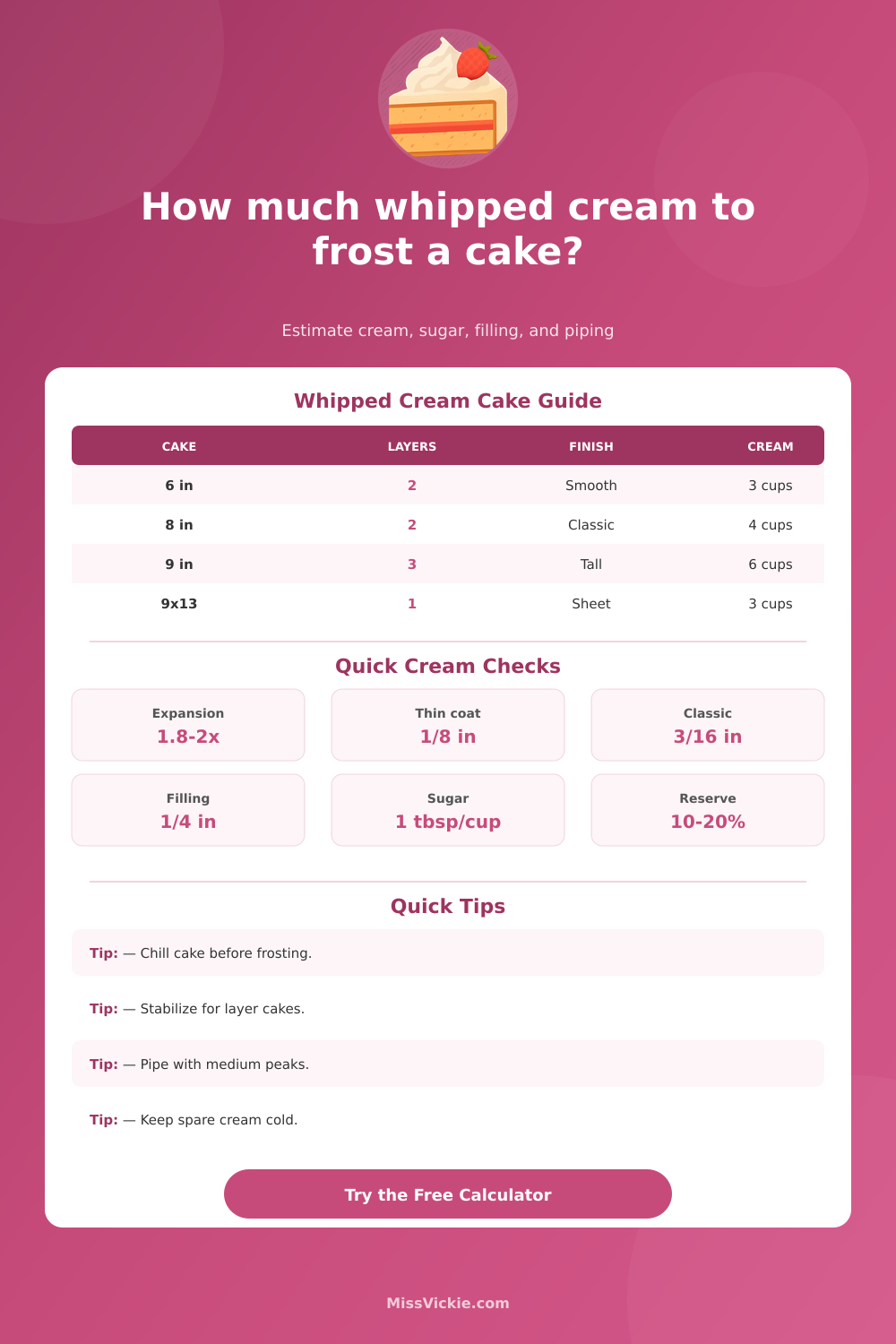
| Cake size | Classic smooth finish | With filling | With piping buffer |
|---|---|---|---|
| 6 inch round, 2 layers | 2.5 to 3 cups finished cream | 3 to 3.5 cups | 3.5 to 4 cups |
| 8 inch round, 2 layers | 3.5 to 4 cups finished cream | 4 to 4.75 cups | 5 to 5.5 cups |
| 9 inch round, 3 layers | 5 to 6 cups finished cream | 6 to 7 cups | 7 to 8 cups |
| 10 inch round, 2 layers | 6 to 7 cups finished cream | 7 to 8 cups | 8 to 9 cups |
| 9x13 sheet cake | 2.5 to 3.5 cups finished cream | Not usually filled | 4 to 5 cups |
| 12x18 half sheet | 6 to 7 cups finished cream | Not usually filled | 8 to 10 cups |
| Whipped cream style | Expansion | Weight per cup | Best cake use |
|---|---|---|---|
| Plain sweetened whipped cream | About 2.0x | 160 g per cup | Same-day cakes and simple toppings |
| Gelatin stabilized whipped cream | About 1.8x | 175 g per cup | Layer cakes, piping, and chilled holding |
| Mascarpone whipped cream | About 1.6x | 205 g per cup | Tall filling and firmer sliced cakes |
| Cream cheese whipped cream | About 1.55x | 215 g per cup | Fruit cakes and tangy fillings |
| Pudding stabilized cream | About 1.65x | 200 g per cup | Quick sturdy party cakes |
| Coconut whipped cream | About 1.45x | 190 g per cup | Dairy-free style cakes |
| Finish detail | Typical thickness | Calculator setting | Planning note |
|---|---|---|---|
| Very thin skim coat | About 1/12 inch | Very thin skim coat | Best when cake will show through. |
| Semi-naked side coat | About 1/8 inch | Semi-naked light coat | Use chilled cake layers and a scraper. |
| Classic smooth coat | About 3/16 inch | Smooth classic coat | The default for birthday and sponge cakes. |
| Soft swirl coat | About 1/4 inch | Generous soft swirls | Spatula ridges use more cream than flat sides. |
| Bakery cream coat | Over 1/4 inch | Thick bakery cream coat | Add reserve because whipped cream compresses. |
| Base cream before whipping | Finished cream | Classic sugar | Gelatin option |
|---|---|---|---|
| 1 cup / 240 ml heavy cream | About 2 cups plain or 1.8 cups stabilized | 1 tablespoon sugar | About 1/4 teaspoon gelatin |
| 2 cups / 475 ml heavy cream | About 4 cups plain or 3.6 cups stabilized | 2 tablespoons sugar | About 1/2 teaspoon gelatin |
| 1 quart / 950 ml heavy cream | About 8 cups plain or 7.2 cups stabilized | 1/4 cup sugar | About 1 teaspoon gelatin |
| 1 liter heavy cream | About 8.4 cups plain or 7.6 cups stabilized | 60 ml sugar | About 3.5 g gelatin |
Thin side coverage keeps the cake visible and lowers the finished cream amount.
A balanced coat for most chilled sponge, chiffon, and berry layer cakes.
Spatula ridges and generous sides need more volume than flat smoothing.
Rosettes, tall borders, and cupcake-style swirls need the biggest cold reserve.
When you are decorating a cake with whipped cream, it is necesary to determine the amount of whipped cream that are required to complete the task. The correct amount of whipped cream to use will ensure that the cake is both fully covered with whipped cream and that the cake itself remain stable. The amount of whipped cream that is required to cover a cake can depend on several different factors, such as the amount of surface area of the cake, the thickness of the whipped cream layer, the amount of filling layers the cake will have, and the stability of the whipped cream itself.
Should you not determine the correct amount of whipped cream, you may either find that you are out of whipped cream before you have finished your cake, or you may find that you have created a large amount of waste whipped cream. The first of the factors to consider is the surface area of the cake. Cakes can have either a rounded design (such as a birthday cake) or they can be sheet cakes, which have a flat design to there cakes.
How Much Whipped Cream to Use on a Cake
Each of these designs will have different amounts of surface area. The amount of surface area will allow you to determine the thickness of the layer of whipped cream that the cook will use to coat the cake; the thicker the layer of whipped cream, the more whipped cream will be required. Additionally, the larger the size of the cake, the greater the difference in the amount of whipped cream that will be required for thin versus thick layers of whipped cream.
The number of filling layer that the cake will contain will also impact the amount of whipped cream that is required for that cake. Filling layers are the layers of whipped cream that is used to fill the cakes; these layers will require some of the whipped cream that are to be used on the cake. For instance, three layer cake will have two filling layers of whipped cream; these two layers will require some of the total amount of whipped cream the baker must prepare.
Another of the factors that will impact the amount of whipped cream that should be used on the cake is the stability of the whipped cream. Plain whipped cream is typicaly not as stable as whipped cream that contain ingredients that will help to stabilize the whipped cream, such as gelatin or mascarpone. Additionally, whipped creams that are stabilized may also be heavier than plain whipped cream.
Due to these factors, some extra whipping cream may be required to account for the potential for some of the whipped cream to be lost to the cake or to become improperly pipe when applied to the cake. Another of the factors that will impact the amount of whipped cream that is needed for the cake is the temperature of the cake. Whipped cream tends to spread more evenly on cakes that is chilled.
Should the cake be warm, the warm cake will absorb some of the whipped cream that is added to the cake crumbs. Additionally, if the cake is too warm, the whipped cream will leave some streaks on the cakes structure. Finally, if the cake is too warm, the whipped cream will weep on the cake if the cake is left in a warm environment.
Another of the factors that will impact the amount of whipped cream that is used on the cake is the amount of sugar that is contained within the whipped cream recipe. Sugar will help to stabilize the whipped cream; however, too much sugar can make the whipped cream too heavy to be used on a cake, and will make it more difficult to pipe the whipped cream to create desired decorations on the cake. Most recipes will contain a specific amount of sugar per cup of cream that will be used to make the whipped cream.
Additionally, if decorative borders are to be piped along the cake, the whipped cream may be slightly sweetening to help the whipped cream retain its sharp edges. To avoid some of the common mistakes made in the application of whipped cream, follow some of the procedures regarding whipped cream. First, never treat whipped cream as if it is buttercream; buttercream can be added again if it isnt distributed evenly on the cake, but whipped cream can make it difficult to add it again if it begins to collapse.
Second, ensure that the tools used to pipe the whipped cream are cold, as well as the ingredient for the whipped cream. Third, do not whip the whipped cream until it reaches stiff peaks; medium peaks will be sufficient for most cakes. Finally, ensure that there is a small bowl of whipped cream that is refrigerated so that some extra whipped cream can be used in case some of the whipped cream is lost during the decorating process.