Wet Cure Bacon Calculator
Scale a pork belly wet cure by belly weight, water volume, brine percent, Cure #1 ppm, equilibrium or cover brine method, injection percent, cure days, rinse, pellicle drying, and smoke yield.
Choose a wet-cure scenario, then tune the pork belly, water, Cure #1 target, injection, curing time, pellicle, and smoke finish.
Wet Cure Breakdown
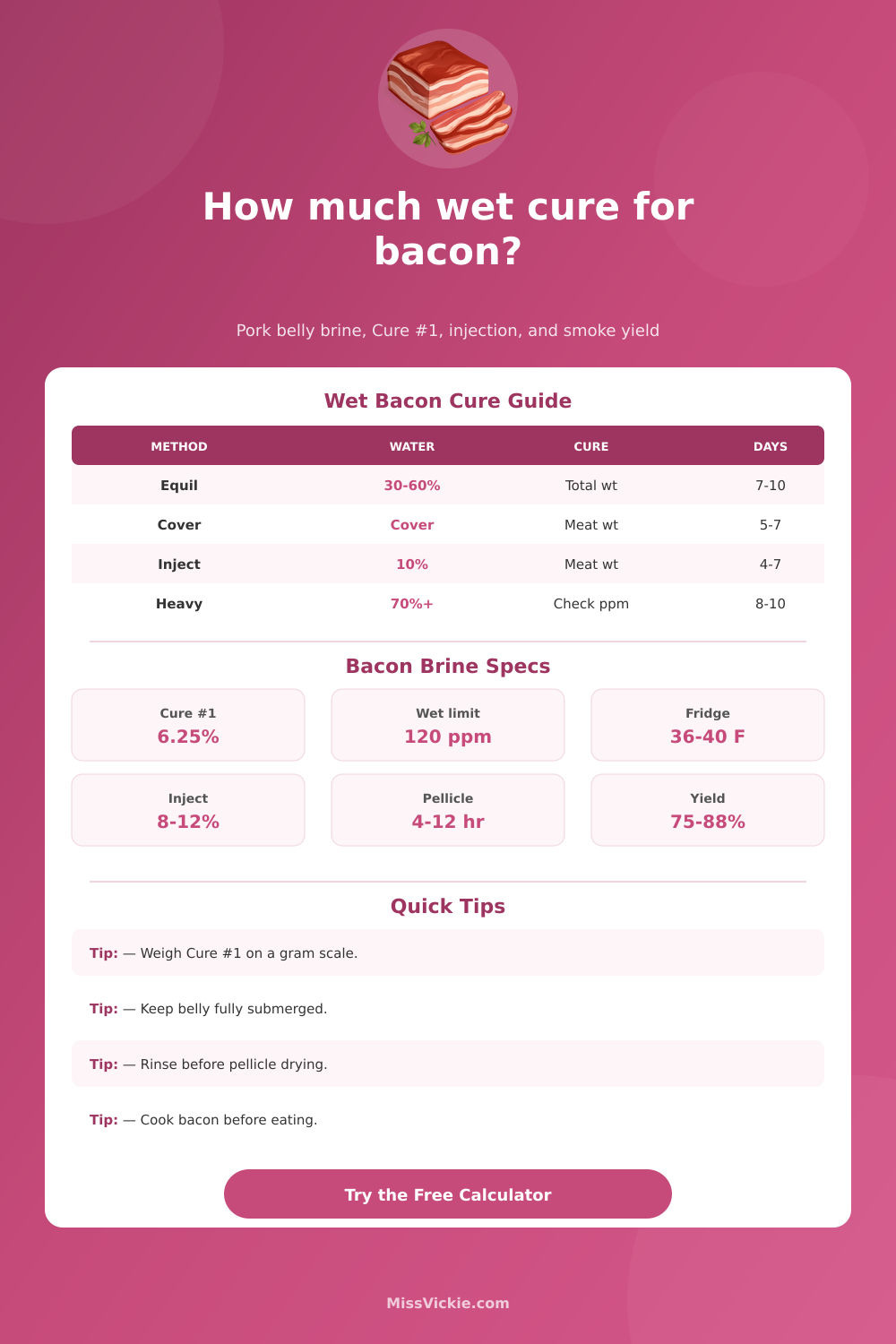
| Wet Cure Method | Best Use | Brine Percent Basis | Cure #1 PPM Check | Process Note |
|---|---|---|---|---|
| Equilibrium wet brine | Precise home batches in a bag or tight container | Belly plus water mass | Calculator also shows green-weight ppm | Needs enough time for salt and nitrite to equalize. |
| Cover brine | Loose container where the slab must stay submerged | Water mass | Cure #1 is checked against belly weight | Use a weight or bag to keep the belly under brine. |
| Injection plus cover | Thick slabs or faster, more even uptake | Water mass, with pump volume reserved | Cure #1 is checked against belly weight | Inject evenly, then immerse and hold cold. |
| Rind-on wet cure | Traditional slabs with skin attached | Depends on method | Use skin-free green weight for ppm planning | May need extra days because the rind slows uptake. |
| Finish | After Cure | Pellicle Drying | Expected Yield | Kitchen Check |
|---|---|---|---|---|
| Cold smoked bacon | Rinse, pat dry, taste-test a fried end if desired | 8 to 24 hours refrigerated or with cool airflow | 82% to 90% | Still needs cooking before serving. |
| Warm smoked bacon | Rinse, dry on rack, smoke gently | 6 to 12 hours | 78% to 86% | Good balance of smoke color and slice yield. |
| Hot smoked slab | Rinse, dry, then smoke to a cooked slab texture | 4 to 8 hours | 72% to 82% | More cook loss, easier slicing after chilling. |
| No smoke, green bacon | Rinse or soak, dry well, chill before slicing | 2 to 6 hours | 86% to 94% | Flavor is milder and more ham-like. |
| Belly or Brine Situation | Salt Direction | Water Direction | Cure Days | Watch Point |
|---|---|---|---|---|
| Thin skinless belly, tight bag | 2.0% to 2.5% equilibrium | 30% to 45% of belly weight | 5 to 7 days | Turn daily so both faces contact brine. |
| Standard 1.5 to 2 inch slab | 2.25% to 3.0% depending on method | Enough to coat or cover | 7 to 10 days | Slice a test end and fry after curing. |
| Thick or uneven belly | Do not raise Cure #1 to rush | Consider 8% to 12% injection | 9 to 14 days | Give thick spots time rather than more cure. |
| High-salt cover brine | Use soak if too salty | Use a weight to submerge | 5 to 7 days | Long soaking can pull out flavor too. |
Here’s the thing about making your own bacon: How much curing salt? How much water? And how much salt should goes onto all that pork belly sitting in your refrigerator? The answer is that the ratio makes all the difference between good bacon and bacon that’s so salty it tastes more like ham, or one that isn’t salty enough at all. Fortunately, there’s a wet cure bacon calculator to help with this math. It turns the changing factors (the amount of water and weight of belly) into real numbers rather than ballpark guesses.
Not all pork belly are the same. The makeup and size of pork belly varies. Some will be thicker; some will have more lean versus fat; some will have skin and others won’t. These factor affect the rate at which salt and nitrites penetrates the meat. Since the cure must pass through a barrier like the skin, a thick slab with rind on one side will take longer to finish curing than a thin cut without skin in a sealed plastic bag. The calculator allows you to note these variations so the calculated cure time represents your specific cut instead of an arbitrary average. If it doesn’t, you’ll either over-salt the outer layer or under-cure the middle. It is not worth waiting several weeks for that.
Why You Should Use a Bacon Calculator
Dry rubbing can lack precision compared to wet curing, which delivers the cure even over the whole piece after it’s injected or at least soaked in the cure solution. So how do you know if the salt percentage applies to the water alone or to the meat plus water together? It matters: Two approaches yield different final percentages and the calculator figures out the math for whichever approach you take. The same applies to injection. If you want to speed things up (on thick pieces), throw a measured pump or so of brine in there as well; just factor that additional water volume into your overall nitrite amount calculation.
Next is rinsing, which washes away any surface salt that might overpower the taste. Then there’s drying on a rack, which produces the tacky skin that enables the smoke to cling to the meat rather than slipping right off. Finally, smoking at the proper temperature determines how quickly the slab lose its moisture and becomes done. Every step reduces the total by a small amount, and the resulting yield won’t match your original green weight. To help you understand how much sliced bacon you’ll get, the calculator accounts for this shrinkage. It provides an estimate of roughly how many pounds of bacon will result from a five-pound belly.
Safety sits behind every number. You have a legal limit on nitrites in your bacon. There’s also a requirement that your fridge be cold enough to slow bacteria growth during the curing period, and so on. Keeping these numbers in sight prevents you from accidentally going over a limit if you change water amounts or batch sizes. It also reminds you that you still need to cook the finished item before eating it.
When you take the exact same belly and put it into the calculator again with two different cure times or two different water ratios, that’s where the money realy starts to show up. You begin to realize what are the variables that truly make a difference and what are the variables that is just busy work. Then after seeing that pattern, the next batch isn’t a guessing game anymore; it’s repeatable and adjustable based off what you plan to do rather than just hoping for the best.