MissVickie kitchen calculator
Wet Brine Calculator
Plan a chilled wet brine by food weight, container size, water coverage, salt strength, sugar level, and brining time. The calculator weighs the liquid, sizes the salt and sugar, checks coverage, and estimates sodium added per serving.
●Start with a brining preset
Choose a real kitchen scenario, then adjust the food weight, salt strength, water coverage, sugar, chilling plan, and serving size.
●Build the brine
Imperial uses pounds, quarts, and teaspoons. Metric uses kilograms, liters, and grams.
Sets suggested coverage, time, serving size, and salt uptake.
Traditional brines size salt from water weight. Equilibrium includes food weight.
Enter pounds of food.
Smaller pieces brine faster than one thick roast.
Percent by brine water weight unless equilibrium is selected.
Sugar is optional for browning and roundness, not food safety.
Quarts of brine per pound of food.
Adds extra liquid for floating, odd shapes, or evaporation while cooling.
Total container size in quarts.
Leave headspace so the food can be moved without spilling.
Hours in the refrigerator, not time cooling on the counter.
Degrees F when food is added. Keep cold.
Ounces per serving after brining or cooking.
Volume conversions are approximate; weight is the reliable measure.
Adds a small water displacement allowance for herbs, garlic, spices, or ice.
Your wet brine plan
Salt, sugar, liquid, timing, coverage, and serving math will appear here.
Full calculation breakdown
Fit and safety checks
●Calculated ingredients at a glance
●Reference tables
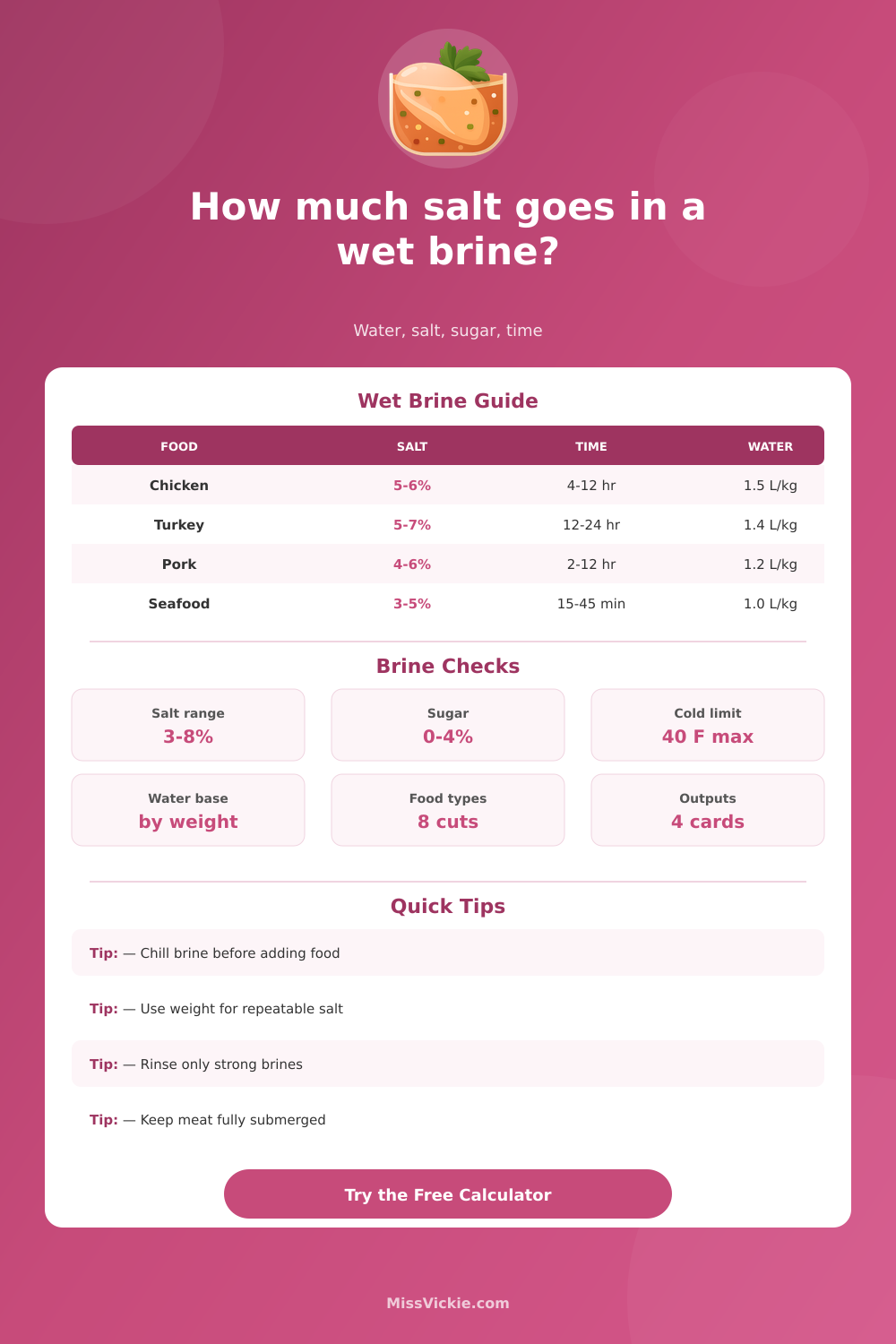
Typical wet brine ranges
| Food | Salt % | Time | Notes |
|---|---|---|---|
| Chicken pieces | 5 to 6% | 2 to 8 hr | Works well for thighs, drumsticks, wings, and split breasts. |
| Whole chicken | 5 to 6% | 8 to 12 hr | Use a deep container and keep fully submerged. |
| Turkey breast | 5 to 7% | 12 to 24 hr | Large, lean cuts benefit from a moderate sugar level. |
| Pork chops | 4 to 6% | 1 to 6 hr | Thin chops need less time than thick bone-in chops. |
| Seafood | 3 to 5% | 15 to 45 min | Short brines firm texture quickly; avoid overnight seafood brines. |
| Tofu | 3 to 5% | 20 to 60 min | Press first so the brine can season the interior. |
Water coverage guide
| Shape | Qt per lb | L per kg | Best use |
|---|---|---|---|
| Flat fillets | 0.45 to 0.55 | 0.94 to 1.15 | Shallow seafood, tofu, and cutlets. |
| Loose pieces | 0.55 to 0.75 | 1.15 to 1.57 | Chicken parts, pork chops, shrimp. |
| Compact roasts | 0.50 to 0.65 | 1.04 to 1.36 | Pork loin, turkey breast, boneless roasts. |
| Whole poultry | 0.60 to 0.80 | 1.25 to 1.67 | Whole chickens and small turkeys. |
| Pickling jars | 0.35 to 0.50 | 0.73 to 1.04 | Cucumbers, onions, carrots, or radishes. |
Salt volume conversions
| Salt type | 1 tbsp | 1 tsp | Calculator use |
|---|---|---|---|
| Fine table salt | 18 g | 6 g | Dense and salty by spoon; weigh when possible. |
| Morton kosher | 15 g | 5 g | Moderately dense kosher crystals. |
| Diamond Crystal kosher | 9 g | 3 g | Large flakes; much lighter by volume. |
| Fine sea salt | 17 g | 5.7 g | Close to table salt for spoon math. |
| Coarse sea salt | 13 g | 4.3 g | Varies widely by brand and crystal shape. |
Serving and nutrition reference
| Food | Serving | Calories | Protein |
|---|---|---|---|
| Chicken pieces | 6 oz | 270 | 42 g |
| Turkey breast | 6 oz | 220 | 46 g |
| Pork chops | 5 oz | 250 | 35 g |
| Salmon fillet | 5 oz | 290 | 32 g |
| Shrimp | 4 oz | 110 | 24 g |
| Pressed tofu | 5 oz | 150 | 16 g |
●Brine style comparison
●Nutrition estimate from this brine
The sodium estimate uses salt weight, sodium content of salt, food-specific uptake, contact time, and estimated servings. It is a planning estimate, not a lab-tested nutrition label.
●Wet brine tips
An wet brine is a type of liquid that you use to season your food. To prepare a wet brine, dissolve salts and sometimes sugar in water. Before adding the food to the wet brine, you must chill the wet brine.
You will have to place the food into the wet brine for a specific length of time. When you place the food into the wet brine, the salt will move into the food, the water will move into the food, and the food will become juicier and more even seasoned with salt and water. The percentage of salt within the wet brine is a critical setting for the brining process because the salt percentage will determine the flavor and texture of the food after brining.
How to Make and Use a Wet Brine
Using a low percentage of salt, such as three or four percent, will allow the salt to penetrate the food quick. This is suitable for foods like delicate seafood. Using a high percentage of salt, such as six or seven percent, will allow the salt to take more time to reach the center of the food.
This is suitable for larger cut of poultry or pork. Using gram to measure the salt ensures that the measurement is repeatable. Using spoons to measure the salt isnt a repeatable process because the size of the salt crystals can vary.
The coverage of the food in the wet brine is the amount of the liquid that will submerge the food. Using the wet brine, you must ensure that there is enough of the liquid to ensure that the food is covered in the liquid. If the food isnt covered in the wet brine, the portion of the food that is exposed to the air will not season correctly.
Using too much of the wet brine will require moving and chilling more of the liquid than necessary. The calculator allows for an extra margin for the coverage of the food in the wet brine because some of the food may float on the wet brine. The amount of time that the food will remain in the wet brine is referred to as the brining time.
The amount of time that the food will remain in the wet brine will depend on the size of the food, the strength of the salt, and the temperature of the wet brine. The smaller the food pieces and the salt concentration, the shorter the brining time will have to last. The thicker the food roasts and the lower the salt concentration, the longer the brining time will have to last.
You must maintain the temperature of the wet brine at forty degrees Fahrenheit or below because the warmer the wet brine, the more bacteria will grows within the brine. This factor is critical to both food safety and the effectiveness of the brine. Sugar is an ingredient that you can add to the wet brine.
The sugar will help the skin of the poultry to crisp when cooked. Sugar also balances the salt on the tongue. Adding too much sugar to the wet brine can result in the food having a sticky surface and too sweet a flavor.
Setting the amount of sugar to zero in the calculator indicates that the recipe will not use sugar. This setting is useful for recipes that will be completed with a sharp or bright sauce. The fit of the container is the ability of the container to hold both the food and the wet brine at the same time.
The container must be large enough for both the food and the wet brine. Using the calculator, you can compare the volume of the food and the wet brine with the volume of the container. The calculator will tell you if the container is large enough.
It is important to ensure that the container is large enough because the food will poke above the surface of the wet brine if the container is too small. Different food will absorb salt at different rates. The calculator allows for the preparation of different types of food to be preset in the calculator.
For instance, chicken will have a higher concentration of salt than salmon because the pieces of fish is thicker. Cucumbers will have a longer brining time because the cells of the cucumber are more dense than the other types of food that can be brined. The brining time is a critical measurement in the preparation of the food.
For short brining times, adding a few hours to the preparation time will create acceptable texture in the food. For long brining times, adding a few hours to the prep time may lead to spongy food. Using the brining time window that is indicated in the calculator is the best way to prepare the food.
Use a lower percentage of salt if you will be away from the food for a long time. You should not place the food into the wet brine if the wet brine has not been fully chilled. Placing food into a warm liquid is not a safe cooking process.
Salt easily dissolve in warm water. If you are using warm water, you must chill the water and salt mixture before you add the food. Dissolving the salt and sugar in a portion of the water will allow for the even distribution of salt and sugar to the food.
Chill this mixture and add the remainder of the water and ice to the salt and sugar mixture before adding the food to the brine. The calculator will estimate the sodium content of the food per serving. This estimation of the sodium content is dependent upon the salt uptake, the contact time between the food and the wet brine, and the portion size.
This estimate is not exact but provides an idea of the amount of sodium the food will contain. This is helpful for individuals who must limit their sodium intake. By running the calculations before the brining process, you can remove the guesswork in the preparation.
The calculator will provide you with measurements of the salt, sugar, water, coverage, and brining time. By using the calculator, you can focus on keeping the wet brine cold and the food submerged in the liquid. It’s actualy alot of work but youll see it’s worth it.