Water to Pasta Ratio Calculator
Calculate pasta water volume, salting weight, pot fill depth, boil-over headspace, starch concentration, and cooking-style adjustments for dry pasta.
🍝 Pasta Water Presets
Choose a starting point, then adjust the dry weight, shape, pot diameter, headspace, salt target, starch goal, and sauce finish.
⚖ Pasta and Pot Details
Pasta water plan
Enter pasta and pot details to calculate the recommended water ratio.
Ratio Breakdown
Pot and Boil-Over Check
- Bring water to a full boil before adding salt.
- Stir during the first 90 seconds to prevent sticking.
📏 Shape Water Needs
📊 Pasta Water Reference Tables
| Pasta Shape | Classic Water | Low-Water Range | Sticking Risk | Best Cooking Style |
|---|---|---|---|---|
| Spaghetti, linguine, bucatini | 4 to 5 qt per lb | 2.5 to 3 qt per lb | Medium; stir strands early | Classic boil or sauce finish after 2 minutes under al dente |
| Fettuccine or tagliatelle nests | 4.5 to 5 qt per lb | 3 to 3.5 qt per lb | High; ribbons cling | Roomy pot for cream sauces, frequent early stirring |
| Penne, ziti, rigatoni, fusilli | 3.5 to 4 qt per lb | 2 to 2.75 qt per lb | Low to medium | Low-water method works well when stirred |
| Macaroni, ditalini, or orzo | 3 to 3.5 qt per lb | 1.75 to 2.5 qt per lb | Medium; small pasta foams | Watch boil-over and stir from the bottom |
| Lasagna sheets or wide ribbons | 5 to 6 qt per lb | Not ideal | High; flat sheets overlap | Wide pot, separate sheets, gentle boil |
| Dry Pasta | Classic Water | Low Water | Salt at 1.5% | Reserve for Sauce |
|---|---|---|---|---|
| 8 oz / 225 g | 2 to 2.5 qt / 1.9 to 2.4 L | 1 to 1.5 qt / 0.9 to 1.4 L | 28 to 36 g salt | 1/4 to 1/2 cup |
| 12 oz / 340 g | 3 to 3.75 qt / 2.8 to 3.5 L | 1.5 to 2.25 qt / 1.4 to 2.1 L | 43 to 53 g salt | 1/3 to 3/4 cup |
| 16 oz / 454 g | 4 to 5 qt / 3.8 to 4.7 L | 2 to 3 qt / 1.9 to 2.8 L | 57 to 71 g salt | 1/2 to 1 cup |
| 32 oz / 907 g | 8 to 10 qt / 7.6 to 9.5 L | 4 to 6 qt / 3.8 to 5.7 L | 114 to 142 g salt | 1 to 2 cups |
🧂 Salt, Starch, and Pot Fit
Good for salty sauces, cheese-heavy dishes, or sodium-conscious cooking.
Restaurant-style seasoning for most dried pasta when the sauce is not salty.
Useful for pan sauces where pasta water helps bind fat and cheese.
Leave room for foaming, stirring, and the pasta volume entering the pot.
💡 Pasta Water Notes
Salt estimates use water weight, with 1 quart treated as about 946 grams and 1 liter as about 1000 grams. Kosher tablespoon estimates are approximate because crystal size varies by brand.
The home cook instinctively knows this: Most of us want to use as little water as we can get away with. A single meal shouldn’t require gallons of it! Why be wasteful? So if it’s just enough to cover those noodles, scrape away at the bottom of pot until you’re done. Guess what happens next? You end up with gummy, mushy clumps, barely resembling real pasta, with only one flavor: straight-up starch.
See, though, water isn’t just something that heats stuff. Water is also how the texture, structure, and even salinity of your dinner are formed. When you finally get the ratio down, it no longer becomes an issue of waste; it becomes one of physics.
How to Cook Perfect Pasta
What it does: Plug in the weight of the pasta (and the pot size) and the calculator do the rest, no more guesswork about exactly how much headspace you actualy need. Because that’s where people go wrong: they focus on volume of water but ignore geometry of the pot. Spaghetti doesn’t want to just sit there; it needs horizontal space so its strands can move around and prevent tangling, a.k.a. Steaming instead of boiling. Steaming ruins dish.
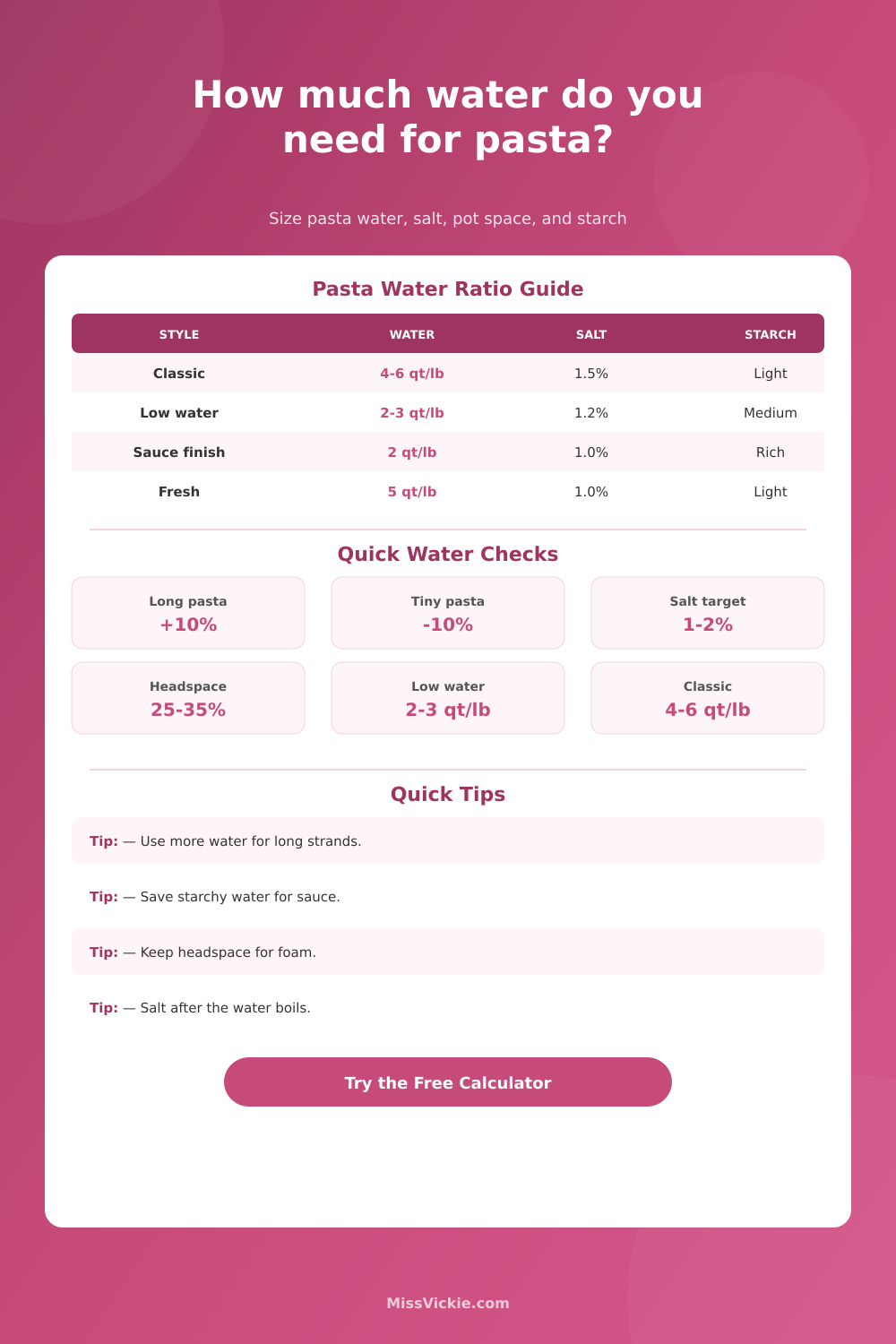
Salt is another consideration. When using less water, you need more salt to season the final product to the same degree. And the salt won’t dissolve right away like some kind of magic spell on your pasta. Instead it must penetrate outer layer of dough while the proteins is still setting. A common restaurant goal is one and a half percent salt by weight of water. Sounds specific, right? In reality, that translates to “taste your water before adding the noodles.” It should taste like the sea. It is not as salty than the ocean, but it is darn close. Bland-flour-tasting soupwater = bland-flour-tasting noodlewater.
There’s also the matter of starch. Most moddern methods recommend using a low-water approach, using only as much water as necessary to cook the pasta through, then quickly adding sauce back into pan to finish. What happens here is that all this starchy water sticks together with cheese and fat, and makes a very creamy emulsion. It’s a great trick, but it takes constant attention; you can’t step away while boiling on low water, and the water dissapears rapidly, leading to an even higher concentration of starch.” In a traditional aglio e olio, yes, you want all that creamy starchiness.
You might toss some leftover spaghetti with vinaigrette to make a pasta salad. Not so much. Firm, unfussy strands that won’t get slimy when dressed are what you need. The tool allows you to change the starch level and therefore know whether you’re aiming for one result or the other.
The size of your pot is important (not just for the reason I said above). You want to have roughly 30 percent empty space in the top of your pot. When pasta soaks up all that water, it get bigger. It also generates foam. And that foam consist of air and starch. The foam will rise. So when your pot’s full to the rim, that foam gets all over your stovetop and turns into a mess. If you use the low-water method, a large pot doesn’t require more water; it simply give you more space for your pasta. Having some breathing room helps the water circulate all around every noodle, so they cook evenly. Packed-in pots results in uneven textures due to hot/cold spots.
Then there’s gluten-free pasta, which changes everything. Gluten-free pastas is typically made of either corn or rice flours, both of which has a tendency to break down quickly. They also give off starch sooner than wheat-based pastas. Within minutes they’ve turned your water into glue. Typically you’ll want to use slightly more water and stir frequently so they stays separated.
On the opposite end of the spectrum is fresh egg pasta. Because it has a dried-out structure, unlike industrial pasta, it doesn’t release much starch as it cooks, and it cook in minutes. All you need for cooking it is just enough water to prevent clumping.
And finally, know your water: Know that it’s not just a source of heat. It is a medium used to control how things cook (heating up), how they season (flavor absorption), and how they feel (texture). Whether you’re boiling a cup of orzo for soup or a pound of rigatoni for a family meal, all of these principles apply. Control the space. Control the salt. Respect the starch. Get those three things right, and you don’t have just good-looking pasta; you’ve got something that tastes like it belongs. It didn’t waste the water. It worked.