Acidity, jar size, pack style, altitude, and tested recipe time
Water Bath Canning Times Calculator
Estimate boiling-water canner timing for high-acid and properly acidified foods, then flag low-acid foods that need a pressure canner instead of a guessed water-bath process.
Load a common USDA-style scenario, then adjust altitude, jar size, pack style, acidity choice, headspace, water cover, and the tested recipe time.
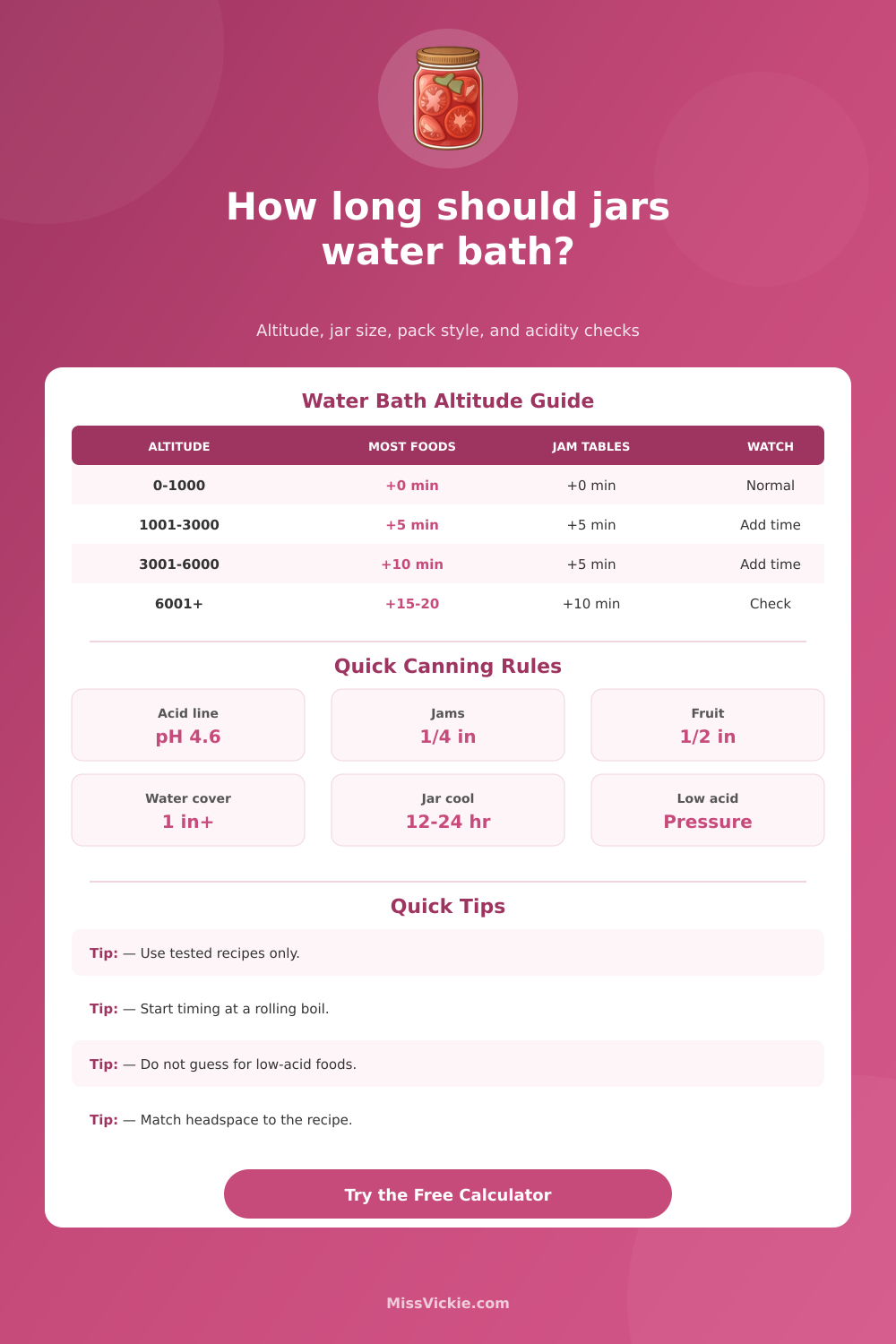
| Altitude Range | Most Boiling-Water Recipes | Jam/Jelly Tables | What It Means |
|---|---|---|---|
| 0 to 1,000 ft | Add 0 minutes | Add 0 minutes | Use the tested recipe time for your jar size and pack style. |
| 1,001 to 3,000 ft | Add 5 minutes | Add 5 minutes | Water boils cooler, so the process runs longer. |
| 3,001 to 6,000 ft | Add 10 minutes | Add 5 minutes | Some jam tables use broader altitude bands; follow the recipe table. |
| 6,001 to 8,000 ft | Add 15 minutes | Add 10 minutes | Check that the canner can maintain a steady boil. |
| 8,001 to 10,000 ft | Add 20 minutes | Add 10 minutes | Use tested high-altitude guidance for the product. |
| Recipe Type | Pack | Jar Size | Base Time at Low Altitude |
|---|---|---|---|
| Strawberry jam with pectin | Hot | Half-pint or pint | 5 minutes |
| Berry jam without pectin | Hot | Half-pint or pint | 5 minutes |
| Strawberry-kiwi jam | Hot | Half-pint or pint | 10 minutes |
| Peaches | Hot | Pint 20, quart 25 | Use hot-pack row |
| Peaches | Raw | Pint 25, quart 30 | Use raw-pack row |
| Applesauce | Hot | Pint 20, quart 25 | Use jar-size row |
| Tomato or Pickle Recipe | Pack | Jar Size | Base Time at Low Altitude |
|---|---|---|---|
| Crushed tomatoes, acidified | Hot | Pint 40, quart 45 | Acid is required |
| Standard tomato sauce, acidified | Hot | Pint 40, quart 45 | 1/4 inch headspace |
| Tomatillos packed in water | Hot | Pint 45, quart 50 | 1/2 inch headspace |
| Pickled mixed vegetables | Hot | Pint 5, quart 10 | Tested vinegar ratio |
| Pickled beets | Hot | Pint or quart 30 | 5 percent vinegar brine |
| Pickled dilled okra | Raw | Pint 10 | Pints only in this table |
| Food Acidity / Headspace | Typical Value | Water Bath Status | Calculator Response |
|---|---|---|---|
| Jams, jellies, fruit spreads | 1/4 inch | Allowed when tested | Uses jam altitude bands when listed. |
| Fruits and many tomatoes | 1/2 inch | Allowed when acid enough | Uses jar size, pack style, and altitude. |
| Tomatoes and figs | Recipe specific | Only after acidification | Flags missing lemon juice, citric acid, or vinegar. |
| Vegetables, meats, seafood, soups | Often 1 inch | Pressure canner required | Blocks water-bath timing for low-acid foods. |
There are many variable to consider before beginning the process of water bath canning. Each of these variables will impact the length of time that the water bath canning process must last. For instance, a batch of strawberry jam may cook for five minutes in a location that is near sea level, but at seven thousand feet in elevation, that same batch of jam may require more cooking time.
The boiling point of water decrease with increased altitudes. The calculator will provide a specific number of minutes that you should utilize for the canning process. This number represent the minimum amount of time that must pass for the jams or jellies to reach an internal temperature that will destroy the spoilage organism that may be present in those products.
What Affects Canning Time for Jams and Jellies
You must utilize this time calculated by the calculator; utilizing less time than the calculated amount will not allow for the products to be safe to eat. The acidity of the jams or jellies is another of the variable that must be considered prior to the canning process. Products that are high in acidity have a pH level of below 4.6.
Because botulism cannot grow in environments that are high in acidity, jams and jellies with a high acidity level are consider to be safe to prepare with the water bath canning method. Products that contain low acidity level, such as vegetables, beans, and tomato products, have a pH level of 4.6 or above, and are, therefore, not suitable for water bath canning methods. If you are preparing jams or jellies that contain tomatoes, it is important to ensure that the recipe also include lemon juice, citric acid, or vinegar to provide the acidity required for safety.
If the recipe for jams or jellies does not contain acid, there is no way to provide that acidity once the jams or jellies have been boiled; thus, the product will not be safe for water bath canning. In addition to the acidity level of the jams or jellies, the headspace that is prepared for each jar must also be considered prior to the canning process. The headspace is the amount of space that is left between the jam or jelly and the lid of the jar.
If the headspace is too small, the liquids may force themselves out of the jar during the boiling process; if the headspace is too large, the air that remains in the jar will prevent the jam or jelly from reaching the desired cooking temperature. You must measure the headspace prior to the canning process; it cant be corrected after the jams or jellies has begun to boil. The altitude at which the jam or jelly is being canned will also impact the length of the canning process.
As the altitude decreases with distance from the earth’s surface, the boiling point of water begins to increase. Thus, at higher altitudes, more time must be allowed for boiling to reach the same boiling point. The calculator will automatically adjust for your altitude; you must use the calculated time for the canning process; using less time will result in jams or jellies that do not reach an internal temperature that will destroy spoilage organism.
The pack style in which the jams or jellies are to be prepared can also impact the length of time that the jams or jellies require to be boiled. Raw-packed jams and jellies are those that are boiled while the fruit is still cold. Because raw-packed jams and jellies require more time to reach the desired internal temperature, five to ten minutes of additional boiling time is require in comparison to hot-packed jams and jellies.
Hot-packed jams and jellies require that the fruit be at or near boiling prior to the jam or jelly is boiled; thus, no additional time is required. The size of the batch of jams or jellies and the depth of the water that you will utilize in the water bath also have an impact upon the canning process. However, these factors dont influence the number of minutes that the calculator will provide.
The more large jars that are to be processed at one time, the longer it will take for the water to return to a rolling boil. Therefore, the timer will be started only after the water has reached a rolling boil. Additionally, the depth of the water must be at least one inch deep over the jams and jellies; one inch of depth will prevent the jams or jellies from developing cool spots.
Following the canning process, the jars will need time to cool. The jars need to be allowed to sit undisturbed for twelve to twenty-four hour. During this period, the lids will set into the jars, and the contents within the jars will complete their equalizing process.
If you move the jars too soon after boiling, the vacuum seal of the jars may be broken. Once the jams and jellies have cooled, you should inspect the lids to ensure they have correctly set into each jar; the jars should be appropriately label and stored in a cool, dark place. This calculator can assist in answering questions regarding the type of jams and jellies to be prepared, the acidity level of the jams and jellies, the size of the jars, the pack style of the jams and jellies, the altitude at which the jams and jellies will be prepared, the headspace of the jars, and the amount of acid that you should add to jams and jellies that contain tomatoes.
Each of these variable is essential to preparing jams and jellies that are safe for water bath canning. Each of these variable must be accounted for prior to beginning the canning process; after you have accounted for all of the variables, the time that is calculated is the time that must be utilized to prepare the jams and jellies. The jams and jellies must be allowed to simmer at a steady rolling boil until the timer end.