Waffle Batter Per Waffle Calculator
Estimate batter per cavity, total mix volume, spill allowance, mix-in displacement, resting expansion, and cooked yield for round, square, Belgian, mini, and stick-style waffle irons.
Each preset loads a real waffle iron scenario with cavity size, depth, leavening style, mix-ins, spill margin, and serving count.
Waffle Batter Breakdown
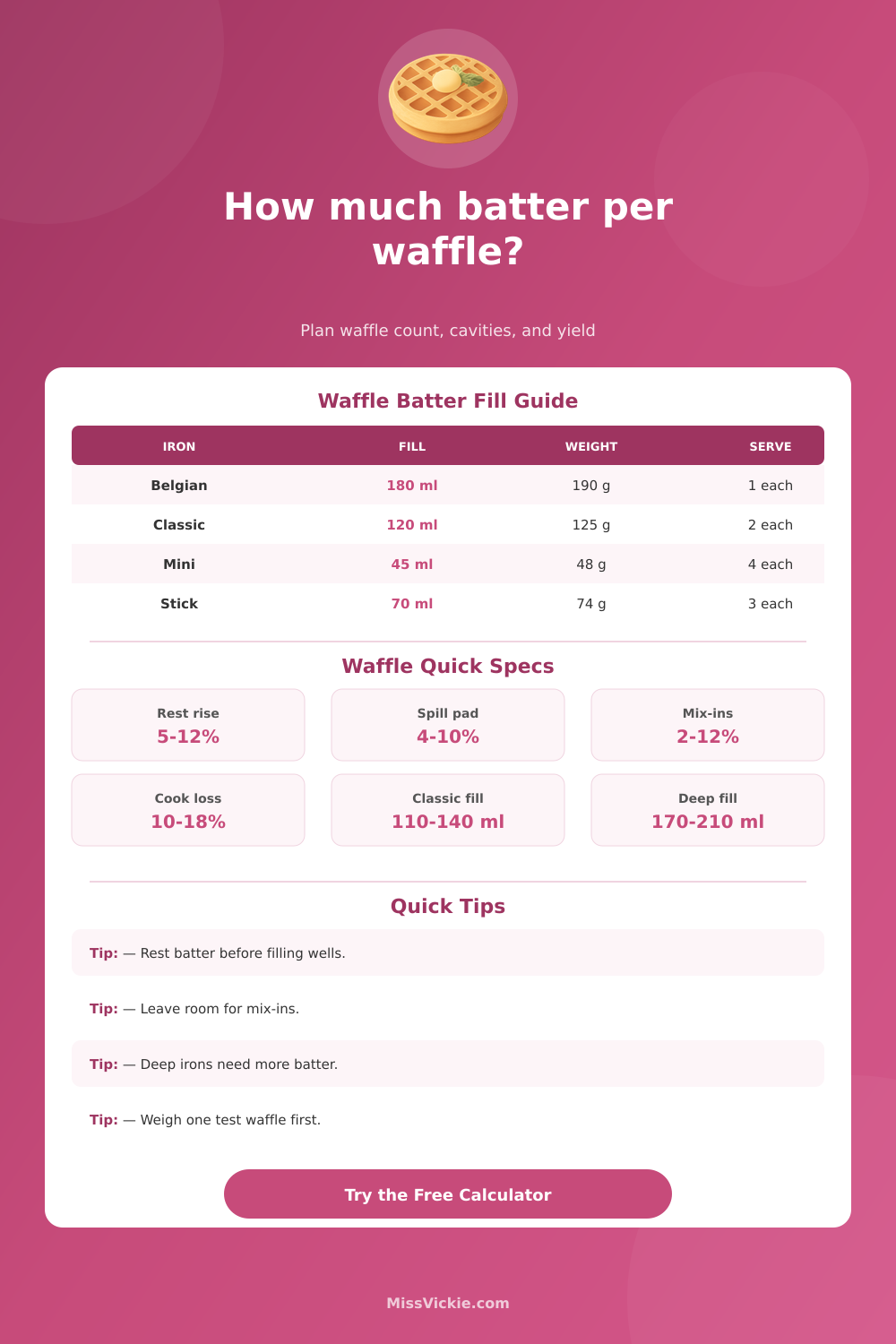
| Iron type | Usual depth | Per cavity | Best fill cue |
|---|---|---|---|
| Deep Belgian round | 1 to 1.25 in | 170 to 210 ml | Center full, edges lightly visible |
| Classic round | 0.5 to 0.75 in | 105 to 140 ml | Spread to two-thirds of the grid |
| Mini round | 0.4 to 0.6 in | 35 to 55 ml | One small scoop per well |
| Waffle stick maker | 0.5 to 0.8 in | 60 to 85 ml | Pipe or pour along each channel |
| Liege pearl grid | 0.8 to 1 in | 140 to 175 ml | Place dough ball slightly off center |
| Batter style | Approx density | Cook loss | Yield note |
|---|---|---|---|
| Buttermilk baking powder | 1.04 g per ml | 13 percent | Balanced crisp edges and tender center |
| Whipped Belgian | 0.98 g per ml | 15 percent | Airier batter cooks lighter by weight |
| Overnight yeasted | 1.01 g per ml | 14 percent | Rest expansion changes final pour volume |
| Protein waffle batter | 1.10 g per ml | 12 percent | Dense batter needs measured spreading |
| Liege enriched dough | 1.16 g per ml | 10 percent | Pearl sugar adds weight and less pour flow |
| Adjustment | Typical range | Use when | Calculator effect |
|---|---|---|---|
| Resting expansion | 0 to 18 percent | Batter thickens, bubbles, or ferments | Reduces mix needed before rest |
| Mix-in displacement | 0 to 14 percent | Chips, berries, nuts, cheese, or savory bits | Leaves cavity room for solids |
| Spill allowance | 3 to 12 percent | Pouring fast or serving a group | Adds backup batter to the batch |
| Cooked yield loss | 10 to 18 percent | Steam leaves during waffle cooking | Estimates finished waffle weight |
| Serving style | Full waffles | Cooked grams | Best for |
|---|---|---|---|
| Light plate | 1 classic or half Belgian | 85 to 120 g | Fruit, yogurt, or side breakfast |
| Standard breakfast | 1 Belgian or 2 classic | 145 to 190 g | Most plated waffle meals |
| Hearty brunch | 2 Belgian or 3 classic | 240 to 330 g | Big brunch with toppings |
| Mini tasting plate | 3 to 5 minis | 90 to 150 g | Kids, buffet trays, and desserts |
Highest batter per waffle and most visible rise from whipped or yeasted batters.
Moderate fill, faster cooking, and better for crisp stacks or weekday batches.
Small wells magnify spill waste, so measured scoops matter more than total volume.
Channels need a little extra margin because batter travels lengthwise before setting.
Knowing this will spare you heartbreak on Sunday morning: If you’re off on volume, batter spills over. And if you guess wrong with how much mix you add to a deep Belgian waffle versus a thin classic grid (like the one pictured here), things gets messy before you even open the lid.
Once you know you need enough liquid to fill in the void but not drown the edges, it’s simply a matter of geometry to get ratio right, enough liquid for perfect crisp perimeter, yet tender within. It change based off which iron you own, the type of leavening used, and what you fold in, such as big chunks of chocolate or fruit.
How to Stop Waffle Batter from Spilling
So how many scoops do we need? That’s where the tool I made (above) comes into play: it does all this math for you, without you having to guess any of this.
There are factors that most home cook don’t think about until it’s already too late, like spilling allowance and resting expansion. Gluten relaxes as it rests, causing apparent volume of whatever was in your bowl to shift; meanwhile, rising bubbles makes the liquid less thick. You want to let it sit for a while (ten or even fifteen minutes), so the structure can set and you won’t have a flat, dense waffle if you poured right away. This adjustment is reflected in calculator. This ensures you don’t try to fit more into the wells than necessary before the batter puffs up while waiting for you to pour it.
The other variable is how deep it is. If you’re using a classic shallow-pocketed waffle iron, you only need to fill it up to ⅓ of a cup’s worth of batter to have enough batter to make a decent-looking waffle. Deep Belgium-style models like this one calls for much larger amounts; I found I needed nearly three quarters of a cup of batter per waffle.
Why does this matter? A deeper pool cook more slowly. It also holds more steam within the grid during cooking. This increases your risk of a soggy center if there is too much volume different than the heat from the element.
To help illustrate that point, the reference table on the page lays things out nicely: stick makers call for a pour along each of their channels, but mini rounds is best made from careful tiny scoops. Too little batter for the depth, and you get an underdone/dry spot… Too much, and you’ve got a mess on your hands that’ll take longer to clean then just making breakfast.
Another problem with mix-ins is that they takes up space and push out some liquid. When you put blueberries or chocolate chips into a pocket that used to hold only batter, there’s less space available for batter. Unless you account for the mix-ins separately when calculating volume, you’ll have too much mixture and the iron will overflow once more. To avoid that, the calculator shrinks suggested amount to account for the non-liquid ingredients, leaving enough room in the batter to prevent an overflow without making the cooked result lopsided.
It even takes into account what cooks lose, namely water, the weight of your raw batter isn’t necessarily the same after it heats up. Ten to eighteen percent of your batter may vaporize away in the form of steam, leaving a lighter, smaller waffle at the end. Knowing this lets you plan how many actual servings you are getting instead of just guessing based off volume.
The trick is to not skip test batch. The first pour won’t be perfect. In fact, you’re better off filling just below what’s called for in that first pour so you can weigh it and then plate it up. You’ll see whether there are any dry spots in the grid, and if so, add a little bit more to your next waffle-making effort. This process is a step from the theoretical measurement you made to the reality of what happens in your particular appliance. Each iron heat differently; each batter react differently depending on temperature of ingredients and humidity.
So, in conclusion: Waffles are about controlling volume inside the grid. Control isn’t just about creating something to eat. It’s about cramming exactly the right amount of expanding batter into a small box made of rigid metal so that nothing dissapears chaotically. Get the filling correct, and the steam comes out the vent holes rather than on your kitchen counter tops. The final product will be reliably golden every time. The connection between control and chaos translates an uncontrolled morning scramble into a dependable routine. You should of known this!