MissVickie waffle leavening math
Baking Powder for Waffles Calculator
Estimate baking powder for waffles from flour weight, waffle count, batter thickness, buttermilk acidity, crispness target, waffle iron size, rest time, and baking soda balance.
Each preset loads a practical waffle profile. Adjust the flour, waffle iron, batter thickness, buttermilk tang, crispness goal, rest time, and soda already in your recipe.
Leavening breakdown
Iron size reference
| Iron style | Area | Depth | Leavening note |
|---|---|---|---|
| Mini waffle maker | 13 sq in | Shallow | Use less powder per waffle; cooks fast. |
| Classic 7 inch round | 38 sq in | Classic | Good with the standard 1.4 tsp per cup rate. |
| Four-square iron | 64 sq in | Classic | Needs enough batter flow to fill corners. |
| Deep Belgian round | 50 sq in | Deep | Benefits from a slightly higher lift target. |
| Thin heart plates | 30 sq in | Thin | Keep powder moderate for a dry crisp shell. |
Acidity and soda balance
| Batter liquid | Soda guide | Powder effect | Watch for |
|---|---|---|---|
| Milk or water | 0 tsp per cup flour | Powder does most lift | Flat taste if under-salted. |
| Half buttermilk | 0.20 to 0.30 tsp | Reduce powder slightly | Good tang without soapy notes. |
| Full buttermilk | 0.35 to 0.45 tsp | Split lift with soda | Too much soda browns fast. |
| Yogurt or kefir | 0.30 to 0.50 tsp | Use powder for backup | Thick batter may need thinning. |
| Cocoa or molasses | 0.20 to 0.40 tsp | Depends on cocoa type | Color can hide overbrowning. |
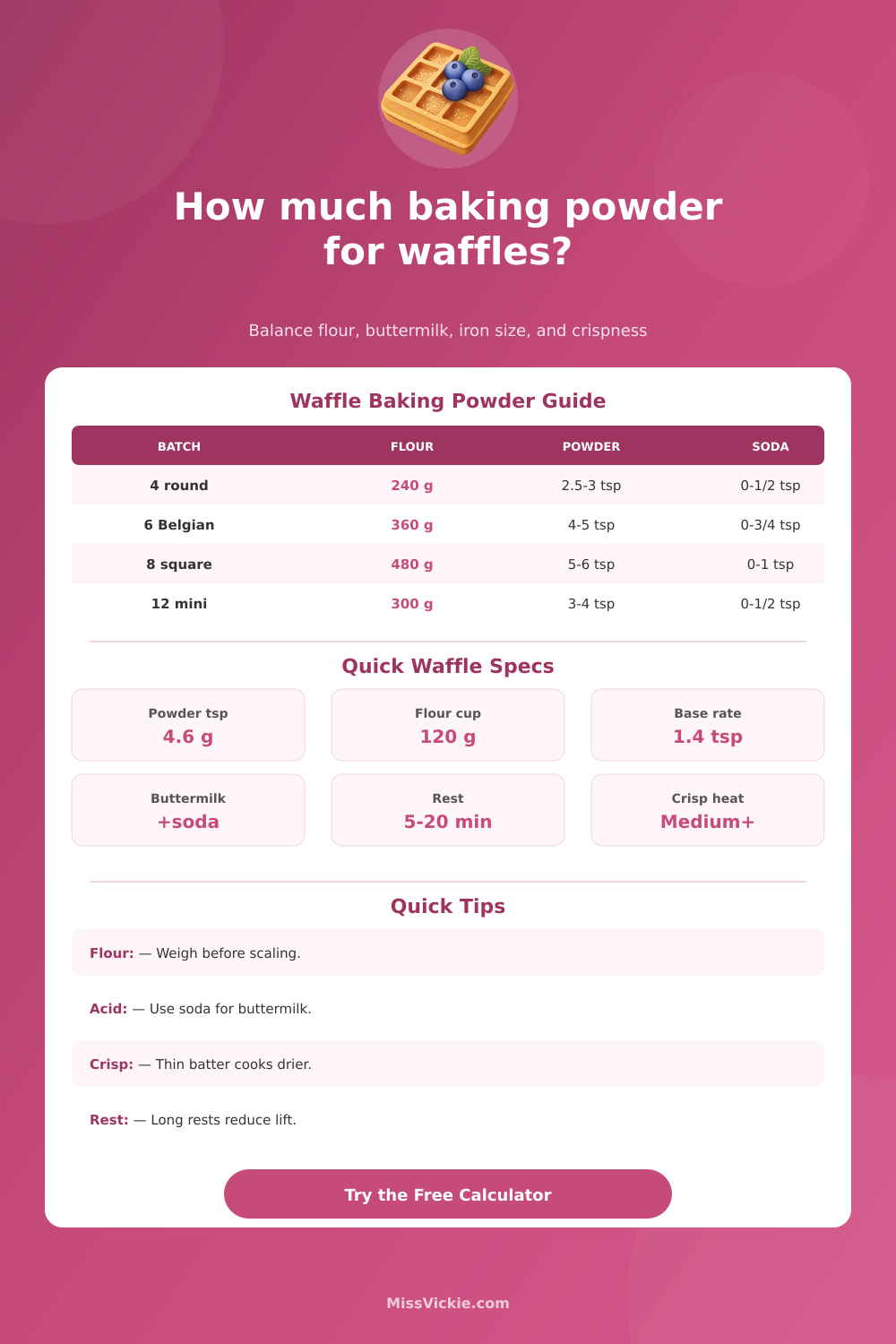
| Waffle batch | Flour | Iron style | Powder range | Soda range | Best texture move |
|---|---|---|---|---|---|
| Classic breakfast four | 240 g | 7 inch round | 2.5 to 3 tsp | 0 to 1/2 tsp | Rest 10 minutes, cook until steam slows. |
| Deep Belgian brunch | 360 g | Deep round | 4 to 5 tsp | 1/2 to 3/4 tsp | Use medium-thick batter and preheat fully. |
| Thin crisp waffles | 300 g | Shallow iron | 3 to 3.5 tsp | 0 to 1/4 tsp | Thin batter slightly and hold on a rack. |
| Mini waffle tray | 300 g | Mini maker | 3.2 to 4 tsp | 0 to 1/2 tsp | Use smaller scoops and wipe overflow. |
| Whole grain batch | 360 g | Classic square | 4.5 to 5.5 tsp | 1/4 to 1/2 tsp | Rest 15 minutes so bran hydrates. |
This calculator gives a practical test-batch starting point for chemical leavening. Brands, flour blends, waffle irons, egg foams, and batter hydration can change the final amount.
Baking powder is an ingredient responsible for waffles rise. Baking powder is essential component of waffle structure. Using too little baking powder will result in flat waffle, while using too much baking powder will impart a soapy taste on the waffles or result in a waffle with a collapsed center.
The amount of baking powder that you will require for making waffles will depend on a few different variable. The variables include the type of iron that will be used, the thickness of the waffle batter, the acidity of the liquids in the recipe, and the altitude at which you cook the waffles. The size and the shape of the waffle iron will dictate the amount of batter that will be pour into the iron.
How much baking powder to use for waffles
Consequently, the amount of baking powder that will be required will also vary with the size of the iron. For example, a classic round waffle iron will have a specified amount of batter that will set the amount of baking powder for that batch of waffles. A deep Belgian waffle iron will require more batter per waffle than a round iron; consequently, a deep Belgian iron will require a different ratio of baking powder to the waffle batter than a round waffle iron.
The same is true for thin irons that may be used to cook heart-shaped waffles. A thin waffle iron will require less baking powder than a deep iron. One reason for this is that thin batter will allow the carbon dioxide gas from the baking powder to escape more easy from the iron than thick batter.
Thick batter will allow the gas bubbles from the baking powder to last longer in the batter. The acidity in the recipe will affect the amount of baking powder or baking soda that should be use in the waffle recipe. Using buttermilk will introduce acidity into the batter.
The acidity will react with baking soda to produce carbon dioxide gas. Recipes that include baking soda will require less baking powder. Using too much baking soda will impart a soapy taste into the waffles, while using too little baking soda will leave the buttermilk flavor in the waffles unbalance.
The calculator included in this article will help you determine the amount of baking powder to add to your waffles. This calculator takes into account the amount of flour in your recipe, the level of acidity in the recipe, and the amount of baking soda in your recipe. Additionally, the calculator also accounts for the amount of time that the batter will rest before it is cooked.
Waffle texture is affected by the amount of leavening agent that is present in the batter as well as the thickness of the batter. To make crisp waffles, use less leavening agent and thin batter. This will allow the waffles to dry quick after they are cooked.
The ingredients in the waffle batter will also have an impact on the rate at which the waffles brown. Batters that contain more butter or more egg yolk will brown faster than lean waffle recipes. In this case, the batters will feel heavy when prepared with the incorrect amount of baking powder.
The altitude at which the waffles are prepared will affect the amount of baking powder that should be in the waffle recipe. At high altitude, the air pressure is lower. At these altitudes, the baking powder will push the waffles too far, and the waffles will end up hollow in the center.
This article provides tables that demonstrate the baking powder amount according to iron size and acidity ranges. These tables show why different amount of baking powder are required for a mini waffle maker and a four-square waffle iron, even if the weight of the flour is the same in each recipe. The tables also show how the amount of baking soda that is required change if plain milk is used instead of buttermilk or kefir.
These tables provide a starting point for the amount of baking powder to be used in waffle recipes. However, they are not absolute rules. Many people make the mistake of treating waffle recipes as if they are the same for everyone and wherever they cook.
People who make deep Belgian waffles but whose waffle irons are not deep may not adjust the baking powder accordingly. Consequently, their waffles will be dense. Other people may add extra baking powder to their deep Belgian waffle recipes to provide more height to their waffles.
However, the extra baking powder will impart a soapy taste into their waffles. Finding a middle ground between too much baking powder and too little will yield the best result for the amount of baking powder for waffle recipes. Using the baking powder calculator will give you a starting point for the recipe.
However, the waffle iron that you use and the batter that you cook in the irons will be the last indicator of whether the amount of baking powder is the correct amount for your recipe.