IU, mcg, percent Daily Value, D2 or D3 form, source type, and weekly averaging
Vitamin D Conversion Calculator
Convert vitamin D between IU and micrograms, average irregular dosing schedules, add food sources, and compare your daily or weekly equivalent with common label and intake references.
Choose a common label or food pattern, then adjust the form, dose frequency, source, target units, and food servings. The calculator uses the label conversion 1 mcg vitamin D = 40 IU.
Conversion Breakdown
| Common Label Amount | Micrograms | Percent Daily Value | Typical Label Context |
|---|---|---|---|
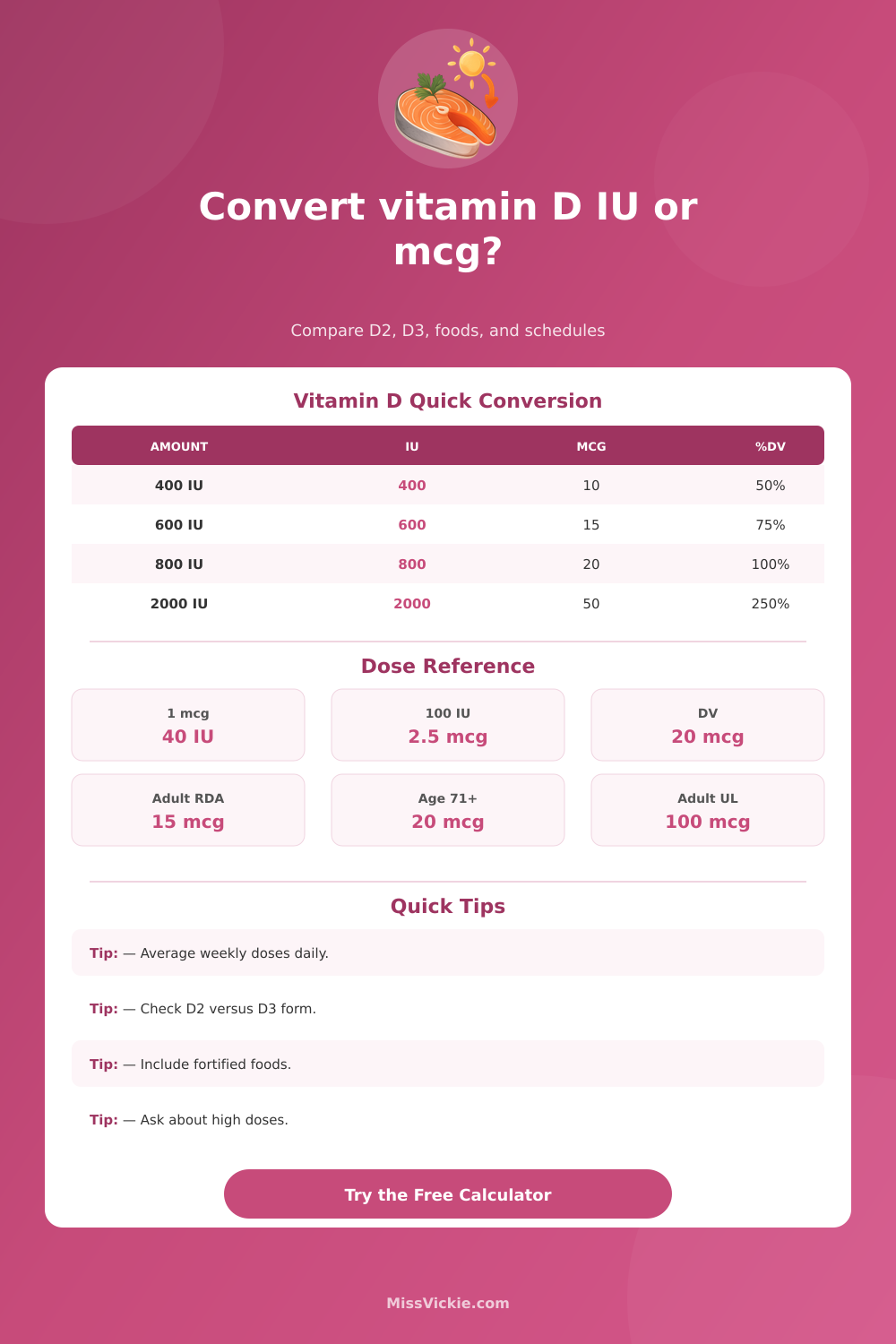
| 400 IU | 10 mcg | 50% DV | Infant drops, multivitamins, smaller fortified servings |
| 600 IU | 15 mcg | 75% DV | Adult RDA through age 70 and many daily supplements |
| 800 IU | 20 mcg | 100% DV | Nutrition label Daily Value and age 71+ RDA |
| 1,000 IU | 25 mcg | 125% DV | Common daily D3 capsule or tablet |
| 2,000 IU | 50 mcg | 250% DV | Higher daily supplement label |
| 4,000 IU | 100 mcg | 500% DV | Adult upper-limit reference for total daily intake |
| Schedule | Example Dose | Average Daily IU | Weekly Equivalent |
|---|---|---|---|
| Daily | 1,000 IU each day | 1,000 IU | 7,000 IU per week |
| Three times weekly | 2,000 IU per dose | 857 IU | 6,000 IU per week |
| Weekly | 10,000 IU once weekly | 1,429 IU | 10,000 IU per week |
| Every 14 days | 10,000 IU every 14 days | 714 IU | 5,000 IU per week |
| Monthly | 50,000 IU once monthly | 1,643 IU | 11,500 IU per week |
| Source | Common Vitamin D Form | Planning Amount | Calculator Note |
|---|---|---|---|
| D3 softgel, capsule, tablet, or gummy | D3 cholecalciferol | Often 400 to 5,000 IU per unit | Use the label amount and units per dose. |
| D2 prescription-style or vegan supplement | D2 ergocalciferol | Often weekly or periodic | Same IU to mcg conversion; compare schedule as an average. |
| Fortified milk or plant drink | Usually D3 or D2 by brand | Often about 100 to 160 IU per cup | Add as extra daily food IU or use source servings. |
| Oily fish meal | Naturally occurring D3 | Can vary widely by fish and portion | Enter a label, database, or recipe estimate. |
| UV-exposed mushrooms | Mainly D2 | Varies sharply by product | Use package data when available. |
| Reference Group | Target mcg | Target IU | Upper Limit Context |
|---|---|---|---|
| Infants 0-12 months | 10 mcg | 400 IU | Upper limit differs for 0-6 and 7-12 months. |
| Children, teens, and adults 1-70 | 15 mcg | 600 IU | Upper limit rises by age band. |
| Adults 71 and older | 20 mcg | 800 IU | Same 100 mcg adult upper-limit reference. |
| Pregnancy and lactation | 15 mcg | 600 IU | Use clinician guidance for individual supplements. |
| Nutrition label Daily Value | 20 mcg | 800 IU | Shown as %DV on Supplement Facts and Nutrition Facts. |
Reference values are general U.S. nutrition planning references. Medical conditions, lab results, medications, and clinician-directed high-dose plans can change individual advice.
Many supplement bottles still print International Units, especially older-style vitamin D labels.
Current Nutrition Facts and Supplement Facts panels commonly show vitamin D in micrograms.
D3 is common in animal foods, fish, and many supplements; use label units for conversion.
D2 appears in UV-exposed mushrooms and some supplements; the IU to mcg math is unchanged.
Vitamin D is an nutrient that people consume through supplements and through food. Yet, the amount of vitamin D that a person consume may differ from the amount of vitamin D that is listed on a supplement labels. People may consume vitamin D through supplements like a vitamin D capsule that a person takes every day, or may consume large doses of vitamin D once every week.
Additionally, people may consume vitamin D from foods like fortified milk or fish. A vitamin D conversion tool can help a person to understand how the amount of vitamin D that is listed on a supplement compare to the average daily amount that the person consumes. Such comparison against an upper limit, or against a target amount of vitamin D, can help a person to understand whether or not they are meeting their bodys requirement for that vitamin.
How to Use a Vitamin D Calculator
The primary calculation that is used in a vitamin D conversion tool are based upon the understanding that one microgram of vitamin D is equal to forty international unit of vitamin D. All calculations of vitamin D is based upon this ratio of micrograms to international units. A vitamin D conversion tool is helpful in that it can account for various variable in the calculation of vitamin D intake. For instance, a vitamin D calculator can all account for the percentage of vitamin D values on supplements, units of vitamin D that are consumed weekly instead of daily, and the amount of vitamin D that is contained in various food source.
The vitamin D calculator allows a person to understand the practical result of their vitamin D intake. The form of the vitamin D can have no effect upon the conversion rate of vitamin D to vitamin D in micrograms. For instance, the conversion of vitamin D2 to micrograms is the same than the conversion of vitamin D3 to micrograms.
However, most animal food and supplements find vitamin D3, while certain mushrooms and vegan products find vitamin D2. A vitamin D calculator can flag the difference between these two forms of vitamin D. Thus, while the vitamin D in both forms is the same in quantity, the differences in the sources of each form allows the vitamin D calculator to make an accuratly comparison between the supplements that contain each type of vitamin D.
Additionally, the source of the vitamin D can have an effect upon the comparison calculations made by a vitamin D calculator. For instance, the vitamin D calculator may use the source of the vitamin D as a variable in calculating the comparison between sources of vitamin D intake. However, the vitamin D calculator do not change the raw conversion calculation of the vitamin D. This adjustment to the vitamin D calculation can help to make clear whether or not a person’s total vitamin D intake is near their reference target.
If the vitamin D calculator does not account for the sources of vitamin D, for instance, a person may have the same inputs into the vitamin D calculator as another person, but have different understandings of their comparison of vitamin D intake to the recommended amount. Another variable that can create a large difference in the amount of vitamin D that a person consumes is the frequency with which the vitamin D supplement is taken. For instance, if a person takes a vitamin D supplement that contains 50,000 IU of vitamin D once a week, the amount of vitamin D that must be taken every day is 7,000 IU of vitamin D (50,000 divided by 7).
Similarly, if a person takes vitamin D capsule once a month with a 50,000 IU dosage, that is the equivalent of 4,167 IU of vitamin D daily (50,000 divided by 30). A vitamin D calculator that accounts for these variables automatically calculates the daily amount of vitamin D that is required to achieve the same vitamin D levels as the supplements that are taken weekly or monthly. These daily calculations are important in allowing people to compare their vitamin D intake to foods that contain vitamin D daily, as well as to the targets for vitamin D intake daily.
Another factor in the vitamin D calculations is the vitamin D that is consumed from food. Foods that contain vitamin D include fortified milk, plant drinks, eggs, and fish. A vitamin D calculator that accounts for each of these food sources allows individuals to calculate how much vitamin D they consume from food each day, and how that compare to the vitamin D from supplements.
The total amount of vitamin D that the body consumes daily from both food and supplement sources may help to alter the understanding of whether or not individuals is meeting their target for vitamin D consumption. The target level of vitamin D for individuals changes with age. For instance, the recommended level of vitamin D for adults is 15 micrograms of vitamin D per day, but for adults over seventy years of age the recommendation increase to 20 micrograms of vitamin D per day.
These different targets may be reflected in the vitamin D calculator by allowing an individual to select their age group. Additionally, individuals may use the vitamin D calculator to ensure that their total vitamin D intake is remaining within the upper limits for vitamin D safety. In such a way, the vitamin D calculator may help an individual to understand what fraction of the safety threshold for vitamin D the individual is consuming.
The output of a vitamin D calculator is various measures of the amount of vitamin D that is consumed daily, weekly, and in relation to the targets of vitamin D intake. Thus, the vitamin D calculator can provide the daily equivalent amount of vitamin D (in both IU and micrograms), the total amount of vitamin D that would be consumed in a week, and the percentage of the vitamin D target that is covered by the amount of vitamin D that is consumed by that individual each day. Each of these figure can be the focus of individuals who prefer either micrograms or the percent daily value of vitamin D intake.
Furthermore, the vitamin D calculator can explain the steps that are perform to calculate each of these figures. While a vitamin D calculator provides references for how much vitamin D an individual should consume daily, it does not provide prescriptions for individuals with various health condition. For instance, certain medications, health conditions, and the ability of the body to absorb vitamin D can impact how effectively the vitamin D performs its function in the body.
Thus, while the vitamin D calculator can calculate the amount of vitamin D that an individual must consume daily, that calculation should of be used to have a conversation with a health clinician regarding the individual’s vitamin D needs. An individual should run their vitamin D intake through a vitamin D calculator whenever there is a change in their regimen for taking vitamin D. For instance, if a person has started a new prescription for vitamin D, if they are switching from one type of vitamin D dosage to another, or if they are adding a fortified food product to their diet, the amount of vitamin D that they consume daily will change. Thus, by using the vitamin D calculator regularly, individuals can ensure that their understanding of their vitamin D intake is accurate.
Thus, the vitamin D calculator transform the various values of vitamin D intake into a single number that each individual can easily understand and use.