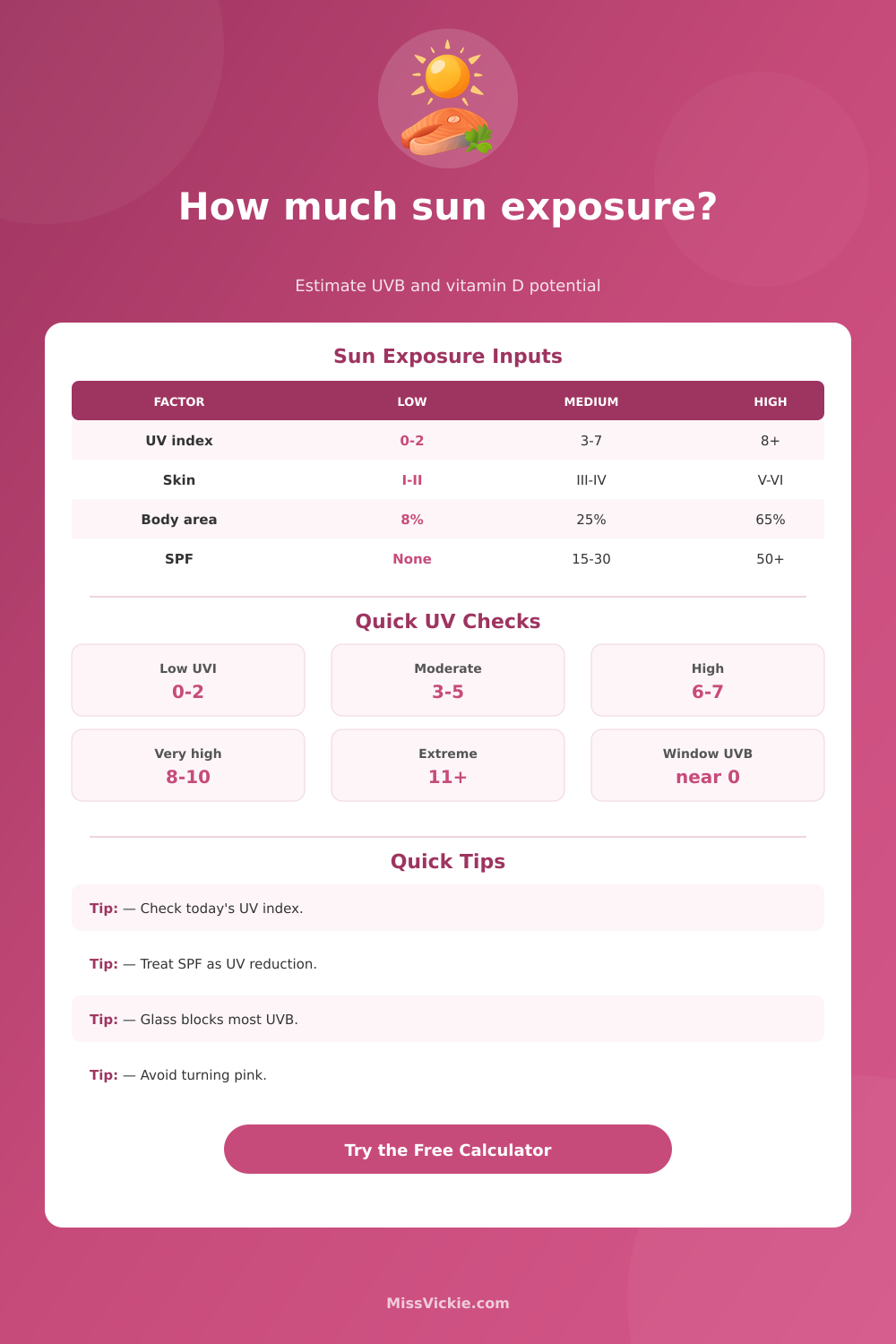
UV index, skin type, latitude, season, body area, sunscreen, and time outside
Vitamin D Sun Exposure Calculator
Estimate general UVB exposure and vitamin D potential from outdoor conditions. The result is a planning estimate only, not a personal vitamin target, sunburn guarantee, or medical recommendation.
Load a realistic outdoor scenario, then adjust the UV index, skin type, latitude and season, exposed body area, sunscreen, and time outside.
| UV Index | WHO Category | Calculator Effect | Planning Note |
|---|---|---|---|
| 0 to 2 | Low | Low UVB input | Vitamin D potential is often small unless time or body area is high. |
| 3 to 5 | Moderate | Moderate UVB input | Sun angle, season, skin type, and body area still change the result. |
| 6 to 7 | High | Strong UVB input | The calculator raises both vitamin D potential and UV load. |
| 8 to 10 | Very high | Very strong UVB input | Small time changes can move the UV load quickly. |
| 11+ | Extreme | Extreme UVB input | Protective choices dominate the scenario comparison. |
| Skin Type | Typical Sun Reaction | Vitamin D Model Factor | UV Load Caution |
|---|---|---|---|
| I | Always burns, never tans | Higher synthesis factor | Shortest burn window in this model. |
| II | Usually burns, tans minimally | Slightly above reference | UV load rises quickly at high UVI. |
| III | Sometimes burns, tans gradually | Reference factor | Middle reference point for results. |
| IV | Rarely burns, tans well | Reduced synthesis factor | Burn risk is lower, but not zero. |
| V to VI | Very rarely burns to least burn-sensitive | Lower synthesis factor | Longer exposure may still add cumulative UV. |
| Latitude And Season | Summer | Spring/Fall | Winter Or Low Sun |
|---|---|---|---|
| Tropical, 0° to 23° | Very useful UVB | Useful UVB | Usually still useful |
| Subtropical, 23° to 35° | Very useful UVB | Moderate to useful | Reduced UVB |
| Mid-latitude, 35° to 50° | Useful UVB | Reduced UVB | Low UVB |
| High latitude, 50°+ | Moderate to useful | Low to reduced | Often very low UVB |
| Body Area Or Sunscreen | Model Shortcut | Vitamin D Direction | Important Limit |
|---|---|---|---|
| Face and hands | About 8 percent exposed | Small area, lower potential | Actual clothing and posture can change this. |
| Arms and lower legs | About 28 percent exposed | Moderate area, stronger potential | Clouds and sun angle still matter. |
| Swimwear or large area | About 65 percent exposed | Large area, high potential | UV load can rise fast at high UVI. |
| SPF 15 to 50+ | UVB reduction, not a timer | Lowers vitamin D potential | Real protection depends on use and reapplication. |
Reference basis: WHO UV index categories, NIH vitamin D sun-exposure factors, FDA sunscreen SPF descriptions, and common Fitzpatrick skin-type wording. This widget turns those into a rough estimator, not a clinical dose model.
The sun perform numerous function for the earth and its inhabitant, such as providing light and heat to an planet. However, the sun also provide ultraviolet radiation in the form of uv rays that the body use to produce vitamin D. While the majority of individual living on the planet are noticeable by the light and heat from the sun, the uv rays is invisible to the human eye. The amount of uv radiation that reaches the skin is dependent on a variety of factor, such as the time of day, the season, location, and the clothing that an individual is wearing.
Each of these factor can continuously change, making it difficult for an individual to rely upon the feel of the weather to determine how much vitamin D their body is producing. Another factor that can play a significant role in the amount of vitamin D that the skin produce is the type of skin that an individual has. The type of skin that an individual has determine the amount of melanin that is contained within their skin.
What affects how much vitamin D you make from the sun
Individuals with lighter skin contain less melanin in comparison to individuals with darker skin. Consequently, individuals with lighter skin are able to produce vitamin D more easily than individuals with darker skin. These factor are accounted for in the calculator.
Thus, the vitamin D calculator is able to provide an estimate of the amount of vitamin D that two individuals with different skin type can produce. Some additional factor that impact the amount of uv radiation that reaches the skin are the latitude at which an individual live and the time of year in which they are exposed to the sun. These factor impact the uv radiation that reaches the skin because the angle of the sun change with season and latitude.
Areas near the equator experience bright sunlight year-round, while regions near the pole experience dimmer light. These factor are also accounted for in the calculator. For instance, a bright winter day in the Arctic may be pleasant to the individual with the weather with bright sunny day in the tropics.
Factors that may reduce the uv radiation that reaches the skin to the body include cloudy weather condition, shaded areas, and glass. Clouds can reflect some of the uv radiation that would otherwise reach the skin. Additionally, shaded area will also reduce the uv radiation that reaches the skin because the uv radiation do not reflect off of objects like water and sand, but rather only some of the uv radiation will reflect off of solid object like buildings.
Lastly, glass will block the majority of uv radiation, preventing it from reaching the skin. Therefore, sitting near a window will not provide the body with uv radiation that is necessary to produce vitamin D.
The amount of skin that is exposed to the uv radiation will also play a role in the amount of vitamin D that is produced. For example, if an individual expose only their face and hands to the uv radiation, their body will produce less vitamin D than if they expose areas like their leg or their forearms.
Individuals who wear swimsuits expose the largest percentage of their skin, while individuals who wear long sleeve and pants will expose the least amount of skin. These factor are accounted for in the calculator. The vitamin D calculator accounts for the percentage of skin exposure so that an individual’s vitamin D production is only calculated for the skin that is exposed to the uv radiation.
One factor that can reduce the amount of uv radiation that is reaching the skin is the use of sunscreen. The use of sunscreen block some of the uv radiation from reaching the skin, which prevent the skin from burning. However, if the skin is prevented from exposed to uv radiation, it will produce less vitamin D than if it was not exposed to sunscreen.
This factor is accounted for in the calculator. The vitamin D calculator allow individuals to manipulate the amount of sunscreen that they use, which allows individuals understand the effect that sunscreen can have upon their bodies ability to produce vitamin D.
Individuals of all age can produce vitamin D with exposure to uv radiation. However, the efficiency of an individual’s skin change with age.
For example, young individual’s skin is more efficient at converting uv radiation into vitamin D than the skin of adults or the elderly. This factor is accounted for in the vitamin D calculator. However, there are other factor that are not accounted for in the calculator.
While the calculator can determine an individual’s potential vitamin D production, it cannot account for every factor that may influence that production. Thus, the calculator is a planning estimate only. The calculator will indicate an individual’s potential vitamin D production and the load of uv radiation that their body is exposed to (which can lead to sunburn if too high).
Additionally, the calculator will indicate a range of potential value for those two measurements. The range account for the fact that the calculator cannot account for every single variable in the body. While the calculator can determine the amount of vitamin D that the skin can produce, it cannot account for variables like the bodys temperature, brightness, or other variable that are not reflected in the calculator.
For instance, bright sunny day in the winter may be cool and windy, but the uv index during those days may be very high. Additionally, other variable are reflected in the calculator, such as the uv index and other specified variable. The calculator allow an individual to test various scenario prior to stepping outside into the sunlight.
For instance, the individual can alter the length of time that they will be exposed to the uv radiation from the sun. Additionally, the individual can manipulate the amount of sunscreen that they use prior to stepping outside. Additionally, the amount of skin that is exposed can also be altered.
Thus, an individual may discover through the calculator that a short time exposure to the sun with exposed skin will produce more vitamin D than a longer period of time with less skin exposure. Thus, the calculator can help an individual to understand how to minimize the uv radiation exposure from the sun. The calculator is a tool that can help an individual to understand the variable that may impact their body’s ability to produce vitamin D. However, it is also essential to recognize that the calculator cannot account for every factor regarding the health of an individual’s body.
For example, the calculator is not aware of the vitamin D level in an individual’s blood. Additionally, it does not account for the diet of the individual, or whether they are taking medication that may impact the ability of their skin to produce vitamin D. Thus, while the calculator is a helpful tool, it can only provide an estimate to an individual regarding their potential vitamin D production.