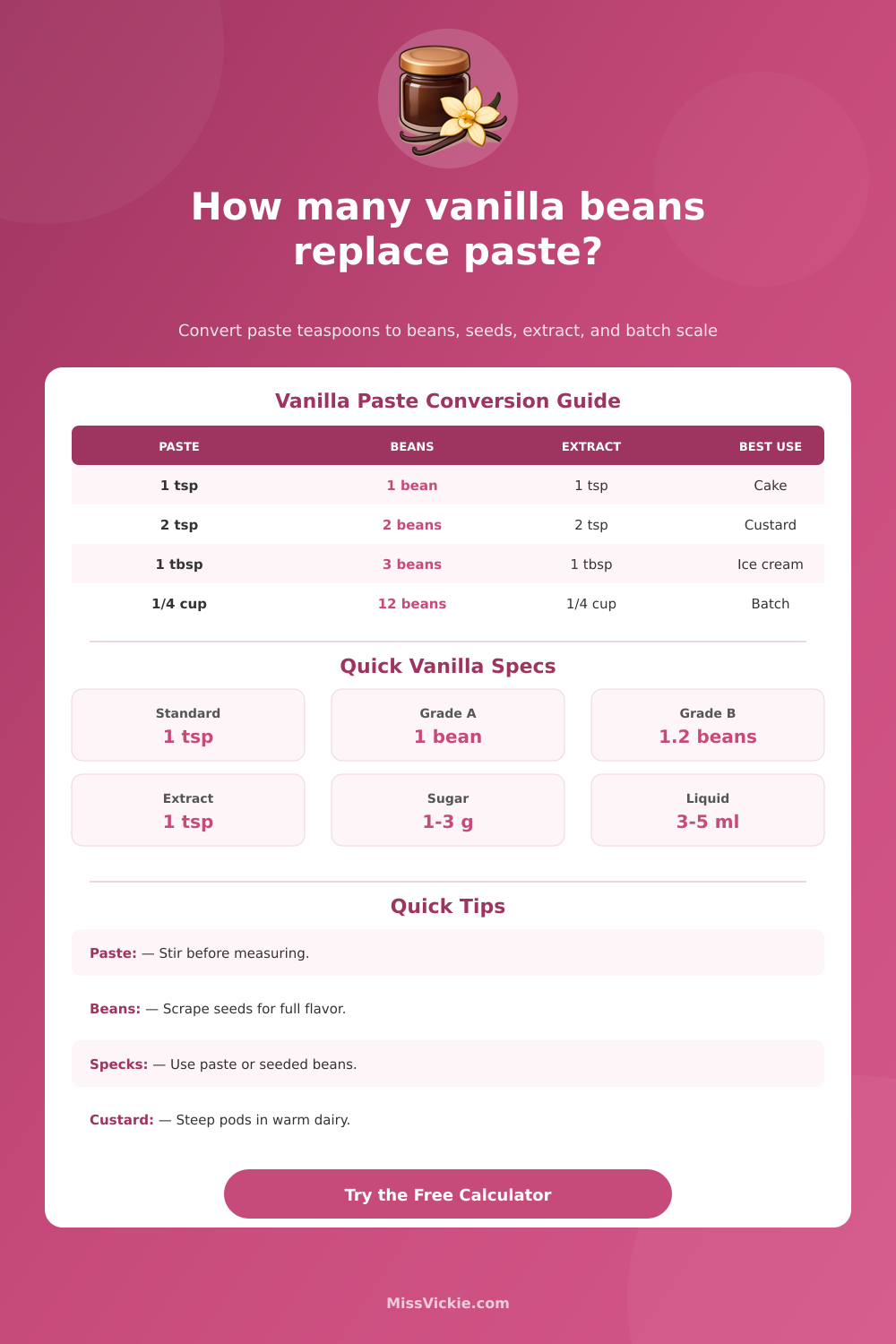
Vanilla paste to bean conversion
Vanilla Bean Paste to Vanilla Bean Calculator
Convert vanilla bean paste teaspoons into whole beans, scraped seed yield, extract equivalents, visible speck strength, and the small sugar and liquid adjustments that matter in delicate recipes.
🍮Paste-to-bean scenarios
Choose a starting point for cakes, custards, cookies, ice cream, drinks, or a scaled bakery batch, then fine-tune the bean grade and speck goal.
🥛Paste amount and recipe style
Conversion breakdown
🔬Vanilla substitution snapshot
🧁Paste, bean, and extract comparison
Fast measuring, visible seeds, and a little syrup that can soften frostings or glazes.
Best for custards, creams, ice cream, and recipes where pods can steep for deeper aroma.
Easy flavor match with no seed texture, but it will not add the same visual specks.
For large batches, round beans up for luxury desserts and down for delicate drinks.
📋Common vanilla paste conversions
| Vanilla bean paste | Whole bean equivalent | Vanilla extract equivalent | Liquid to consider | Best recipe fit |
|---|---|---|---|---|
| 1/2 teaspoon | 1/2 bean or seeds from a short bean | 1/2 teaspoon extract | About 2.5 ml paste volume | Small glaze, whipped cream, mug cake |
| 1 teaspoon | 1 medium Grade A bean | 1 teaspoon extract | About 5 ml paste volume | Cake layer, cookie batch, custard cup |
| 2 teaspoons | 2 medium beans or 1 large bean for mild flavor | 2 teaspoons extract | About 10 ml paste volume | Cheesecake, pastry cream, frosting |
| 1 tablespoon | 3 beans | 1 tablespoon extract | About 15 ml paste volume | Ice cream quart, rich pudding, bakery batter |
| 1/4 cup | 12 beans before grade adjustment | 1/4 cup extract | About 60 ml paste volume | Large bakery or catering batch |
🌿Bean grade and seed intensity guide
| Bean choice | How it compares to paste | Flavor behavior | Speck behavior | Use when |
|---|---|---|---|---|
| Grade A 7 inch plump bean | Closest to 1 tsp paste | Round, moist, fragrant | Medium visible specks | You need a reliable one-for-one swap |
| Grade A 6 inch medium bean | Needs about 1.12 beans per tsp paste | Balanced, slightly lighter | Medium-low specks | You have average grocery beans |
| Grade B 6 inch bean | Needs about 1.22 beans per tsp paste | Best after steeping | Lower immediate seed gloss | You are making extract, custard, or warm dairy |
| Short 5 inch bean | Needs about 1.35 beans per tsp paste | Good but less seed mass | Lower speck count | You only have short beans available |
| Large 8 inch gourmet bean | About 0.86 bean per tsp paste | Strong aroma and visible seeds | High speck count | You want a luxury dessert look |
| Split or slightly dry bean | Needs about 1.18 beans per tsp paste | Fine if steeped or chopped | Uneven specks | You will strain or steep the pod |
🍰Recipe type adjustment guide
| Recipe type | Bean swap advice | Liquid note | Sugar note | Visible speck note |
|---|---|---|---|---|
| Cake, muffins, quick bread | Use calculated beans; no need to steep | Usually ignore under 2 tsp paste | Ignore unless batch is very large | Seeds may hide in browned crumb |
| Custard, pastry cream, pudding | Scrape seeds and steep pods in dairy | Keep dairy the same for small batches | Reduce sugar only for heavy paste use | Specks show clearly in pale custard |
| Ice cream or frozen custard | Steep pods, chill, then churn | Track paste liquid in exact formulas | Paste sugar can affect softness slightly | High specks look premium |
| Cookies, bars, dough | Scraped seeds mix best with butter and sugar | Paste moisture rarely matters | Do not reduce sugar for small batches | Specks are subtle after baking |
| Frosting, glaze, buttercream | Use seeds directly; add extract if aroma feels flat | Paste liquid can loosen texture | Paste sugar can make glaze sweeter | Specks stay very visible |
| Coffee, latte, syrup, drink | Extract is cleaner unless specks are desired | Paste dissolves best in warm syrup | Count paste sugar in sweet drinks | Specks settle unless shaken |
💡Kitchen notes for swapping paste and beans
Vanilla bean paste and whole vanilla bean are different ingredient, and therefore, they require different methods of substitution within a recipe. Vanilla bean paste contain vanilla seeds, vanilla syrup, and sugar. Whole vanilla beans contain vanilla seeds and vanilla pod, but it dont contain any added sugar or liquid.
Because vanilla bean paste contains sugar and liquid, you should also adjust its sugar and liquid level when it is to be substituted with whole vanilla beans. Vanilla bean paste contains the necessary amount of moisture to a recipe, but whole vanilla beans do not contain that same level of moisture. The size and quality of the vanilla bean will affect the way vanilla beans must be substituted for vanilla bean paste.
How to Use Whole Vanilla Beans Instead of Vanilla Bean Paste
Grade A vanilla beans are known to be plump and moist with more vanilla seeds and aroma compared to smaller vanilla beans that do not contain the same amount of moisture. Using dry vanilla bean may produce a dessert that dont have the same amount of flavor as expected. Using vanilla beans in a custard or ice cream base allow for the vanilla beans to be steeped in the warm dairy product to extract the vanilla aroma.
However, using vanilla beans in baked goods like cookies or quick breads may result in the vanilla aroma dissapears during the baking process. The concentration of vanilla bean paste vary. Some vanilla bean paste products contains many visible vanilla seeds while others have thin vanilla bean paste that contains more syrup.
Using vanilla beans to replace thick vanilla bean paste may require more vanilla bean to provide the same number of visible vanilla seeds in the finished dessert. Using vanilla beans to replace thin vanilla bean paste may require adjustment to the amount of sugar in the recipe since thin vanilla bean paste contains more sugar then vanilla beans contains. The type of recipe being made will determine how vanilla bean may have to be substituted for vanilla bean paste.
Using vanilla bean paste in products like frosting or glaze may require add milk to the frosting to compensate for the liquid that using vanilla beans removes. Using vanilla beans in drinks may cause the vanilla bean seeds to settle at teh bottom of the drink while vanilla extract and vanilla bean paste will remains visible throughout the drink. Additionally, the scale of the recipe will change the number of vanilla bean needed.
A fraction of a vanilla bean may be used in a small batch of dessert, but larger batches may allow vanilla beans to be rounded up or down in number according to the cost or visual appearance of vanilla seeds that is desired. In order to make the best substitution of vanilla beans for vanilla bean paste in a recipe, a process should be followed. First, the cook should measure the amount of vanilla bean paste that is required for the recipe.
Second, the cook should identify the grade of the vanilla beans that are available. Third, the cook should decide the number of vanilla seeds that is desired in the final dessert. After measuring the vanilla bean paste that is required, identifying the vanilla bean grade, and deciding on the number of vanilla seeds, the substitution can be made.
Although the strength of vanilla bean may differ from harvest to harvest, following this process will ensure that the outcome of the substitution will be the same.