Turkey Roasting Time Per Pound Calculator
Estimate turkey roasting time per pound from raw weight, stuffed or unstuffed setup, oven temperature, spatchcocking, starting temperature, tenting plan, rest time, altitude, and safe target temperature.
🦃 Turkey Roasting Presets
Choose a real holiday or dinner setup, then adjust the turkey, oven, tenting, rest, and temperature checks for your kitchen.
⚖ Roasting Inputs
Estimated Turkey Roast Plan
Adjust the inputs to build a weight-based roasting window.
Roast Breakdown
Safety and Timing Checks
Thermometer Plan
🌡 Safe Turkey Temperature Targets
Check the thickest breast area without touching bone.
Measure the inner thigh near the body joint.
Stuffing inside the bird needs its own thermometer reading.
Large birds carve cleaner after a longer protected rest.
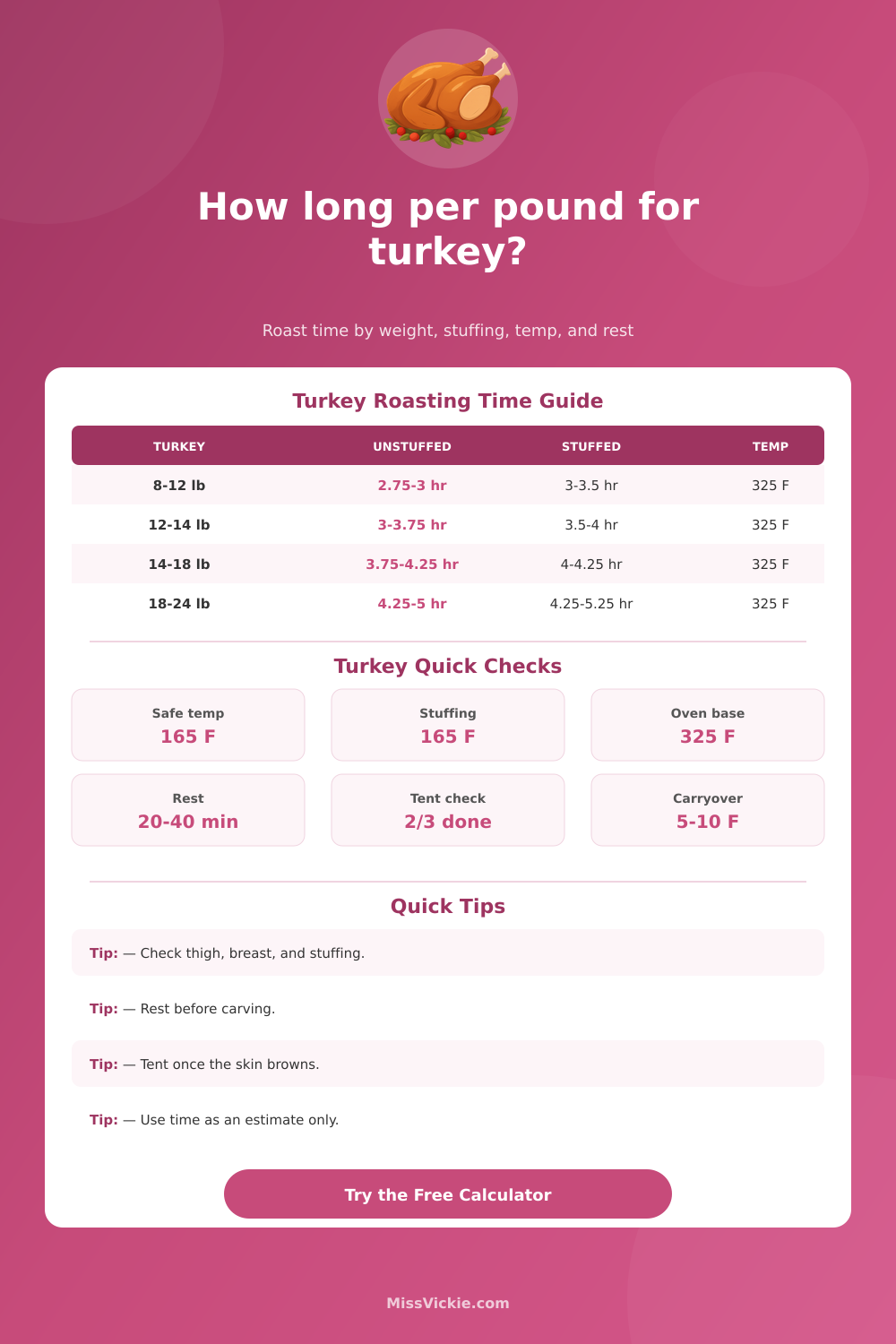
📋 USDA-Style 325°F Whole Turkey Timetable
| Turkey Weight | Unstuffed Time | Stuffed Time | Approx. Unstuffed Min/Lb |
|---|---|---|---|
| 8 to 12 lb | 2 3/4 to 3 hours | 3 to 3 1/2 hours | 15 to 21 min/lb |
| 12 to 14 lb | 3 to 3 3/4 hours | 3 1/2 to 4 hours | 13 to 19 min/lb |
| 14 to 18 lb | 3 3/4 to 4 1/4 hours | 4 to 4 1/4 hours | 14 to 16 min/lb |
| 18 to 20 lb | 4 1/4 to 4 1/2 hours | 4 1/4 to 4 3/4 hours | 13 to 15 min/lb |
| 20 to 24 lb | 4 1/2 to 5 hours | 4 3/4 to 5 1/4 hours | 11 to 15 min/lb |
Use the table as a planning baseline, then confirm doneness with a food thermometer in the breast, thigh, and stuffing if used.
🔥 Oven Temperature Adjustment Table
| Oven Setting | Best Use | Time Effect | Watch Point |
|---|---|---|---|
| 300°F / 149°C | Gentle roasting | About 12% longer | Skin browns slowly |
| 325°F / 163°C | Classic whole turkey | Baseline | Most timetable friendly |
| 350°F / 177°C | Moderate faster roast | About 8% shorter | Tent breast as needed |
| 375°F / 191°C | Small birds or spatchcock | About 14% shorter | Check earlier |
| 425°F / 218°C | Initial browning only | Not a full-roast base | Reduce heat after browning |
🔪 Preparation and Shape Timing Table
| Preparation | Typical Time Shift | Why It Changes | Temperature Check |
|---|---|---|---|
| Whole turkey on rack | Baseline | Air reaches the sides and bottom | Breast and inner thigh |
| Deep roasting pan | 5% to 10% longer | Pan walls shield lower heat | Lower thigh area |
| Oven bag or covered roaster | 10% to 18% shorter | Moist enclosed heat cooks faster | Thigh and breast |
| Spatchcocked turkey | 30% to 40% shorter | Bird lies flat with shallow center | Breast, thigh, leg joint |
| Separated breast and legs | 40% to 50% shorter | Pieces finish at different speeds | Each piece separately |
✅ Poultry Safety Timing Checks
| Check | Safe Target | When to Check | Kitchen Note |
|---|---|---|---|
| Whole turkey breast | 165°F / 74°C | 30 minutes before estimate | Insert from side into thickest area |
| Inner thigh | 165°F / 74°C | With breast check | Do not touch the bone |
| Stuffing center | 165°F / 74°C | Near end of roast | Stuffing may lag behind meat |
| Rested turkey | 165°F / 74°C final | Before carving | Carryover varies by bird size |
🧭 Roasting Method Comparison
Best when you want a traditional presentation and predictable 325°F timetable.
Needs extra time because the cavity center must also reach 165°F.
Flat shape shortens the heat path and improves skin exposure.
Covered roasting may finish faster but needs careful browning management.
💡 Turkey Roasting Tips
A turkey is just one piece of this holiday puzzle; the beginning is a bird whose appearance hides a complicated heat-transfer situation: Heat needs to reach from bone to skin, but not so much that the exterior dries out. How do you get heat into a big lump of chilled flesh inside a hot oven? That’s where the per-pound guidelines is useful as starting points, but only as such. The calculator does the work for you by accounting for things like stuffing, initial chill, and pan shape, things that other guides don’t considers. Time moves you from guesswork to thinking about science of heat.
Okay, first things first: weight. But secondly, there’s density. An eighteen pounder that’s nice and compact have less surface area to let heat reach the inside than one with air pockets in its cavity. You can tell it whether you’re planning to stuff your bird or simply tuck aromatics, such as herbs and onions (into the cavity).
How to Cook a Turkey Perfectly
If stuffed, the stuffing provide additional insulation, so the internal temperature rise even slower. And because it takes time for grains within to come up to a safe temp, the meat needs to remain warm even longer. Which is where folks mess up. Out they yank the turkey when breast is right, but then realize the stuffing is barely warm. Oops. Leave it in longer and risk overcooking the white. There’s the trade-off.
There are other sneaky variables… Like starting temperature (that trip up most home cooks). The calculator will ask whether your bird was just pulled out of fridge and put in oven, or whether it’s been sitting on the counter, coming up to room temp. Obviously a cold bird right out of the fridge will take much longer, as the oven needs to use some energy warming the middle of it before it can begins cooking it. But don’t let it sit too long or you risk bacterial growth. Thaw completely, then let it come to room temperature for an hour or two, usually the sweet spot. This little step will shave 20 minutes off your overall roasting time without sacrificing any safety.
With a spatchcocked bird, however, you change entire equation. Flattening out the bird exposes all parts of meat at once. Before, breast acted as a shield that protected the legs from direct heat. That’s why the tool compensates for that form-shift, realizing that a plumped-up bird takes longer to cook than a flatter one; and then it factors in what kind of oven you’re using. A convection oven circulates its hot air around food items more quickly, speeding up cooking and browning. Deep roasting pans may create steamier conditions and slow things down. All of these nuances help ensure that your skin comes out nice and crispy rather than pale and rubbery.
When the turkey starts to brown before the inside is cooked, your best friend is a tent. A loosely fitted sheet of aluminum foil will prevent the turkey from burning while allowing the inside continue heating. The calculator includes tenting so you can plan whether to use or take off the foil. Rest time is another reminder from the calculator.
When you pull the bird at one hundred sixty degrees rather then one hundred sixty-five, the heat remaining inside will finish cooking it during rest. This will leave the turkey tender and juicy. And rest there must be. Without it, juices will run down onto the cutting board; they want to redistribute themselves.
There’s another element to high altitude, the lower boiling point of water means that the steam pressure in the bird will also be different than usual. If you’re over two thousand feet, the tool has you covered. It doesn’t let you undercook just because air gets thinner. Finally, nothing beats a thermometer with any timer. Insert it into deepest part of the thigh, and into the thickest part of the breast. Use the numbers for a window; use the probe for truth. Trust the tool to plan your afternoon, but trust the thermometer to save your dinner.
The meat is moist, the skin is crispy, and there is no guesswork. That balance between instinct and science is what transforms a good roast into a great one. You want that bird looking as good as it tastes, and those variables are the tools you should of used to get there.