🦃 Turkey Fryer Calculator
Balance bird weight, oil heat, altitude, and recovery for a steadier fry
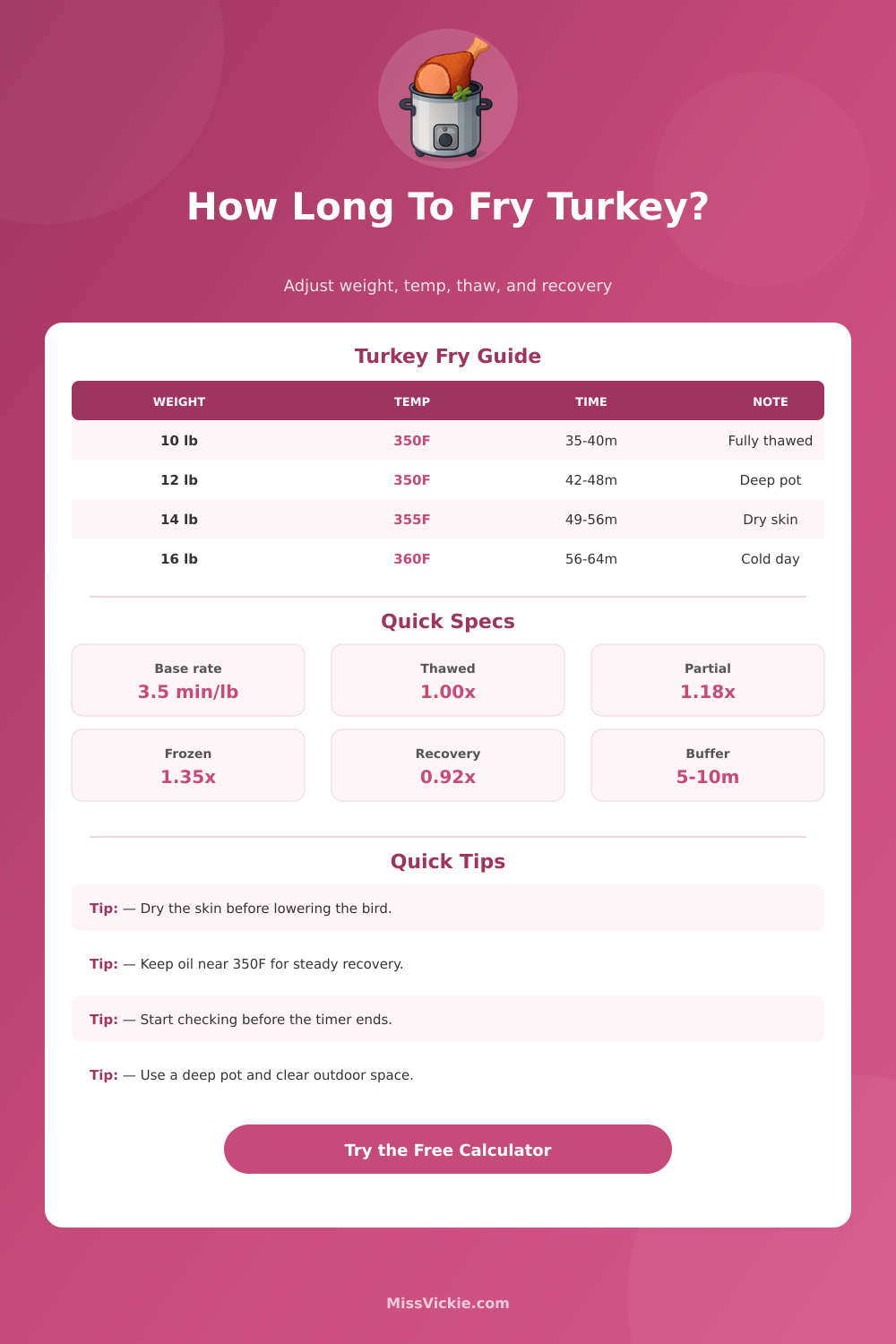
| Weight Band | Base Time | Oil Temp | Notes |
|---|---|---|---|
| 10 lb or less | 3.5 min/lb | 350F | Small birds |
| 11 to 12 lb | 3.5 min/lb | 350F | Most common |
| 13 to 14 lb | 3.4 min/lb | 355F | Watch recovery |
| 15 to 16 lb | 3.3 min/lb | 360F | Heavy load |
| Thaw State | Factor | Time Shift | Notes |
|---|---|---|---|
| Fully thawed | 1.00x | Base | Best case |
| Mostly thawed | 1.12x | +6 min | Cool legs |
| Partial thaw | 1.25x | +12 min | Risky |
| Frozen edges | 1.35x | +18 min | Not ideal |
| Condition | Factor | Temp Dip | Notes |
|---|---|---|---|
| Warm and calm | 1.00x | Low | Easy recovery |
| Cool breeze | 1.05x | Medium | Add buffer |
| Cold morning | 1.08x | Higher | Watch dip |
| High altitude | 1.10x | Highest | Thin air |
| Buffer | Check | Use Case | Notes |
|---|---|---|---|
| 3 to 5 min | Early | Small birds | Tight watch |
| 6 to 8 min | Normal | Most birds | Balanced |
| 9 to 12 min | Wide | Cold days | More margin |
| 13 to 15 min | Extra wide | Heavy birds | Slow recovery |
Compact Fryer
40 to 50k BTU
Best for 10 to 12 lb birds
Warm, calm days
Home Setup
55 to 65k BTU
Best for 12 to 14 lb birds
Most steady recovery
Cold Weather Rig
65 to 75k BTU
Best for 14 to 16 lb birds
Needs extra buffer
High Output Rig
75k BTU or more
Best for 15 to 18 lb birds
Fastest rebound
When frying a turkey in oil, the oil temperature will drops due to the turkey’s cold temperature. This drop in oil temperature is known as a recovery dip. During the recovery dip, you must manage the oil temperature so that the turkey cooks evenly.
If the oil dont reach its proper temperature quick, the turkey may cook to an undercooked temperature in the center of the turkey. To find the proper cooking time for the turkey, calculate for the weight of the turkey, the air temperature, the thaw state of the turkey, and the power of the burner. The weight of the turkey will have a direct bearing on cooking time.
How to Fry a Turkey: Time, Heat and Safety
The standard time for cooking a turkey is three and a half minutes per pound at 350 degrees Fahrenheit. For turkeys weighing ten pounds or less, use three and a half minutes per pound. For turkeys that weighs more than ten pounds, use three point three minutes per pound.
Use three point three minutes per pound for turkeys that weigh more than ten pounds because the thicker cut of turkey will cook more slow. Using a rate of three and a half minutes per pound will result in the turkeys exterior crisping before the interior of the turkey reach 165 degrees Fahrenheit. The thaw state of the turkey will also impact the cooking time.
For a fully thawed turkey, use the standard cooking time. If the turkey is mostly thawed but has cold legs, increase the cooking time by twelve percent. For a turkey that is only partially thawed, increase the cooking time by twenty-five percent.
If the turkey is still frozen, increase the cooking time by thirty-five percent because the ice in the turkey will fight the heat. If you would like to use your turkey in frying, allow it to thaw in the refrigerator for two to three days. The air temperature around the turkey will also affect the oil temperature recovery.
On warm days around sixty-five degrees Fahrenheit, the oil will easily recover its temperature. On cold days around forty degrees Fahrenheit, the air will remove heat from the oil at a faster rate. This will result in an increase in cooking time by eight percent.
The wind will also play a role in the oil temperature recovery. With the wind at a higher speed, the oil will cool at a faster rate around the pot. Consider both the air and wind temperatures when calculating the cooking time for the turkey.
The power of the burner will determine the oil temperature recovery rate. A sixty-five thousand BTU burner is suitable for turkeys in the range of twelve to fourteen pounds. Forty thousand BTUs is a low output for preparation of a turkey fry.
Using a low-output burner will result in a sluggish recovery of the oil temperature. Using a high-output burner with over seventy-five thousand BTUs will provide the best results for turkeys that weigh alot of pounds because the oil will reach 350 degrees Fahrenheit the fastest. The higher the altitude, the less efficient the burner.
Use the BTU burner output recommendation if you are cooking a turkey at altitudes of five thousand feet or higher. The thinner air at higher altitudes will result in the burner producing less heat. If this is the case, increase the cooking time by ten percent.
A safety buffer will allow for unexpected variables in the cooking time. Use a safety buffer to provide extra time to cook the turkey to ensure it is properly done. Six to eight minutes of extra time will allow for most emergency.
If the turkey is heavy or the weather is cold, use a buffer of twelve to fifteen minutes. Use the safety buffer time to begin checking the internal temperature of the turkey. Insert an instant-read thermometer into the thickest portion of the thigh meat.
Make sure that the thermometer does not touch the bone of the turkey. Safety is important when frying a turkey in oil. Make sure to pat the skin of the turkey dry with paper towels so that the oil does not boil over when you add the turkey to the oil.
When adding the turkey to the oil, do so slowly. Make sure that there is a twenty-foot area outdoors that is clear of eaves, trees, and any flammable materials. Have a fire extinguisher nearby to put out any flames that may emerge from the fryer.
Make sure that the extinguisher is approved for grease fires, and never use water to extinguish the grease fire. Make sure that the oil is deep enough so that the turkey does not float and spill the oil.