🦃 MissVickie turkey math
Turkey Doneness Temperature Calculator
Estimate the pull temperature for a whole turkey by bird weight, stuffing load, cook method, thermometer lag, and the amount of carryover heat that happens during the rest.
Each preset loads a real whole-bird scenario with weight, stuffing, method, probe zone, and rest so the calculator can back-solve the pull temperature fast.
The model uses whole-bird weight, then adjusts for stuffed cavities, roast method, bird profile, thermometer lag, and resting carryover.
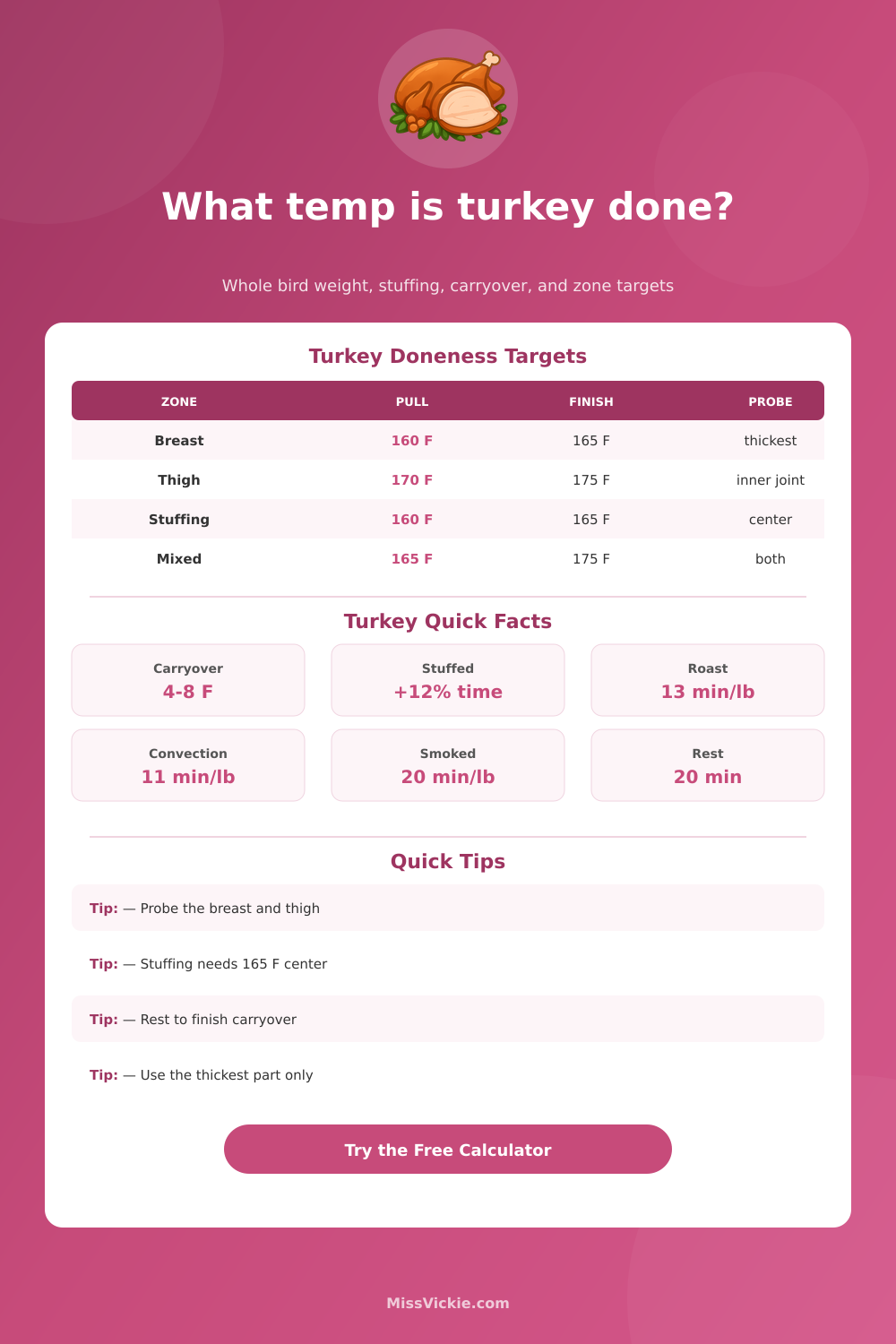
Use these turkey-specific guides to compare zones, stuffing load, method speed, and carryover before you trust the last temperature check.
| Zone | Pull | Finish | Probe point |
|---|---|---|---|
| Breast | 160 F | 165 F | Thickest center |
| Thigh | 170 F | 175 F | Inner leg joint |
| Stuffing | 160 F | 165 F | Middle of cavity |
| Mixed | 165 F | 175 F | Check both spots |
| Method | Minutes/lb | Oven Temp | Best cue |
|---|---|---|---|
| Classic roast | 13-15 | 325 F | Even browning |
| Convection | 11-13 | 325 F | Fan speed |
| Spatchcock | 9-11 | 400 F | Flat and fast |
| Smoke | 18-24 | 275 F | Slow probe |
| Stuffing | Time | Carryover | Risk cue |
|---|---|---|---|
| Unstuffed | 1.00x | High | Fastest path |
| Lightly | 1.10x | Med | Check cavity |
| Fully | 1.18x | Lower | Longer finish |
| Mixed load | 1.14x | Med | Probe twice |
| Weight | Rest | Carryover | Probe start |
|---|---|---|---|
| 8-10 lb | 15-18 min | 4-5 F | At 80% |
| 12-14 lb | 18-22 min | 5-6 F | At 82% |
| 16-18 lb | 22-28 min | 6-7 F | At 84% |
| 20+ lb | 28-35 min | 7-8 F | At 85% |
Pull early for the juiciest white meat and var carryover close the gap.
Dark meat wants more heat, so this spot should be the last to leave the oven.
Stuffing slows the core, so the bird needs a longer runway before it is done.
The cavity heats cleanly, so the doneness check is simpler and the finish is cleaner.
The fastest way to verify the breast and thigh temperatures.
Useful for long roasts when the last 10 degrees matter most.
Lifts the bird so the heat moves under the whole turkey evenly.
A wide board helps the juices settle while carryover finishes.
To prepare a turkey that is succesful cooked, one must understand the process of carryover cooking. Carryover cooking are the process whereby the internal temperature of the turkey continues to rise after you remove the turkey from the oven. The reason for this temperature rise is due to the fact that the heat from the outer layer of the turkey continues to even out with the temperature of the turkey’s center, especially during the resting period of the turkey.
Should one not account for the process of carryover cooking, the turkey may become dry and too tough due to the internal temperature of the turkey exceeding the targetted internal temperature of the turkey. Due to the difference in composition of the thickest part of the turkeys breast and its thigh portion, each portion require different internal temperatures to ensure that the turkey’s breast dont become dry. More specifically, the turkey’s breast will become dry if its internal temperature is too high; thus, the cook should remove the turkey from the oven at 160 degrees F. Due to carryover cooking, the turkey’s breast will reach 165 degrees F, which are the targeted internal temperature of the turkey’s breast.
Why Your Turkey Keeps Cooking After You Take It Out
In contrast, the turkey’s thigh muscles reaches a higher temperature; as a result, the thigh should be removed from the oven when the internal temperature reach 170 degrees F. Carryover cooking will raise the internal temperature of the turkey’s thigh to 175 degrees F, which is the targeted internal temperature for the thigh. The weight of the turkey and the method in which the turkey is cooked will have an impact on how the turkey is cooked. For instance, the more substantial the turkey, the more carryover cooking that will occur for that turkey.
Additionally, if the turkey is stuffed, the stuffing will require longer cooking time based off its insulating property. Additionally, if the turkey is cooked with methods other than roasting, such as convection or smoking, the cooking time will change for that turkey. One should utilize a kitchen thermometer to ensure that the turkey reach the proper internal temperature.
Timers that pop out of the turkey isnt accurately in measuring the internal temperature of the turkey. The thermometer should be inserted into the thickest portion of the turkey’s breast and into the thigh joint. However, the thermometer should not be placed into the bone of the turkey; the bone will conduct heat different than the turkey meat, thus rendering the internal temperature reading from the thermometer inaccurate.
It is mandatory for the turkey to rest for at least 20 minutes after removing the turkey from the oven. Allowing the turkey to rest enable the juices within the turkey to redistribute throughout its interior, as well as allowing the protein within the turkey to relax. If the turkey is not allowed to rest, the juices will exit the turkey once it is carved, rendering the turkey dry.
Additionally, one should cover the turkey with a foil while resting, but should not be covered too tightly, as excessive steam may make the skin of the turkey soggy. Finally, the internal temperature of the turkey should be checked once the turkey has completed 80 to 85% of its estimated cooking time. Checking the temperature too early may cause the turkey to overcook.
By measuring the temperature of both the turkey’s breast and thigh portions, the carryover cooking of the turkey will enable the turkey to reach the proper internal temperature for those different portions.