Turkey Brine Salt Calculator
Measure salt for wet brines, equilibrium brines, and dry brines using turkey weight, water volume, salt density, salinity target, brine time, and thaw state.
🥣 Turkey Brine Presets
Choose a common turkey setup, then adjust the bird weight, brine volume, salt type, salinity target, and refrigerator timing.
⚖ Brine Inputs
Your Turkey Brine Plan
Salt, timing, and food-safe brine checks will appear here.
Measurement Breakdown
Food-Safe Timing Checks
🧂 Salt Density Reference
Salt brands vary by crystal shape. For repeatable brines, weigh salt in grams and use volume only as a kitchen convenience.
📊 Turkey Brine Timing Table
| Turkey Weight | Traditional Wet Brine | Equilibrium Wet Brine | Dry Brine | Food-Safe Note |
|---|---|---|---|---|
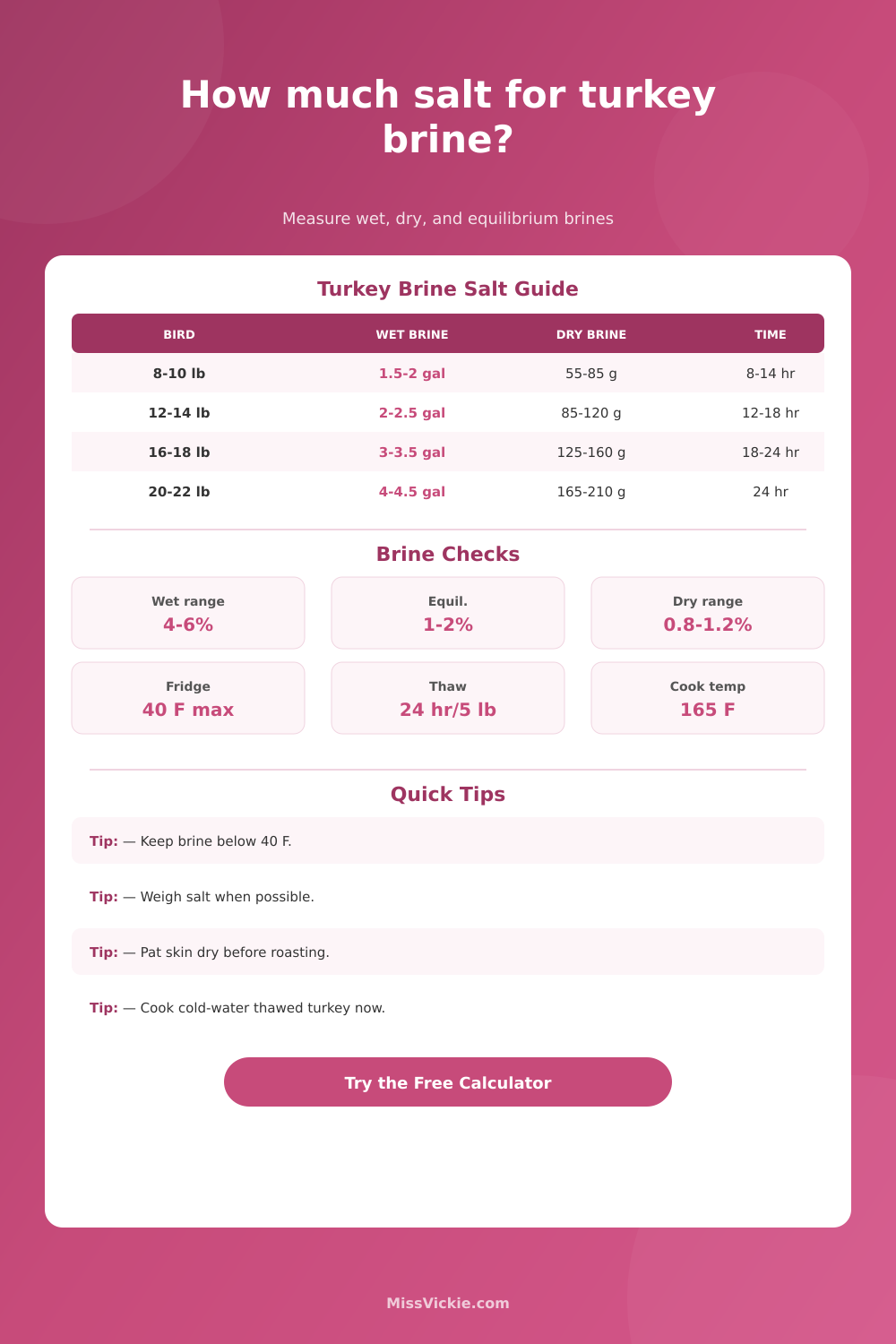
| 6 to 10 lb turkey or breast | 6 to 12 hours at 4% to 6% | 12 to 24 hours at 1% to 2% | 12 to 24 hours at 0.8% to 1.2% | Keep covered at 40 F or below. |
| 11 to 15 lb whole turkey | 12 to 18 hours at 4% to 6% | 18 to 30 hours at 1% to 2% | 24 to 36 hours at 0.8% to 1.2% | Refrigerator thawing can overlap. |
| 16 to 20 lb whole turkey | 18 to 24 hours at 4% to 5% | 24 to 36 hours at 1% to 1.8% | 36 to 48 hours at 0.7% to 1% | Use a cooler only if it stays below 40 F. |
| 21 to 24 lb whole turkey | 20 to 24 hours at 3.5% to 5% | 30 to 48 hours at 1% to 1.6% | 40 to 48 hours at 0.7% to 1% | Long strong brines can taste salty. |
Traditional wet brine ranges are culinary planning ranges, not a substitute for refrigerator temperature control and thermometer-verified cooking.
🌡 Food-Safe Thawing and Temperature Table
| State or Step | Safe Timing Rule | Calculator Use | Action Before Cooking |
|---|---|---|---|
| Refrigerator thawing | About 24 hours per 4 to 5 lb | Useful for frozen or partly frozen birds | Brine only while held at 40 F or below. |
| Cold-water thawing | About 30 minutes per pound | Use for last-minute thaw checks | Change water every 30 minutes and cook immediately. |
| Frozen turkey cooking | At least 50% longer than thawed | Do not brine solid frozen at room temperature | Cook to 165 F in breast, thigh, and wing. |
| Wet brine holding | Keep below 40 F for entire brine | Calculator flags unsafe holding temps | Discard used brine after raw turkey contact. |
🧪 Salinity and Salt Method Guide
| Method | Target Range | What It Means | Best For |
|---|---|---|---|
| Traditional wet brine | 4% to 6% of water weight | Strong brine bath, timed carefully | Classic holiday turkey and short brines |
| Mild wet brine | 3% to 4% of water weight | Less salty but still seasoned | Longer soaking or sensitive palates |
| Equilibrium wet brine | 1% to 2% of turkey plus water | Salt is based on total system mass | Precise, lower-risk extended brines |
| Dry brine | 0.7% to 1.2% of turkey weight | Salt goes directly on skin and meat | Crisp skin and fridge-space control |
🍲 Common Turkey Brine Volumes
| Turkey Size | Minimum Container | Typical Water Volume | 5% Wet Brine Salt |
|---|---|---|---|
| 8 to 10 lb | 12 to 16 qt pot or bag | 1.5 to 2 gal / 5.7 to 7.6 L | 285 to 380 g salt |
| 12 to 14 lb | 20 qt food-safe container | 2 to 2.5 gal / 7.6 to 9.5 L | 380 to 475 g salt |
| 16 to 18 lb | 28 qt cooler or bucket | 3 to 3.5 gal / 11.4 to 13.2 L | 570 to 660 g salt |
| 20 to 22 lb | Large food-safe cooler | 4 to 4.5 gal / 15.1 to 17 L | 760 to 850 g salt |
✅ Brine Safety and Kitchen Notes
Keep the bird, brine, and container at or below 40 F / 4 C for the full hold.
Check breast, innermost thigh, and innermost wing with a food thermometer.
Cold-water thawing is a thaw method, not a long unattended brining method.
Plan thaw time before brine time, especially with a bird still icy in the center.
💡 Brining Tips
For most people, there’s one key ingredient to the holiday meal. And if you’re doing that right, you better get it done just right. The meat should be crisp-skinned and juicy. It should not be over-salted or too risky. At least, that’s how you want things to turn out.
So brining seems like an easy solution. Throw it in some salty water, let it soak. Except that it’s not so easy. Each brand of salt has a different density. How big is your pot? What size bird? How long will it take? Get any variable wrong and you’ve ruined the entire meal plan.
How to Brine Your Turkey Correctly
This webapp takes care of all the math for you. It turns all these variables into a straightforward plan.
Most people underestimate how much salt actualy goes into a brine. A lot? Yes. But remember, that’s salt dissolved in water. Also, some of the salt doesn’t get absorbed by the turkey. Getting the salt amount right is a major variable and risk factor. Salinity is. Salinity is the ratio of salt to total weight of the water. Usually a normal wet brine will target 4-6 percent. That sounds really salty, but it gets the salt into the meat fast.
What about table salt vs. What about kosher salt? Table salt is fine and dense. Kosher salt is flakier and lighter by volume. You can’t use volume as your measurement and expect accurate results. Only weighing the salt (in grams) works. The tool makes this easy because you specify type of salt and it adjusts the density accordingly.
How salty is a brine? That’s when things get tricky. How long do you put it in the brine? It’s not just any amount of time. Put the turkey in the brine for too little time and it’s just like having the seasoning sit on top of your turkey. Put it in for too long, however, and your turkey will be either too salty or even worse, mushy. On the page, you’ll find a chart that explains this. How long should you let it go for? It depends on its size. Ten pounds is different than twenty pounds.
And there are shades to the technique. One more gentle way (equilibrium brining) involves a longer soak time with less salt in the water. Here, you’re aiming for balance, your bird and liquid is meant to hit a balance point together. Because it is less aggressive than other methods, there is less chance of oversalting, but you have to wait longer for it to work.
There’s also dry brining, which eliminates all that liquid business. You just rub some salt onto the skin, stick your bird in the fridge, and call it good. It’ll help with browning. It will also keep it off your counter. But you have to do some math specific to meat weight.
And there’s safety: Don’t think of brining as a means of preserving food; it’s a flavor-enhancing method that depends on keeping the food cold. In fact, the turkey need to be held at 40°F or below throughout brining. Got a fridge that can hold the whole bird? Good. Otherwise, you may want to invest in a cooler. As long as you stuff it full of ice, that’s fine; the goal is to maintain a cold environment. And under no circumstances should the bird ever touch the counter, or be allowed to soak in warm water.
Another problem: Brining a frozen turkey is even harder. You need to defrost the thing first, which will take roughly one day per five pounds (in the refrigerator). Alternatively, a quicker approach would of being to defrost in cold water, changing out the water every half hour; then cook the bird promptly afterwards. The calculator flags this time-related hazard, just in case you forget and leave the bird sitting in an unsafe temp zone.
Salt doesn’t have to be replaced with sugar and aromatic ingredients to add flavor (though you can do so if you want). Salt penetrates into the meat. Honey, citrus, and other herbs primarily flavor the liquid or perhaps the outer layer of meat. Adding a lot of acidity. Like cider vinegar or lemon juice, will begin to “cook” the exterior of the turkey, resulting in a curdled texture on the meat. Limit your acidic additions.
After brining, rinse the bird off under cool water (to remove any excess salt that may remain on the surface) and then pat dry. For crispy skin, this drying out process is important. Moisture is the enemy of browning. To help the final crust more, let the turkey air dry overnight in the refrigerator before roasting.
Control: That’s what brining is all about. It keeps the bird juicy while balancing out the dryness of the white breast meat with the juiciness of the dark meat. It seasons the bird inside-out, rather than just outside-in.
To do it right, you don’t have to be a chemist. But you should respect the math. Respect the ratios. Measure. Watch the clock. Keep the bird cold. Brining takes effort (but it makes for a moist), flavorful turkey that will pay off at the end of the meal.