Turkey Brine Calculator
Size a wet brine, equilibrium brine, injection brine, or dry-brine conversion for whole turkeys, spatchcocked birds, breasts, legs, and holiday roasts with salt-by-weight math instead of guesswork.
Each preset loads a realistic turkey situation, including cut shape, salt strength, sugar level, coverage water, injection pickup, chilling allowance, and brine time.
Your turkey brine plan
Adjust the turkey weight, brine method, salt strength, and container allowance, then calculate.
Full breakdown
Wet brine percentages here mean salt weight divided by water weight unless you choose equilibrium brine. Dry brine percentages mean salt weight divided by turkey weight.
Fast, familiar, and good for whole birds when the turkey is fully submerged and chilled.
Salt is calculated against turkey plus water, so the final seasoning is gentler and harder to overshoot.
Moves seasoned brine into thick breast meat and large roasts, then a light soak evens the surface.
Uses no tub of liquid, helps skin dry, and seasons by turkey weight instead of water volume.
| Turkey Cut | Coverage Rate | Salt Target | Typical Time |
|---|---|---|---|
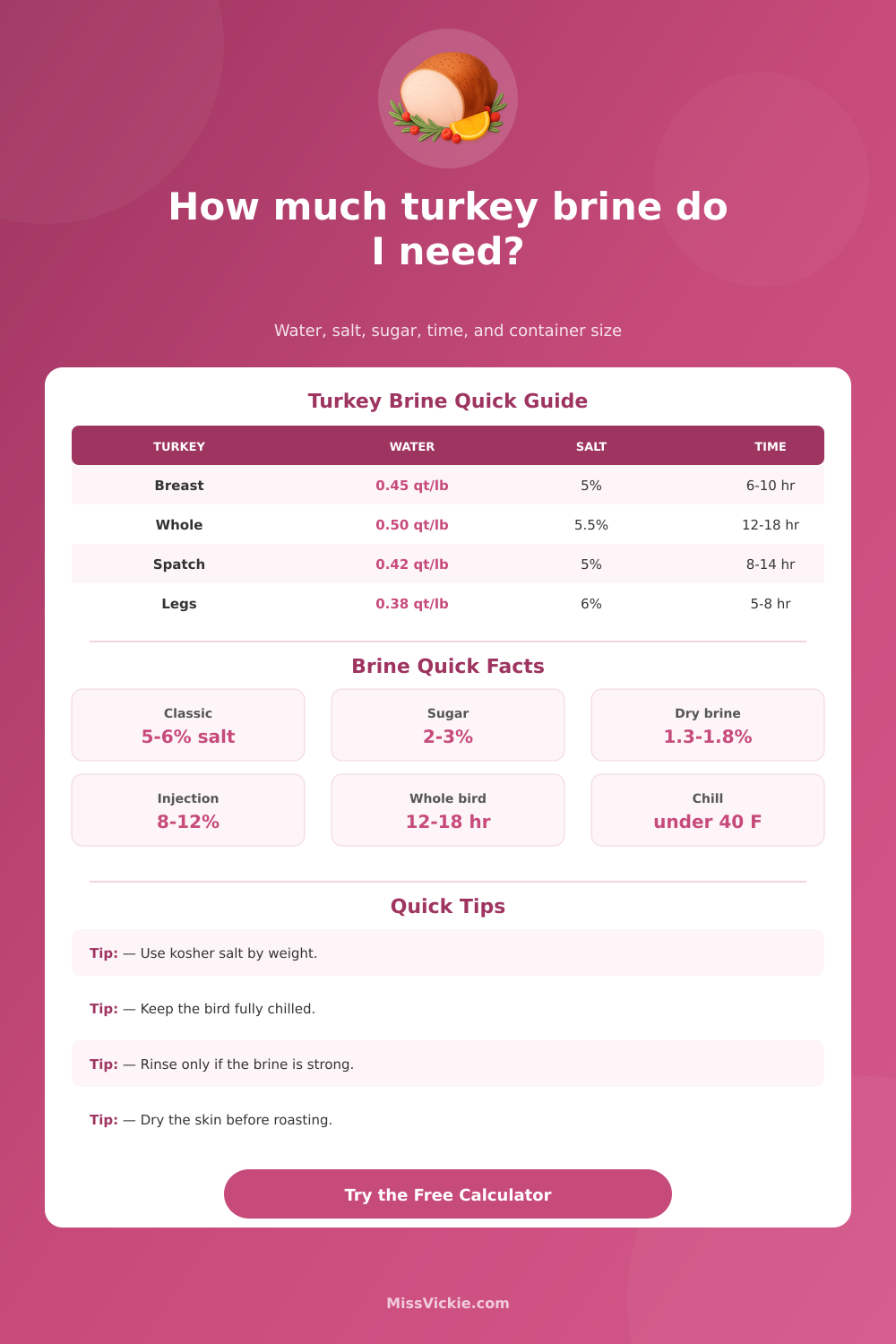
| Whole turkey, 10 to 16 lb | 0.48 to 0.55 qt per lb | 5.0 to 6.0 percent wet brine | 12 to 18 hours, then dry skin well |
| Spatchcocked turkey | 0.38 to 0.45 qt per lb | 4.8 to 5.5 percent wet brine | 8 to 14 hours because the bird is flatter |
| Bone-in turkey breast | 0.42 to 0.50 qt per lb | 4.5 to 5.5 percent wet brine | 6 to 10 hours for a juicy but not hammy texture |
| Boneless breast roast | 0.35 to 0.42 qt per lb | 4.0 to 5.0 percent wet brine | 4 to 8 hours, or inject for thick roasts |
| Drumsticks, thighs, and wings | 0.32 to 0.40 qt per lb | 5.5 to 6.5 percent wet brine | 4 to 8 hours because pieces expose more surface |
| Ingredient | Approx Cup Weight | Best Use | Calculator Detail |
|---|---|---|---|
| Diamond Crystal kosher salt | About 137 g per cup | Flaky, lighter cup measure | Produces more cups for the same salt grams |
| Morton kosher salt | About 243 g per cup | Denser crystals | Use less volume than Diamond for equal grams |
| Fine table salt | About 288 g per cup | Strongest cup-for-cup choice | Best weighed because a cup is very salty |
| Light brown sugar | About 220 g per packed cup | Classic roast turkey brines | Adds browning and balances salt perception |
| Honey | About 340 g per cup | Injection or dissolved brines | Counts as sugar weight after it is mixed in |
| Turkey Size | Classic Water | 5.5% Salt Weight | Container Planning |
|---|---|---|---|
| 6 lb breast | 2.7 to 3.0 qt | 140 to 156 g salt | 8 to 10 qt nonreactive container |
| 10 lb spatchcocked bird | 4.0 to 4.5 qt | 208 to 234 g salt | 12 to 16 qt food-safe tub or bag |
| 12 lb whole turkey | 5.8 to 6.2 qt | 302 to 322 g salt | 16 to 20 qt stockpot, bucket, or brining bag |
| 16 lb holiday turkey | 7.6 to 8.8 qt | 395 to 457 g salt | 24 qt cooler or tall food-safe container |
| 20 lb large turkey | 9.5 to 11 qt | 494 to 572 g salt | Use equilibrium brine or a very cold cooler setup |
| Variable | Target Range | Why It Matters | Adjustment |
|---|---|---|---|
| Brine temperature | 34 to 40°F / 1 to 4°C | Raw poultry must stay cold while salt diffuses | Chill brine fully before adding turkey |
| Strong brine time | Shorter window | High salt brines season quickly but can taste cured | Use 4.5 to 5 percent or reduce hours |
| Skin crisping | Dry surface | Wet skin steams before it browns | Air-dry uncovered after brining when possible |
| Injected breast | 8 to 12 percent pickup | Thick white meat benefits from internal seasoning | Reduce soak time to avoid oversalting the surface |
Brining a turkey requires many different variable to consider to ensure that the turkey meat comes out juicy, not wet. Many variables can impact the brining of turkey including the size of the turkey, the thickness of the turkey breast, and whether the turkey is a whole turkey or a spatchcocked turkey. Other variables include the salt concentration in the brine, and how long the turkey is to sit in that brine.
Each of these variables can be managed with the calculator to remove the guesswork that an individual might otherwise use in scaling the recipe. Many people know that adding more salt to the turkey will produce more flavor. However, the flavor relationship with salt is not direct; the salt must move into the turkey’s meat through a process called diffusion.
How to Brine a Turkey with a Calculator
Diffusion takes time to move the salt to the turkey’s center. While a strong brine will allow the turkey to season faster, the stronger the brine the more the turkey’s surface may season to the flavor of the brine before the center of the turkey seasons to the same flavor. For this reason, the calculator also asks for the salt strength of the brine and the thickest measurement of the turkey cut.
The thicker the turkey the longer that the salt must travel to reach the center of the turkeys meat. For instance, a turkey with a six-inch breast will take longer to season than a spatchcocked turkey with a four-inch breast. The water rate for the brine asks for how much liquid the brined turkey requires to cover the turkey.
This is not asking for the amount of brine that is to be used, but rather the amount of liquid that will be required to cover the turkey that is placed into a container. Turkeys require more liquid than legs or wings. If the container isnt filled enough, parts of the turkey will remain half submerged in the brine.
Additionally, if the container is filled with too much liquid, the brine may overflow from the container when the refrigerator is opened. The calculator includes allowances for these variables as well. The amount of sugar that is to be used in the brine will aid in the browning of the turkey’s skin and will also help to soften the perception of the salt in the turkey’s meat.
Since sugar does not penetrate the turkey’s meat as salt does, the user of the calculator can adjust the amount of sugar in the turkey. Some may desire a turkeys with a sweet flavor while others may not desire the addition of sweetness to the turkey’s flavor. The same is true of the aromatics choice.
Aromatics will add flavor to the brine but less than a percentage of that flavor will find its way into the turkey’s meat. Aromatics will prevent the brine from having a flat flavor but can be skipped over by individuals who wish only to season the turkey evenly and add moisture to the meat. Dry brining is accomplished on a different principle than wet brining.
A small amount of salt is applied to the turkey’s skin. The turkey releases moisture and reabsorbs the moisture. The calculator can also convert a wet brining recipe to a dry brined turkey target and show the difference in the weight of the salt that will be required.
Dry brining will take longer than wet brining. Dry brined skin will be dryer than wet brined skin and drier skin will lead to crispy skin when roasted. Injection is somewhere in between dry brining and wet brining.
The seasoned liquid is pushed into the breast of the turkey where the turkey is thickest. The turkey will sit in the brine for a shorter period of time after this step. Injection is a percentage of the turkey’s weight since there is a limit to how much liquid the turkey can hold.
Too much injection will lead to the turkey’s skin tasting oversalt. The time for the turkey to sit in the brine will be shorter if the turkey is injected with the seasoned liquid. Raw turkey must remain below 40 degrees throughout the brining process.
The refrigerator that is used to brine the turkey may not remain at a constant temperature. The refrigerator field in the calculator will account for the refrigerator’s temperature since that will impact the rate at which the salt diffuses into the turkey’s meat. If the refrigerator is warm the time for brining can be shortened so that the raw turkey remains below 40 degrees.
The container in which the turkey is to be brined may impact the amount of liquid that is required. If the turkey is to be placed into a brining bag the amount of liquid will be less than if the turkey is to be placed in a stockpot. Brining bags will conform to the shape of the turkey and require less space in the container.
Additionally, the brining container may contain ice packs to keep the turkey’s temperature low. The headspace in the container will be accounted for in the calculator since there is risk in both running out of space and buying a container that is too large. The value of the calculator allows for each of these variables to be considered individually.
For instance, if a person desires a gentle brine they may determine that that type of brine is best applied to a smaller turkey. An injected turkey breast may require less time in the brine than a whole turkey. The type of salt can impact how many cups of salt are required since different types of salt contain different amounts of salt per cup.
Swapping types of salt may require adjustments to the amount of salt to be used. Finally, after brining the turkey the skin should be patted dry to allow for crispy skin when the turkey is roasted.