Turkey Breast Smoking Time Calculator
Estimate active smoke time, first probe check, ready-after-rest timing, and cooked yield for bone-in or boneless turkey breast using weight, smoker temperature, brine, skin, starting temperature, safe target, and rest.
Choose a Smoking Preset
Each preset fills realistic turkey breast settings and recalculates immediately.
Turkey Breast Smoke Inputs
Your Turkey Breast Smoke Plan
Times are estimates. Verify the thickest center with a food thermometer.
Time Factors
Cooking Details
Smoking Reference Grid
Cut Comparison Grid
Slowest center heat, strong moisture buffer, best for holiday carving.
Faster and even, but easier to overcook if the thin end faces hot airflow.
Moderate pace with a smaller footprint and easier probe placement.
Compact shape cooks thicker than it looks, especially when injected.
Baseline Smoking Times by Cut
| Turkey Breast Cut | Typical Weight | 250 F Baseline | Best Use | Probe Placement |
|---|---|---|---|---|
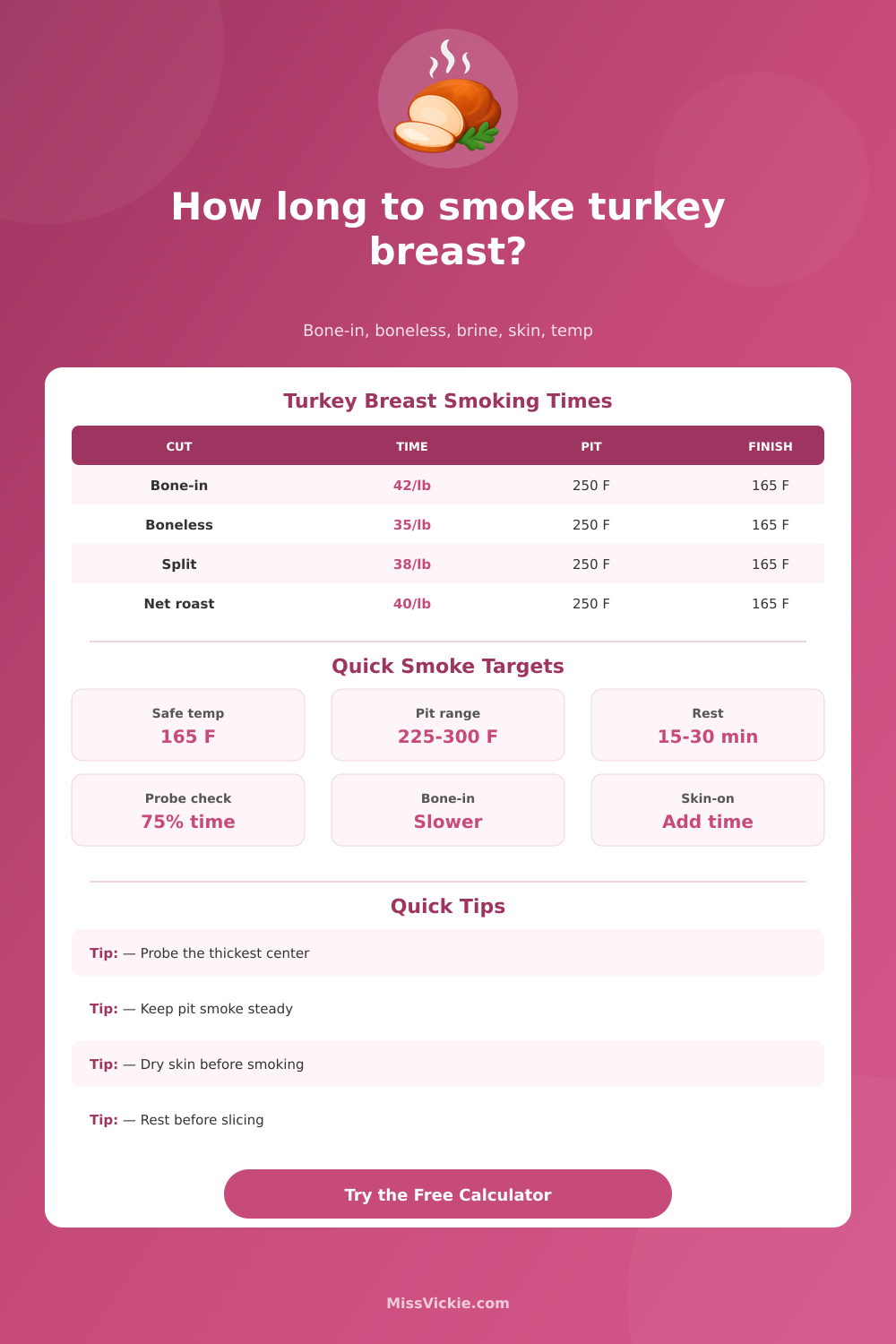
| Whole bone-in breast | 5 to 8 lb | 40 to 45 min per lb | Holiday slicing and smoky skin | Thickest breast center, away from bone |
| Boneless breast lobe | 2 to 4 lb | 32 to 38 min per lb | Weeknight slices and sandwiches | Middle of the thickest lobe |
| Split bone-in breast | 2.5 to 5 lb | 36 to 41 min per lb | Smaller gathering with skin-on flavor | Thickest side, not touching rib bone |
| Boneless netted roast | 3 to 6 lb | 38 to 44 min per lb | Uniform slices and meal prep | Center of the roast bundle |
| Tenderloins | 1 to 2.5 lb | 28 to 34 min per lb | Fast smoker meal | Largest tenderloin center |
| Two similar breasts | 6 to 12 lb total | 35 to 43 min per lb each | Party trays with even pieces | Probe the larger breast first |
The calculator scales by individual piece shape, not just total meat. Two smaller breasts often finish sooner than one very thick breast of the same total weight.
Smoker Temperature Adjustment Table
| Smoker Temp | Cooking Pace | Skin Result | When to Probe | Calculator Effect |
|---|---|---|---|---|
| 225 F | Slowest, deepest smoke | Soft unless finished hotter | After about 75 percent of estimate | Adds about 10 to 15 percent |
| 240 F | Gentle smoke pace | Lightly rendered skin | Start checking in the last hour | Adds about 4 to 7 percent |
| 250 F | Reference setting | Balanced smoke and moisture | Use calculator probe time | Baseline |
| 275 F | Faster holiday pace | Better skin rendering | Check earlier than low smoke | Reduces about 8 to 12 percent |
| 300 F | Hot smoke finish | Best color, less smoke time | Probe before the final third ends | Reduces about 16 to 20 percent |
Brine and Skin Timing Table
| Choice | Time Change | Moisture Effect | Surface Note | Calculator Logic |
|---|---|---|---|---|
| No brine, dry rub only | No extra time | Leanest texture | Rub can darken faster | Neutral factor |
| Dry brined 12 to 24 hours | Slightly faster | Seasoned and juicy | Best for skin drying | Small time reduction |
| Wet brined overnight | Slightly slower | Strong moisture buffer | Pat very dry before smoking | Adds a small delay |
| Injected or enhanced breast | Slightly slower | Juicy but uneven thickness matters | May brown quickly | Adds a small delay |
| Skin-on with crisp finish | Longer active plan | Good breast protection | Finish near 300 F if desired | Adds finish time |
| Foil shield after color | Can slow surface heat | Protects dark rubs | Use once color is set | Adds mild time |
Target, Rest, and Yield Table
| Item | Recommended Range | Why It Matters | Result Impact | Calculator Treatment |
|---|---|---|---|---|
| Target internal temp | 165 to 170 F | Turkey breast needs a verified safe center | Higher target adds minutes | Minimum allowed is 165 F |
| Starting internal temp | 33 to 40 F chilled | Cold centers take longer to climb | Warm starts reduce estimate | Scaled against heat rise |
| First probe check | 70 to 80 percent of time | Prevents overshooting the lean breast | Earlier on hot smokers | Shown as a result card |
| Rest time | 15 to 30 minutes | Juices settle before slicing | Adds to ready time | Included after smoke time |
| Cooked yield | 72 to 80 percent | Brine and skin can reduce moisture loss | Sets serving estimate | Adjusted by cut and brine |
Cooked Turkey Breast Nutrition Estimate
Turkey Breast Smoking Tips
Smoking a whole turkey breast is fine. But smoking just the turkey breast are much harder; you can’t rush it, which makes it tricky. Sure, you might pace around watching the clock all morning, but meat doesn’t give a crap about your time table. It gives a damn about heat transfer and moisture retention.
Pull it off early and there may be safety concerns. Leave it on too long and…well, that’s just dry shoe leather. Guessing wrong in either direction isn’t going to get you very far. Accurate timing is what’s important here. And the calculator up top will do the math for you after you input details of your smoker temp and cut type. You won’t have to wonder if you should of left it on for an extra couple of hours.
How to Smoke Turkey Breast Perfectly
Is that bone-in breast gonna need an extra hour? But then there’s also cut. And this is where things get interesting because bone is both a heat sink and insulator. This means a boneless lobe of equal weight will cook faster than a whole bone in breast. That wider margin for error (yes!) comes at a price. Patience. The bone slow down the cooling of the center so it takes longer.
Then there’s shape. Shape matters with netted roast or even a split breast. How does the grill adjust for that? It doesn’t have to remember a coefficient. It just does. It knows a flat split half will hold heat different than a compact netted roast. Select the cut that matches what’s on the grate. No need to memorize anything.
The second part of this equation is temperature consistency. Most folks believe smoking requires putting lid on and waiting. Sure, but when was the last time you opened the lid and checked color? Did you spritz the meat? Each of those actions costs you heat. That resets your cooking curve. With the calculator, you can account for regularly checking temperatures (intervention) vs maintaining consistant smoke.
Basting every 45 mins bumps up active cook time. No magic trick there. Just physics. The added buffer will help keep you from pulling meat too soon and risking making it unsafe. Allows you to plan your day around what’s cooking, not staring at a gauge freaking out.
Let’s talk about brine, which affects both initial temp and density. First, a wet brined breast is heavier because of the water. So there’s more mass that has to be heated. And unless you take it out of the refrigerator immediately to cook, it will typically begin cooler as well. The calculator includes this little lag.
Now, dry brining is different. It seasons the breast without adding substantial weight. In fact, dry brining may help render the skin faster since its drier on the surface. This is a small detail, but it impacts how you handle it at the finish. Covering the breast early on will stop crispiness. Allow the heat to go to work all the way to the end if you desire skin crunchiness.
This means it is time to probe. Most home cooks fail by sticking a thermometer in the thinnest part of the wing or near the bone and calling it done. This results in a false positive. Put that probe all the way into the meat, away from the bone and pan metal (the thickest part). The calculator suggests when to start checking based off the seventy-five percent mark of the estimated time.
Since it’s an estimate, this number is really just a guideline. Check yourself with your own thermometer. You can trust the calculator, but don’t be so trusting as to not check for yourself. It is fine to use the calculator to know what to expect, but you shouldn’t rely on it to do the work for you.
You have to let it rest. Why? Because turkey breast are lean. There’s not much fat on the meat to keep it juicy as you slice. When you cut into it when it’s still warm, all of your juices leak onto the cutting board. It instantly loses texture and flavor.
That rest time becomes part of the cook time, which is why you add that wait time to your overall estimate. While it rests for those twenty minutes, it keeps getting hotter from the inside. That extra cooking ensures that even if you take it off just a bit too soon, the center will be up to a safe temp. This makes the finished product more consistant.
But there’s also a practical element: serving size. Many of us buy our meat in whole birds. We use them to estimate amounts, but it is really just a guess. A breast weighs less cooked than raw because you have to subtract water and bone. The calculator estimates your end result so that you can plan accordingly when it comes to accurate side dishes. No more embarrassing empty-table-when-guests-are-stuffed moments.
Control is the name of the game with smoked turkey breast. Control the temperature. Control the time. And control the fire. Leave the rest to biology. Don’t fight the process. Establish a steady heat in your smoker. Trust the estimated times that the tool gives you. Let the probe be your guide as to when to make the final call. Patience pays off in flavor. Every time you rush it, you ruin it.