
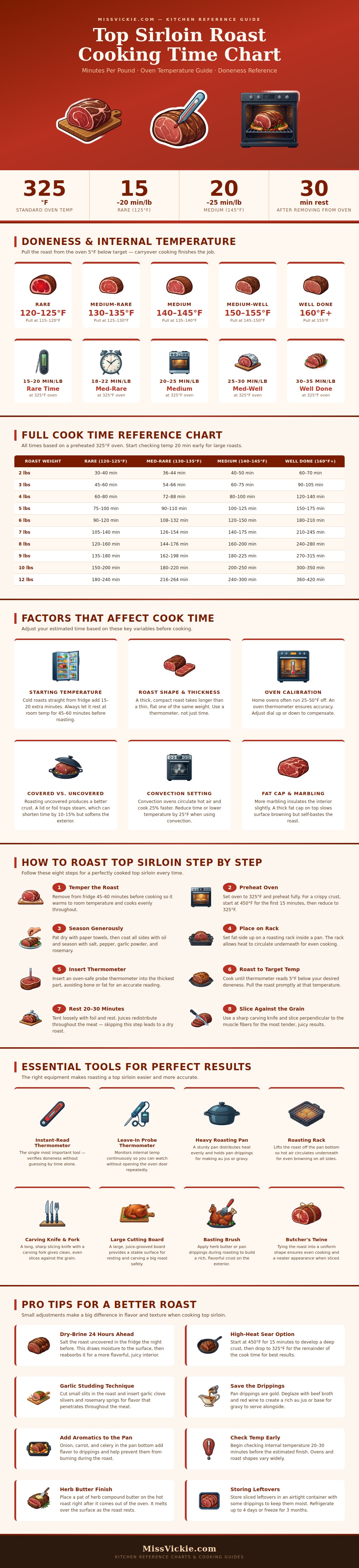
There’s a particular kind of kitchen anxiety that comes from pulling a five-pound top sirloin roast from refrigerator. It rests heavily on counter; it is chilly and waiting. And yet it’s also true that dinner must be on the table at seven, though you can’t quite decide if it should goes in oven soon or later. The worry isn’t that you’ll undercook the meat: There’s always time for more cooking. No, the worry is that you’ll scurry to get the table set, only to overcook your roast into a dry brick of regret. That’s how many a dinner party has been spoiled, and why this error happen each holiday season.
This chart breaks it down by weight (above), saving you from having to stare at the clock and go in panic mode. At a normal 325-degree-Fahrenheit temperature, it shows you just how long per pound you’ll have to wait until your meal reaches rare, medium-rare, or medium doneness. If you’ve got a two-pound roast, you’re in and out of the oven fast; when you’ve got a ten-pounder, you’d better be patient… It will take almost four hours.
How to Cook Your Roast Perfectly
It’s obvious from looking at it that if you’re going off memory alone, time is your enemy, and you’ll end up with some tough, gray meat. These baseline take away the guesswork from equation. But the numbers aren’t everything. Here’s the true key: carryover cooking.
This is what happens when the roast keep cooking inside after coming off the heat source, and it affects each of these pull temps. As you can see from infographic, all of those pull temps are actualy five degrees lower then your desired end result. Why? Residual heat will still be in meat as you let it rest, raising its internal temp further. Pull a perfectly medium roast right at 145 degrees out of oven and by the time you cut it up, it’ll probably has overshot into medium-well territory. It is a small margin for error, but one that makes all the difference in texture.
Additionally, most home cooks forget about initial temperature of their meat. If you take a cold or frozen roast out of your fridge and throw it directly into hot oven, it will cook unevenly. The outer parts burn while interior is still warming up. To avoid this, the guide recommends taking the roast out of the fridge ahead of time and allowing it to reach room temperature for about an hour before putting it in the oven to roast. Seems like more effort, but it pays off in consistency.
Oven calibration is another quiet way to ruin a good roast. In many homes, their ovens is off by as much as twenty-five degrees and hotter or colder before they know it. The chart’s based on a perfectly calibrated 325-degree environment, not something that happens often in reality. That is why the article emphasizes not just relying on time, but on using a thermometer to check roast doneness. A roast will cook faster if your oven’s hot, and slower if it’s cold. Only the probe can tell you when the roast are ready; the clock only tells you how long ago you began.
Thickness is another very important factor in cook times, as is shape. The same pound of meat, if shaped like a flat patty instead of a thick round cylinder of beef, will have less surface area, meaning it’s going to take less time to cook through even though it still takes the same amount of time per pound. Because the center of a thick roast holds onto heat longer, it need additional overall time, even at the same estimated per-pound rates.
Charts are useful, but not perfect; that isn’t a law of physics. It’s a guide you should of followed. After removing from heat, tenting the roast in foil and letting it rest for at least 20 minutes gives the juices an opportunity to move back into the fibers. If you cut into it right away, all that juice come out on the cutting board, leaving you with…dry slices. It is a disappointing conclusion after all those hours of careful cooking. Take the extra time to rest and you’ll have tender, juicy beef that’s just as good as you imagined when purchasing it.