Tomatoes Per Can Calculator
Convert tomato cans into fresh tomato count, drained cups, sauce cups, puree yield, recipe batches, and shopping needs.
🍅Canned Tomato Presets
Pick a common kitchen job, then adjust can size, can count, canned tomato style, fresh tomato size, drained use, recipe use, moisture loss, and cup target.
⚖Can And Recipe Inputs
Canned tomato estimate
Your can conversion appears here.
Can Breakdown
Yield Breakdown
Recipe Plan
📌Quick Can Cards
🔍Canned Tomato Comparison Grid
A 14.5 oz can gives chunks and juice for chili, tacos, and salsa.
A 28 oz can crushes into a rustic sauce with strong tomato body.
A 28 oz can gives a spoonable base for pasta, soup, and braises.
Smooth tomato base with fewer chunks and less draining work.
An 8 oz can is already smooth, seasoned by some brands, and ready to simmer.
A 6 oz can equals several cups of reduced tomato flavor.
Similar to diced tomatoes with smokier taste and slightly softer chunks.
Soft pieces with added seasoning and a looser cooked texture.
📊Can Size Tomato Equivalent Table
| Can size | Common label | Approx cups | Fresh Roma equivalent | Best use |
|---|---|---|---|---|
| 6 oz | Tomato paste | 0.7 to 0.8 cup | 3 to 5 Roma after reduction | Thickening sauce, stew, chili |
| 8 oz | Tomato sauce | 1 cup | 3 Roma after cooking | Pizza sauce, small pasta pot |
| 14.5 oz | Diced or stewed | 1.7 to 1.9 cups | 4 to 6 Roma | Chili, tacos, casseroles |
| 15 oz | Sauce or puree | 1.8 to 2 cups | 5 to 6 Roma | Soup base and one-pan dishes |
| 28 oz | Whole, crushed, puree | 3.2 to 3.6 cups | 9 to 11 Roma | Marinara, braise, large soup |
| 35 oz | Imported whole tomatoes | 4.1 to 4.4 cups | 12 to 14 Roma | Pizza sauce and long simmer sauce |
| 105 oz | No. 10 can | 12.5 to 13.5 cups | 36 to 42 Roma | Meal prep, event sauce, large chili |
🥄Canned Tomato Type Yield Table
| Canned tomato type | Solids share | Cup factor | Fresh tomato match | Recipe note |
|---|---|---|---|---|
| Diced tomatoes | 68% | 0.97x | Roma or medium tomatoes | Drain for firm salsa or spoonable taco filling |
| Whole peeled tomatoes | 72% | 1.00x | Plum tomatoes | Crush by hand for rustic sauce |
| Crushed tomatoes | 78% | 1.02x | Plum tomato pulp | Good middle ground between dice and puree |
| Tomato puree | 86% | 0.95x | Cooked smooth tomatoes | Needs less simmer time than whole tomatoes |
| Tomato sauce | 82% | 0.93x | Cooked blended tomatoes | Check salt before adding more seasoning |
| Tomato paste | 96% | 0.38x | Reduced tomato concentrate | Dilute with water for sauce-style use |
| Fire roasted diced | 66% | 0.96x | Roasted diced tomatoes | Use when smoky flavor is desired |
| Stewed tomatoes | 64% | 1.00x | Cooked tomato pieces | Soft texture and added seasoning |
🧪Recipe Can Quantity Table
| Recipe plan | Finished tomato cups | 14.5 oz cans | 28 oz cans | Fresh Roma equivalent |
|---|---|---|---|---|
| Two pizzas | 1.5 cups sauce | 1 sauce can | 0.5 can | 4 to 5 Roma |
| Chili for 4 | 3 cups chunky | 2 cans | 1 can | 8 to 10 Roma |
| Shakshuka pan | 3.5 cups sauce | 2 cans | 1 can | 9 to 11 Roma |
| Lasagna pan | 5 cups sauce | 3 cans | 1.5 cans | 14 to 16 Roma |
| Soup for 8 | 6 cups puree | 4 cans | 2 cans | 18 to 22 Roma |
| Event marinara | 32 cups sauce | 20 cans | 10 cans | 90 to 105 Roma |
🔧Drain And Simmer Adjustment Table
| Adjustment | Light setting | Standard setting | Heavy setting | When to use it |
|---|---|---|---|---|
| Drain loss | 8% | 22% | 38% | Salsa, casseroles, pizza topping, firm spoonfuls |
| Simmer moisture loss | 10% | 25% | 55% | Quick warm sauce through thick long-simmer sauce |
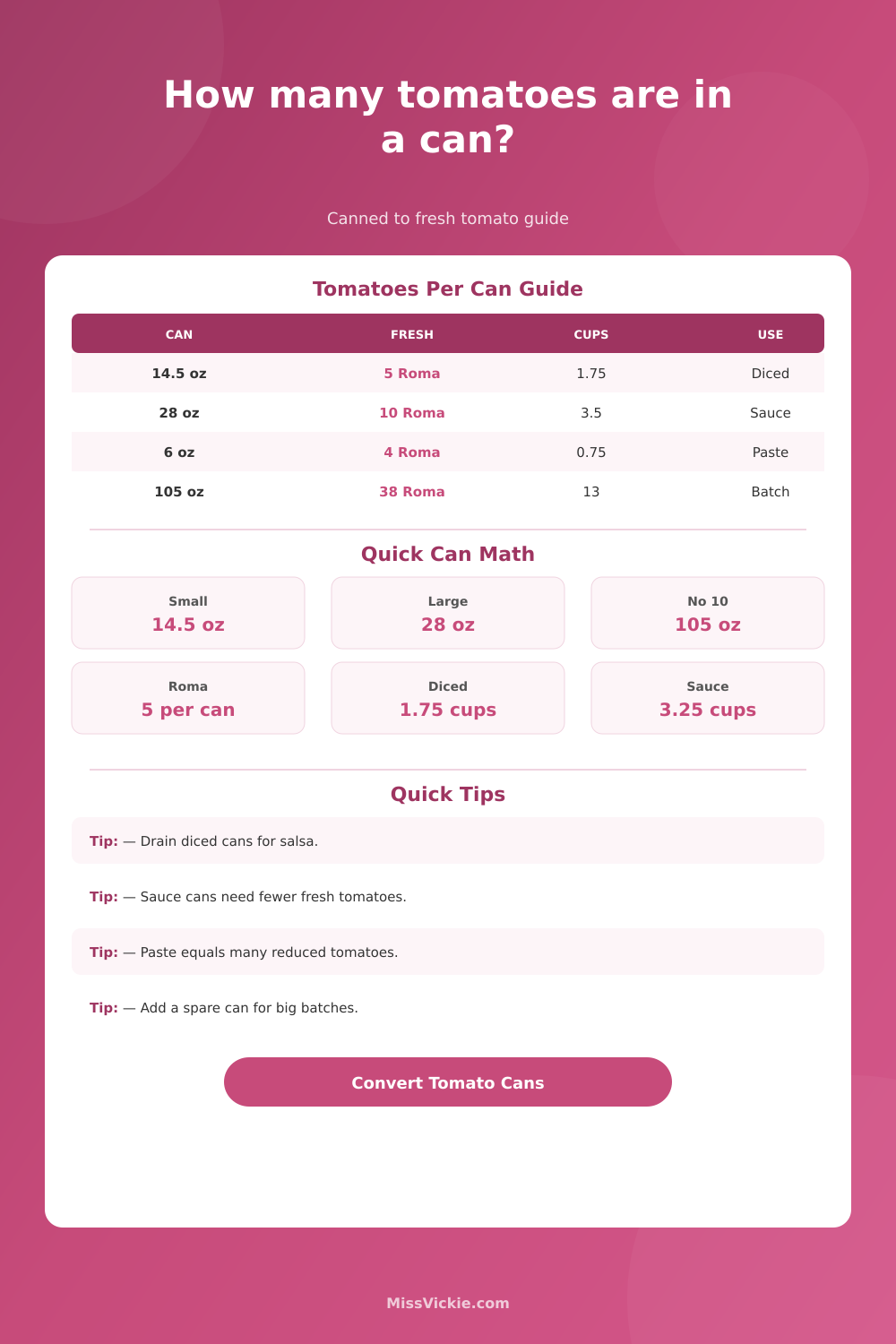
| Fresh tomato swap | 5 Roma per small can | 10 Roma per large can | 38 Roma per No. 10 can | Use when replacing canned tomatoes with fresh tomatoes |
| Batch buffer | 5% | 10% | 20% | Pan residue, tasting, reduction, and serving variation |
💡Canned Tomato Tips
Canned tomato yields vary by brand, pack style, salt level, and tomato variety. The calculator uses common U.S. can sizes and practical kitchen cup estimates.
You know that panic when you pull a recipe out of the archive and it calls for three cups of crushed tomatoes? You don’t know what to do: Is that one can or two? Do I have enough? Everyone guess. Everyone opens up the can, measures out the volume, and hopes it’s right. Canned tomatoes are not cooked by intuition; they’re cooked by geometry. It’s a matter of liquid, solid, and empty space in your pan.
How many cans you need depends on what’s in there before you even open the can. But that’s why the calculator exists: to do the math for you. It takes the guessing out of equation.
Why You Need a Tomato Calculator
Because a can of whole tomatoes (like those pictured below) appears massive. But then you drain them for a salsa, and what remains isn’t as much. What many people don’t realize is that weight of the tomato on the can is not the same than the quantity of tomato in your bowl. That liquid portion? It’s mostly water and juice. Cook it off, discard it, and that’s less there than you think. That impacts your seasonings. And it affects how you shop.
Think about what’s in it. The structure make a difference with ingredients. There is a difference between tomatoes in puree and those cut from whole peeled cans. Hand-crushing whole tomatoes keeps pulp and fiber. That gives the sauce a thicker texture, one that resist breaking down with long cooking times. Puree is already smooth and reduces faster, without chunks. The option let you pick the type of product being used. For instance if you’re preparing lasagna, puree could get to runny. Whole tomatoes provides control over the finished texture. How rustic do you want this?
Another look: How many fresh tomato are in a can? It works out to about 10 roma tomatoes in one big 28-ounce can. That’s a lot of washing, coring and chopping. When we use canned things, it’s not that we’re lazy; it’s about the consistency. Commercial tomatoes is all picked ripe on the vine and then sealed up, which locks in a flavor that winter tomatoes just don’t have. Take a look at the calculator and see how many fruits you’d of had to chop yourself to get as much volume. Maybe this explains why sauce-made-from-cans tends to beat the pants off of fresh when they’re both available out of season. Off-season produce may be mealy and more acidic than desirable.
The main point is that end product depends far more on drainage settings than you might think. Removing most of the liquid (leaving just the solids) takes almost a quarter of the can‘s total weight out of equation. That isn’t wasted; that’s concentrated flavor. The resulting solids are also more intensely sweet, aka high brix levels. They require less added acidity from things like vinegar or sugar. When you want to make soup, retaining the juice provide richness. Tinkering with this setting via the tool change your outcome quite drastically. How you do things determines both taste and volume.
Batch cooking complicates thing. When scaling up a meal from 4 servings to 20, it’s not just a matter of multiplying recipes. As things simmer, they lose moisture over time, which is cumulative. If a recipe simmers in a pot for an hour, it will lose a smaller percentage of moisture than if it simmers for four hours. So the calculator factors this in with options to enter your pan residue buffer and moisture loss. That way you don’t end up running out of sauce. You won’t be feeding your guests empty bowls.
Stop guessing and start planning with mathematical understanding, taste as you proceed; adjust for salt; simmer until it seems right to your eye. Brand will make a difference; so will the year’s harvest. Use these figures as a guide, not an order. But knowing what you’re starting with is helpful. It eliminates guesswork, and turns cooking into planning. It frees you up to think about heat, herbs, and aromatics. Those are the ingredients that distinguish one meal from another.
The tomatoes are the base. If you know how much bedrock you have to work with, everything gets easier.