Tomato Sauce Per Pound Of Pasta Calculator
Scale tomato sauce for dry pasta by pound, pasta shape, sauce style, tomato base, simmer reduction, sauciness, baking, add-ins, and serving count.
Choose a real pasta scenario, then adjust tomato density, reduction, shape, add-ins, and final sauciness.
| Pasta shape | Multiplier | Best sauce texture | Why it changes sauce |
|---|---|---|---|
| Spaghetti or linguine | 0.92x | Smooth or creamy tomato | Long strands need a lighter surface coating. |
| Penne or ziti | 1.00x | Classic tomato sauce | Tubes hold a balanced amount inside and outside. |
| Rigatoni or paccheri | 1.12x | Chunky or meat sauce | Large ridges and hollow centers trap extra sauce. |
| Shells | 1.10x | Rustic crushed tomato | Cups catch tomato pieces and thicker sauce. |
| Fusilli or rotini | 1.08x | Vegetable tomato sauce | Spirals carry sauce through each fold. |
| Farfalle | 1.04x | Light chunky sauce | Pinched centers stay firmer and need coverage. |
| Tomato base | Approx weight per cup | Typical reduction | Best use |
|---|---|---|---|
| Canned crushed tomatoes | 8.4 oz | 15% to 25% | Balanced everyday sauce. |
| Passata or strained tomatoes | 8.6 oz | 8% to 18% | Smooth sauce with short simmering. |
| Canned whole peeled tomatoes | 8.2 oz | 20% to 30% | Hand-crushed rustic texture. |
| Fresh plum tomatoes | 6.8 oz | 30% to 45% | Summer sauce after peeling or milling. |
| Fresh juicy slicer tomatoes | 6.4 oz | 35% to 50% | Watery tomatoes that need longer cooking. |
| Tomato puree | 9.0 oz | 5% to 15% | Thick base for fast sauce. |
| Dry pasta | Classic finished sauce | Baked finished sauce | Typical servings |
|---|---|---|---|
| 0.5 lb | 1.5 cups | 2 cups | 3 to 4 |
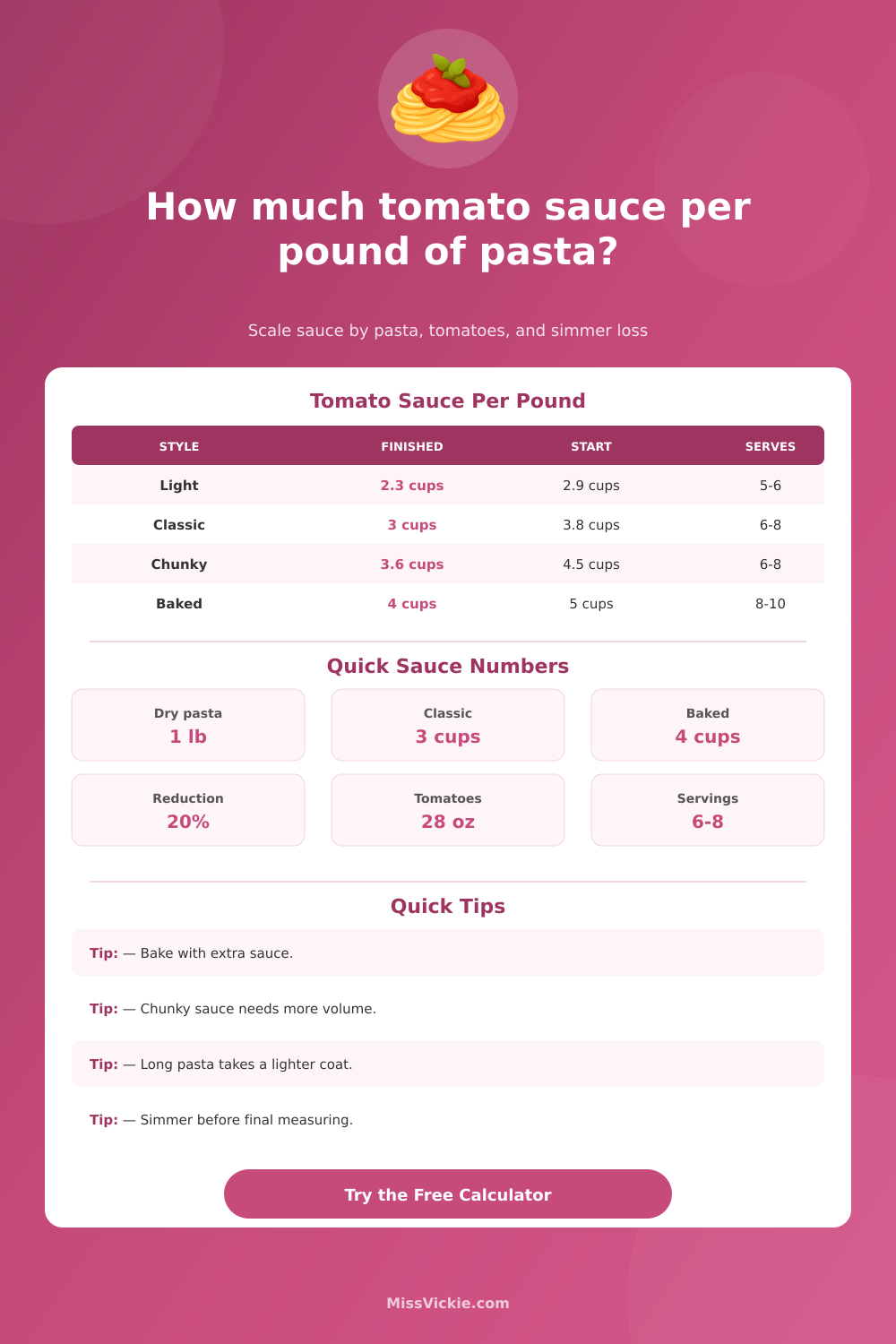
| 1 lb | 3 cups | 4 cups | 6 to 8 |
| 2 lb | 6 cups | 8 cups | 12 to 16 |
| 3 lb | 9 cups | 12 cups | 18 to 24 |
| 5 lb | 15 cups | 20 cups | 30 to 40 |
| 8 lb | 24 cups | 32 cups | 48 to 64 |
Good for long pasta, side portions, and a cleaner tomato finish.
Works for most short pasta shapes served immediately after tossing.
Allows room for tomato pieces, onion, mushrooms, or crumbled meat.
Starts wetter so pasta can absorb sauce while it bakes or reheats.
| Adjustment | Typical factor | Use it when | Calculator effect |
|---|---|---|---|
| Quick simmer | 8% loss | Using passata or puree. | Lower starting tomato volume. |
| Standard simmer | 22% loss | Using crushed or whole canned tomatoes. | Balanced reduction estimate. |
| Long simmer | 38% loss | Cooking fresh tomatoes or watery sauce. | Higher starting tomato volume. |
| Hearty meat sauce | 18% extra | Adding browned meat or sausage. | More finished tomato sauce. |
| Roasted vegetables | 10% extra | Adding eggplant, zucchini, peppers, or mushrooms. | More coating sauce for bulk. |
For those who want to skip the math, there’s also a calculator above to figure out how much of each ingredient to use, no more lopsided pasta bowl! If you’re familiar with this predicament, you’ve probably simmered the sauce and cooked the noodles just right. But then you take a bite only to find yourself chewing on a bare noodle while the rest of your meal is in a pool at the bottom of the bowl. While most home chef eyeball the amount of sauce to pasta instead of using math, they end up here. By entering weight of pasta (and type) into the tool, it will do all the work for you, and save you from that fate.
There’s always that one key variable: the weight of dry pasta prior to its plunge into boiling water. A pound of dried penne weigh about the same as a pound of dried spaghetti, yet cooking time will differ due to their different shapes in a pan. Long shapes such as linguine create less surface area for sauce then other shapes like ruffled ribbon or tubes. Enter the shape adjuster. Since tubular pastas has all those ruffles and wells that hold onto sauce like tiny pools, you require additional volume for rigatoni than you would with spaghetti. Why? Because the tubular pasta just slides down through center without coating anything except your plate when tossed with a regular smooth sauce.
Why This Tool Helps You Get It Right
But beyond volume, texture also counts. For example, a chunky meat ragu will require far more product than a light coating of passata. That’s because it all depends on how well it cover and displaces what’s underneath it. If you’re adding roasted vegetables, ground beef, sausage, etc., then the solids will fill some of the space that would of been covered in tomato liquid. In order to make up for that, you’d need to increase total amount of the sauce base to make sure each piece of pasta is still coated.
And that’s when folks tend to under-sauce things. They see a recipe asking for three cups of sauce and assume they can get away with three cups of meat in there too, but it’ll never work like that. The tool takes into account that displacement and prevents your meal from turning out unevenly and dry.
The other wrinkle in this process is simmering. As water evaporates from your tomatoes, it concentrates their flavor. However, this also means you will have less of the original amount at the end. While a quick sauce may lose perhaps ten percent of its initial liquid volume, a slow-simmered Sunday gravy may lose half its original weight in evaporation. Start with three cups, simmer for two hours and you might be left with just one and a half cups, insufficient for coating a pound of pasta. Want to cook something down a lot? You’ll need more tomato product to begin with. Depending on how much you’re planning to simmer things, the calculator takes into account an appropriate starting amount.
But then there are those other rules: baked pasta. Lasagna and baked ziti aren’t stovetop dishes. They’re cooked in the oven where the noodles soak up some moisture during their bake. They continue to suck in water once they exit the oven through what’s called residual heat. So your sauce should be slightly more wet than it would otherwise if serving immediately. Otherwise, the top may appear just right but the underside becomes a firm, hard brick. More is needed to ensure it stay tender all the way through cooking time and even when sitting out while being served.
There is no exact science; instead there is balance. Think of the numbers in the reference table as a trustworthy sign that points you in the right direction, but never forget that the ultimate authority is your tongue. While they serve as an excellent jumping off point for repeatable results, this is not a set-in-stone rule book. Once you know how to control the sauce by understanding how it behaves at various weights and temperatures, you stop guessing and begin to master the dish. Whether it’s your initial or final bite, every one reach the same level of satisfaction.