🍅 Sugar in Tomato Paste Calculator
Calculate sugar content by paste type, serving size, and number of servings
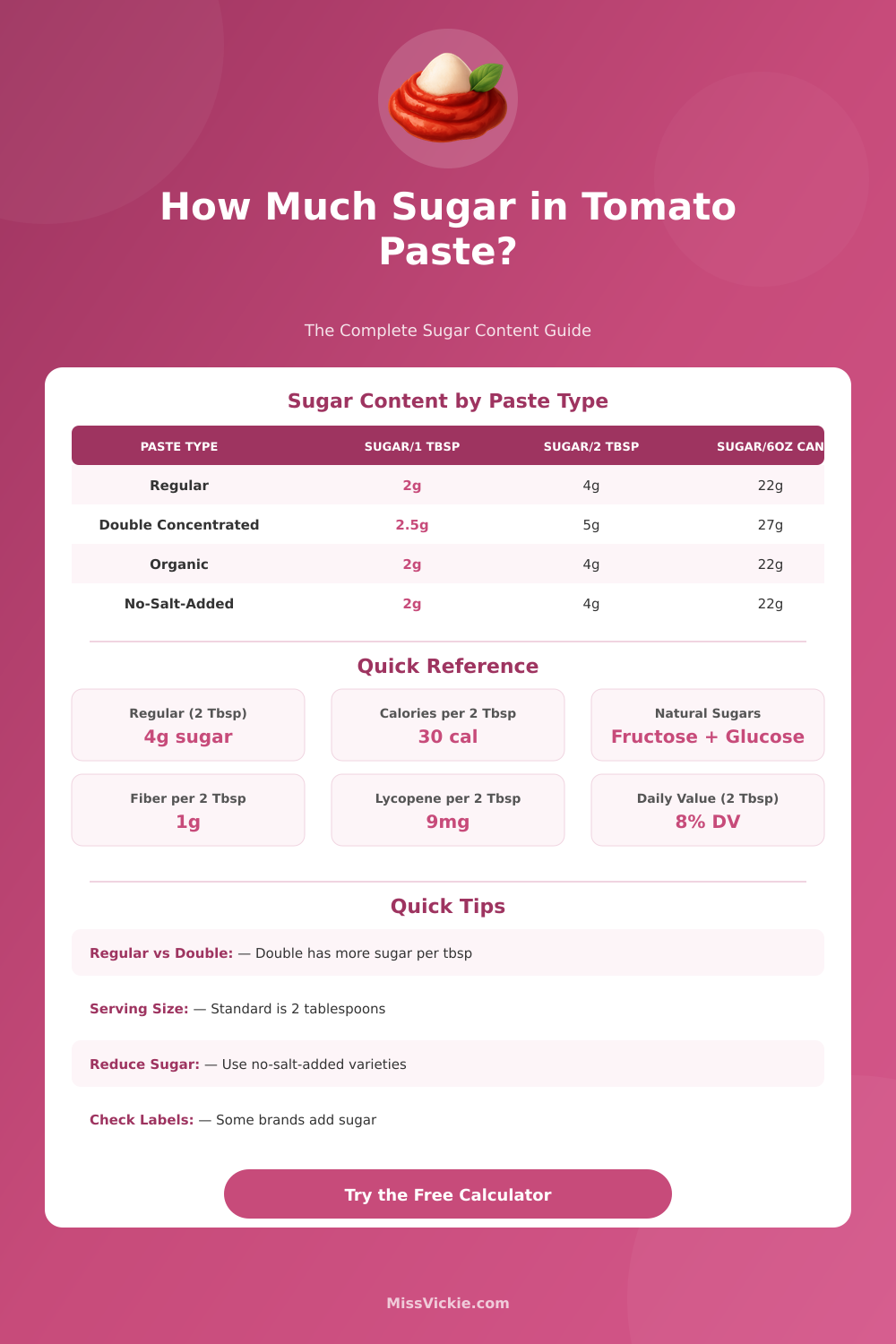
| Paste Type | 1 Tbsp (16g) | 2 Tbsp (33g) | 6oz Can (170g) |
|---|---|---|---|
| Regular | 2g | 4g | 22g |
| Double Concentrated | 2.5g | 5g | 27g |
| No-Salt-Added | 2g | 4g | 22g |
| Organic | 2g | 4g | 22g |
| Italian Seasoned | 2.3g | 4.5g | 24g |
| Fire-Roasted | 2g | 4g | 22g |
| Sun-Dried Tomato Paste | 2.8g | 5.5g | 30g |
| Store Brand | 2g | 4g | 22g |
| Product | Sugar | Calories | Notes |
|---|---|---|---|
| Tomato Paste | 16g | 107 | Most concentrated form |
| Tomato Sauce | 5g | 29 | Thinner, less sugar per cup |
| Diced Tomatoes | 4g | 25 | Whole chunks, minimal processing |
| Crushed Tomatoes | 5g | 39 | Partially blended texture |
| Marinara Sauce | 7g | 52 | Often has added sugar |
| Ketchup | 14g | 60 | Heavily sweetened condiment |
| Measurement | Tablespoons | Ounces | Grams |
|---|---|---|---|
| 1 Tablespoon | 1 Tbsp | 0.5 oz | 16g |
| 2 Tablespoons (1 serving) | 2 Tbsp | 1.1 oz | 33g |
| Small Can (6 oz) | 11 Tbsp | 6 oz | 170g |
| Medium Can (12 oz) | 22 Tbsp | 12 oz | 340g |
| Large Can (18 oz) | 33 Tbsp | 18 oz | 510g |
| Tube (4.5 oz) | 8 Tbsp | 4.5 oz | 128g |
Fresh tomato paste starts from fresh tomatoes, that cook for a long time, I talk about actual hours, until almost all the water dries up. Later the seeds and skins are removed and everything that stays in the pot turns into that dense, thick mass. That gives stronger flavor than regular tomato sauce, so a little bit is enough to replace a whole box of other sauces.
Think of it like a tomato flavor cube, you have a rich set of flavors in small space. It strengthens soups, stews and sauces with depth, that seems almost impossible with other ingredients.
Make and Use Tomato Paste
What type of tomatoes you use, that really affects the result. Tomatoes for tomato paste, that are more meaty, help to double the amount compared to regular or cut types. The good part?
Making it at home is not a hard task. You simply need tomatoes, salt, olive oil and a food processor. It works well, whether you start with garden fresh ones or with canned tomatoes.
tomato paste brings sugar and that savory umami flavor, that makes folks ask, what went in your dish. One gets also a darker, more rich shade, that changes every food that you prepare. Also it works as a natural thickener, which is practical.
It works in stews and chilis, but best it shines in marinara sauce, wear tomatoes must be the main element. In beef stew, for instance, a bit of tomato paste gives tomato flavor without big bits floating around. For curries, where you already mix coconut milk or broth, it adds both thickness and layers of flavor.
Here the main point though; you must try to brown tomato paste. It does not matter, whether you cook it alone or mix it in a jar already full of onions and vegetables. The mass needs time to sit, thicken and turn brown into that deep red.
Straight from the tin or tube, it shines red almost surprisingly, but cooking turns it to something clearly darker and richer. Skip that stage, and everything risks tasting flat and dull. Too much tomato paste?
Then the dish becomes too sweet and heavy.
Most grocery stores sell canned tomato paste with citric acid in the mix. Tube versions on the other hand stay with only salt and almost always come from Italy. Those double focused tubes of brands like Cento and Mutti have that fuller, stronger taste.
Italian imports mostly last very well.
The problem with leftover tomato paste is real, because recipes usually want only a tablespoon or two. Freezing single portions in bags works well. Another idea is put the whole opened can right in the freezer.
Or simply buy it in a tube and skip the hassle of storing. A normal small can holds maybe five spoons or so, which ends quickly. Mainly, it stays only tomatoes.
Cooked differently, andusing it does not cheat more than adding salt or oil.