Tempura Batter Water Calculator
Estimate chilled water for tempura batter from flour and starch weight, yolks, sparkling water, water temperature, coating item, batch size, rest time, viscosity, oil heat, and ice melt.
Choose a frying scenario, then fine-tune the dry mix, yolks, water type, coating item, rest time, oil temperature, and ice melt allowance.
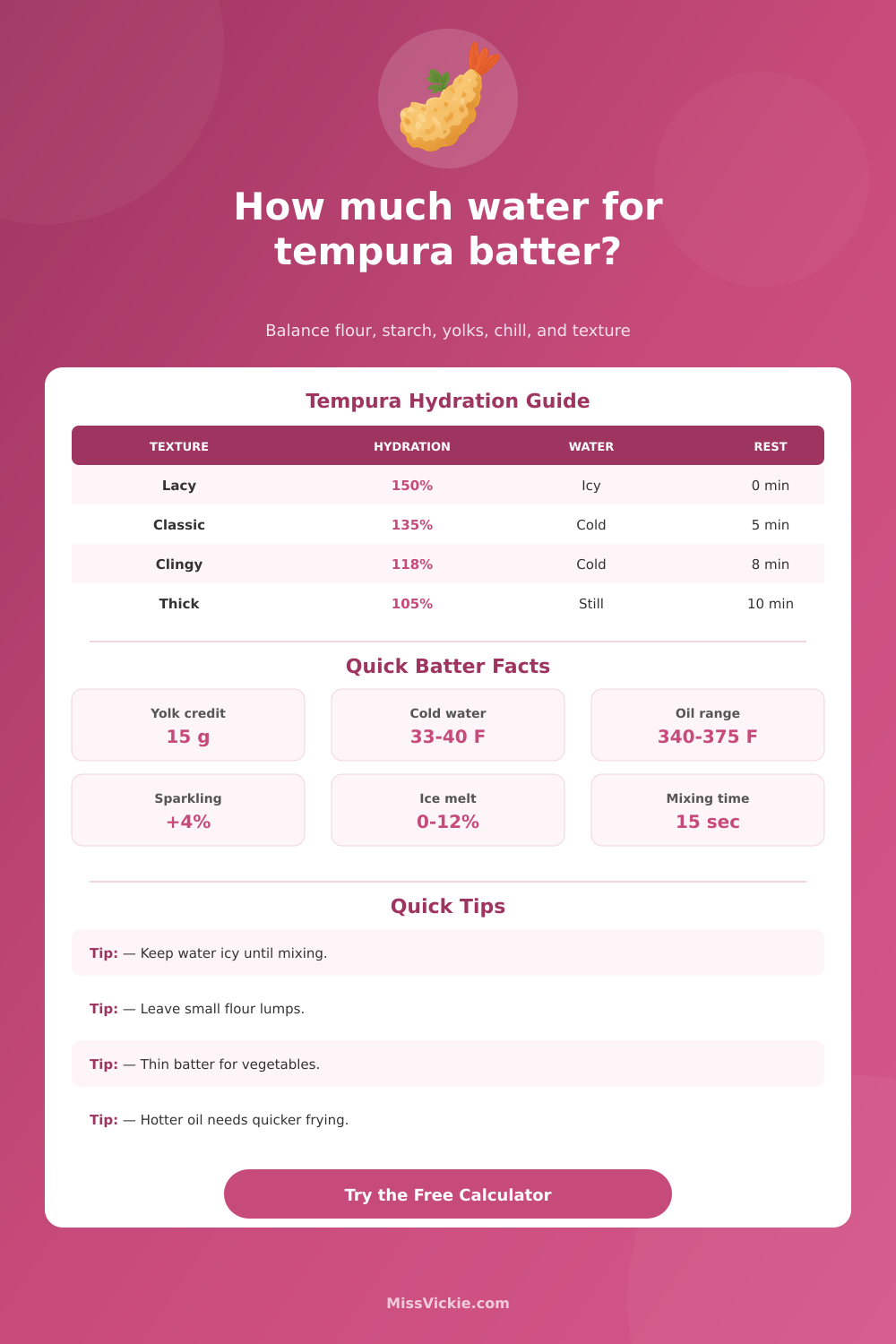
Tempura Hydration Breakdown
| Desired Batter | Starting Hydration | Best Coating Items | Water Texture | Mixing Cue |
|---|---|---|---|---|
| Lacy and very thin | 145% to 155% | Leafy herbs, onions, thin zucchini | Icy sparkling or still water | Runs fast from chopsticks with visible dry specks |
| Classic light coating | 130% to 140% | Shrimp, fish strips, asparagus, peppers | Cold sparkling water for extra lift | Ribbon breaks quickly and leaves a thin film |
| Clingy medium coat | 115% to 125% | Mushrooms, eggplant, root vegetables | Cold still water or lightly sparkling water | Coats the item without hiding its shape |
| Thicker fritter-style coat | 100% to 110% | Squash, chicken pieces, larger seafood | Still water gives a steadier cling | Slow ribbon with small lumps still visible |
| Coating Item | Pickup Rate | Suggested Viscosity | Oil Temperature | Water Adjustment |
|---|---|---|---|---|
| Shrimp or prawns | 28 g batter per 100 g food | Classic light coating | 350°F to 365°F | Use base water amount |
| Leafy herbs or shiso | 16 g batter per 100 g food | Lacy and very thin | 340°F to 350°F | Add a splash if leaves drag |
| Thin vegetables | 22 g batter per 100 g food | Lacy or classic | 345°F to 360°F | Thin by 2% to 4% for crisp edges |
| Mushrooms and eggplant | 34 g batter per 100 g food | Clingy medium coat | 350°F to 365°F | Keep batter slightly thicker |
| Chicken or larger pieces | 40 g batter per 100 g food | Thicker fritter-style coat | 335°F to 350°F | Hold back water for cling |
Flour to starch gives a light shell with familiar tempura cling.
More starch makes the coating brittle and fast browning.
One large yolk counts as water when setting hydration.
One US fluid ounce equals about 29.6 milliliters.
The temperature of the water: How do you get your tempura batter just right to ensure that shell is light, crisp and not heavy and greasy? Every variable affect how much water your batter will hold. You have to treat the calculation of water as part of recipe for consistant texture. So how much? It all depends on what ingredients go into the recipe (e.g., the number of egg yolks or type of liquid, such as still or sparkling water). Sparkling water, etc.), as well as soaking time and resting time before cooking. All these factors affects the final amount of hydration.
Enter that info into the calculator and let it do the math. It will take into account the tiny bit you lose in your bowl and when dredging, plus the amount that’s melted ice. So what it spits out is the real deal, the amount you’ll want to pour.
How to Get the Right Water for Tempura Batter
Cold water keeps gluten development in check: But it’s nuanced. If you’re making batter and the water is warmer than fridge temperature, the batter will thicken up faster once it hits food. More water are needed to get the same amount of coating, but no need to guess, the calculator does that for you. This is good if your kitchen is hot or tap water are warm. Sparkling water has a little lifting action by itself, which means you can use a little less liquid to achieve the same viscosity. The tool account for this automatically, no guessing required.
Targeted hydration depends on what is being coated For example, shrimp and thin vegetables will absorb less batter by weight then thicker items (like chicken). So, the amount of water required to hydrate the same dry batch differ based off the type of item. A batter that works well on something like asparagus will leave a mushroom naked. On the other hand, a batter designed for chicken will smother a leafy green with globs. So, the calculator allows you to specify coating item; thus, it accounts for this distinction when providing the recommended amount.
Less is more; the rest time. The longer a batter sits after mixing (eight or 10 minutes at least), the more it will hydrate the flour. This means that over time, the same amount of water create a thicker coating. That’s why the tool adds a bit more water if you want to mix and then let it sit; this helps keep final thickness consistent.
Temperature-wise, the reverse holds true for the oil. It will set the batter faster when it’s hotter, allowing a lighter coating even though the mix is on thin side. These selections matches in practice as this reference table shows. This table show common items to coat along with best viscosity ranges and oil temperatures for each. From there, the figures don’t seem random anymore; they become more like a map. A leafy herb needs a thinner batter than, for example, a squash.
Treat the batter as a system that responds to time, weather, and food: That’s where the real payoff is. You should of not think of it as one static formula for all. The calculator just takes away the math, leaving you free to make decisions that impact the outcome.