Tea Ratio Calculator
Calculate loose tea grams, teaspoons, water volume, cup count, steep time, kettle temperature, and iced or hot adjustments for black, green, white, oolong, herbal, rooibos, chai, matcha, and more.
Load a common tea setup, then adjust the tea type, water amount, cup count, strength, leaf format, and hot or iced mode.
Tea Ratio Breakdown
Bold body, 3 to 5 minutes, good with milk or lemon.
Lower temperature keeps grassy and bitter notes in check.
Delicate leaves prefer more time and a gentle kettle.
Flexible ratio; whole leaves often handle several infusions.
Caffeine-free infusions usually need more grams and time.
Forgiving, naturally sweet, and hard to over-steep.
Use a stronger ratio when milk or sweetener is added.
Powdered tea uses less water and is whisked, not steeped.
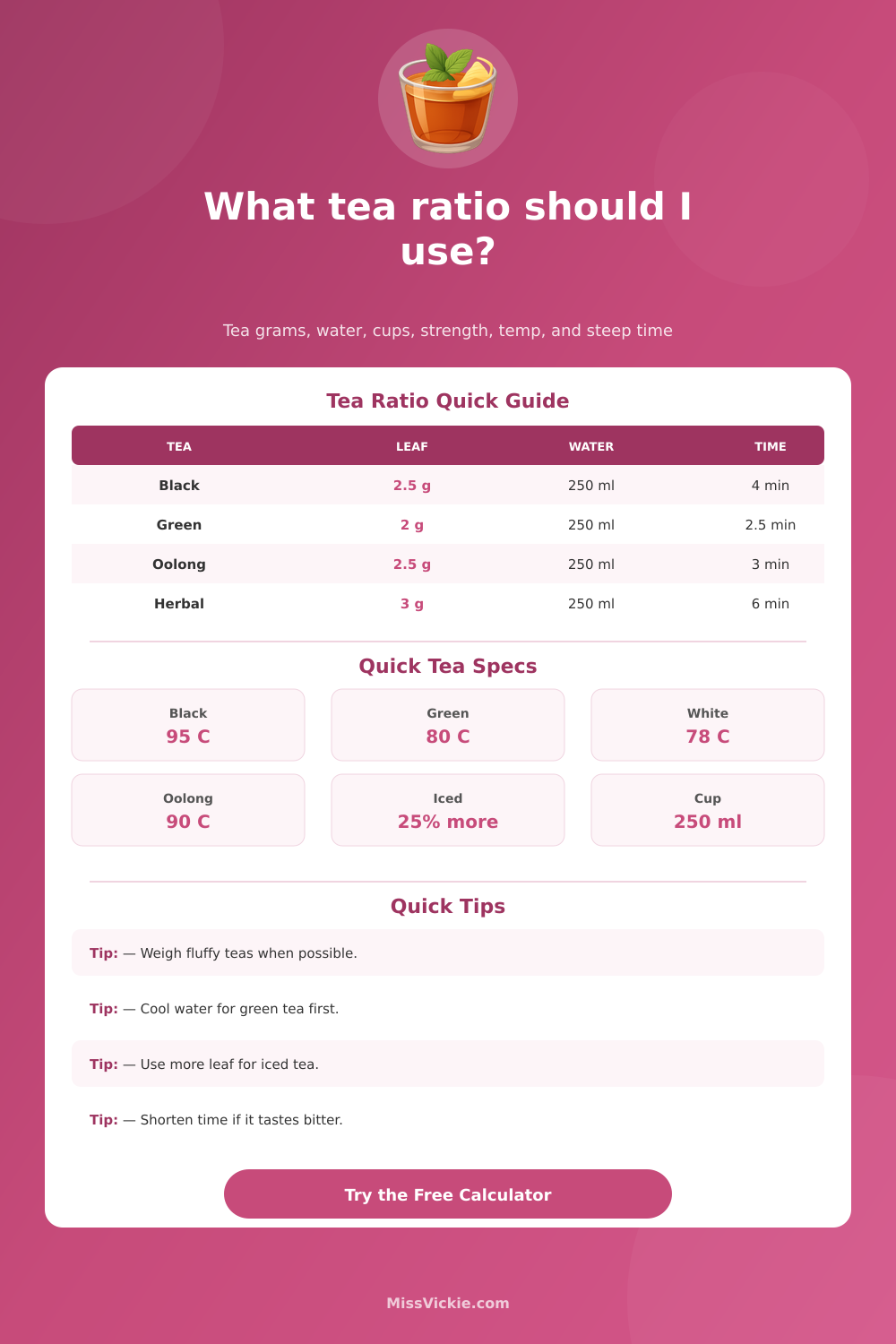
| Tea Type | Balanced Leaf | Approx Teaspoons | Temp | Steep Time |
|---|---|---|---|---|
| Black tea | 2.5 g per 250 ml | 1 level tsp | 93 to 98°C | 3 to 5 min |
| Green tea | 2.0 g per 250 ml | 1 level tsp | 75 to 82°C | 2 to 3 min |
| White tea | 2.2 g per 250 ml | 1.5 to 2 tsp | 75 to 82°C | 4 to 5 min |
| Oolong tea | 2.5 g per 250 ml | 1.5 tsp | 85 to 92°C | 3 to 4 min |
| Herbal infusion | 3.0 g per 250 ml | 1.5 to 2 tsp | 96 to 100°C | 5 to 7 min |
| Rooibos | 3.0 g per 250 ml | 1.5 tsp | 96 to 100°C | 5 to 7 min |
| Chai blend | 3.5 g per 250 ml | 1.5 to 2 tsp | 96 to 100°C | 5 to 8 min |
| Matcha | 2.0 g per 80 ml | 1 chashaku scoop | 70 to 80°C | Whisk 20 to 40 sec |
| Strength | Leaf Change | Time Change | Best For |
|---|---|---|---|
| Delicate | Use 15% less leaf | Steep 10% shorter | White tea, soft green tea, late evening cups. |
| Balanced | Use the base ratio | Use the standard time | Everyday mugs and most teapots. |
| Full flavored | Use 15% more leaf | Steep 10% longer | Breakfast tea, oolong, and stronger herbal cups. |
| Strong | Use 35% more leaf | Steep 25% longer | Milk tea, iced tea, chai, and large mugs. |
| Cups | Final Volume | Black Tea | Iced Tea Ice |
|---|---|---|---|
| 1 cup | 250 ml | 2.5 g balanced | 95 g ice |
| 2 cups | 500 ml | 5.0 g balanced | 190 g ice |
| 4 cups | 1,000 ml | 10.0 g balanced | 380 g ice |
| 8 cups | 2,000 ml | 20.0 g balanced | 760 g ice |
| Taste Result | Likely Cause | Ratio Fix | Time or Temp Fix |
|---|---|---|---|
| Thin or watery | Too little leaf, oversized mug, or too much ice melt. | Add 10% to 20% more leaf next time. | Keep the same temp and steep slightly longer. |
| Bitter or harsh | Water too hot, steep too long, or broken leaves brewed hard. | Keep leaf steady before cutting the dose. | Lower temp 3 to 8°C or shorten steep. |
| Flat aroma | Old leaves, water not hot enough, or teapot losing heat. | Use fresh leaf and a normal ratio. | Pre-warm the pot and hit the target temp. |
| Good hot, weak iced | Hot tea was diluted by ice without extra leaf. | Use iced mode or add about 25% leaf. | Brew hot, then pour directly over measured ice. |
A tea ratio calculator is an tool that will help a person determine the correct amounts of tea leaves that should be used in the brewing of tea, as well as the correct amount of water that should be used to make that tea. When transitioning from using teabags to using tea that comes in individual leaves, the tea may taste thin or strong. Each type of tea have a different ratio of tea leaves to water that provides the best flavor when brewed.
By using a tea ratio calculator, a person can avoid the guesswork in brewing tea; the calculator will provide suggested measurement of tea leaves and water based off the type of tea that is to be brewed. To use a tea ratio calculator, a person will need to provide several types of information. For instance, the calculator will ask for the number of cups of tea that are to be brewed, the size of each cup, and the strength of the tea that is to be brewed.
How to Use a Tea Ratio Calculator
A person will also need to decide whether the tea will be brewed in hot water or brewed over ice. Each type of tea has a different density and different rate at which the leaves will release flavor into the water when brewed. Therefore, the tea ratio calculator is able to account for these different rate in determining the correct amount of tea leaves and water.
The type of tea that will be brewed is one of the first decision that a person must make when using a tea ratio calculator. Each type of tea has different requirements for the brewing of that tea. For instance, black tea leaves can be steeped in boiling water for long periods of time, whereas green tea leaves may be destroyed if brewed with boiling water.
A tea ratio calculator account for these types of difference; each tea type has a set amount of leaves recommended for brewing, a target temperature for the water, and the length that the tea should steep for. Therefore, if a person selects a different type of tea in the tea ratio calculator, the amount of leaves that should be used will change automatically. Another of the factors that must be taken into consideration is the volume of water that is to be used.
Different type of tea may have different volumes of water needed for brewing. For instance, if a person selects any type of tea that is to be served over ice, the amount of water is likely to change. This is due to the volume of the ice blocks that will be added to the tea and how that water will dissolve into the tea.
If the tea is brewed with the full volume of boiling water and then the ice is added to the tea, the resulting tea will be weaker in flavor. Therefore, to account for the amount of ice that may be added to tea, the tea ratio calculator will suggest increasing the amount of tea leaves to brew by about one quarter if the tea is to be brewed over ice. In addition to the type of tea, the volume of water, and the serving options, tea ratio calculators also include settings for the strength of the brewed tea.
For instance, if a person selects the “delicate” setting for tea strength, the tea ratio calculator will decrease the amount of tea leaves that are to be brewed, as well as the length of time that the tea should steep. If, however, a person selects the “strong” brewing setting, the tea ratio calculator will adjust the tea to use an increased amount of tea leaves, as well as an increased steep time. The strong setting is beneficial for those who would like to add milk to their tea, as well as those that would like to serve their tea cold.
Each of these settings can be adjusted individually to allow for a person to find the perfect setting that produces the best results. The format of the tea leaves is another factor in brewing tea. For instance, tea leaves that are in whole leaf format will take longer to steep than leaves that are in broken leaf format.
Tea leaves that are in powder format, like matcha tea, will differ from the other tea leaf formats, as matcha tea is stirred into the water rather than steeped. Because these leaves will take some time to color and flavor the water based upon the shape of the leaves, a tea ratio calculator will adjust for this difference in tea leaf format. Teas can also be brewed to various temperatures; the tea ratio calculator will provide different settings for the leaves and water temperatures.
Each type of tea has different ideal temperature at which the tea should be brewed. For instance, green tea should never be brewed in boiling water, but chai tea should be brewed in warm rather than cold water. Additionally, a person who knows their specific tea kettle reaches different temperatures when boiling water may change the temperature settings for tea.
Therefore, each person can use the tea ratio calculator to avoid adding too much or too little strength to the tea when brewing, and to avoid bitterness from boiling tea leaves. Due to the fact that not all variables in brewing tea can be accounted for by the tea ratio calculator, some adjustment to the brewed tea may be needed. For instance, the age of the tea leaves will change how they taste when brewed.
Additionally, the water hardness, if brewed in a teapot, will change the flavor of the brewed tea. Therefore, unless the tea is brewed in a well-insulated teapot, it is recommended that a person first brew the tea and adjust the steep time or the brewing temperature according to the flavor of the brewed tea. This is likely to be faster than adjusting the amount of tea leaves.
Lastly, if a person decides to brew a much larger volume of tea than recommended, the tea ratio calculator will offer suggestions for the amount of tea leaves to be brewed. However, because the tea may lose strength in large volumes of tea if brewed in a teapot, it is likely that the steep time will also have to be adjusted. The tea ratio calculator can assist a person in creating an even recipe for tea so that no matter how many times that tea is brewed, it will always taste the same.