🍞 Tangzhong Calculator for Bread
Calculate the exact tangzhong amount, flour, and water needed for any bread recipe
| Total Flour | Tangzhong Flour (7%) | Water for Tangzhong | Total Paste | Remaining Flour |
|---|---|---|---|---|
| 200g | 14g | 70g (70ml) | 84g | 186g |
| 250g | 17.5g | 87.5g (87ml) | 105g | 232.5g |
| 300g | 21g | 105g (105ml) | 126g | 279g |
| 350g | 24.5g | 122.5g (122ml) | 147g | 325.5g |
| 400g | 28g | 140g (140ml) | 168g | 372g |
| 450g | 31.5g | 157.5g (158ml) | 189g | 418.5g |
| 500g | 35g | 175g (175ml) | 210g | 465g |
| 600g | 42g | 210g (210ml) | 252g | 558g |
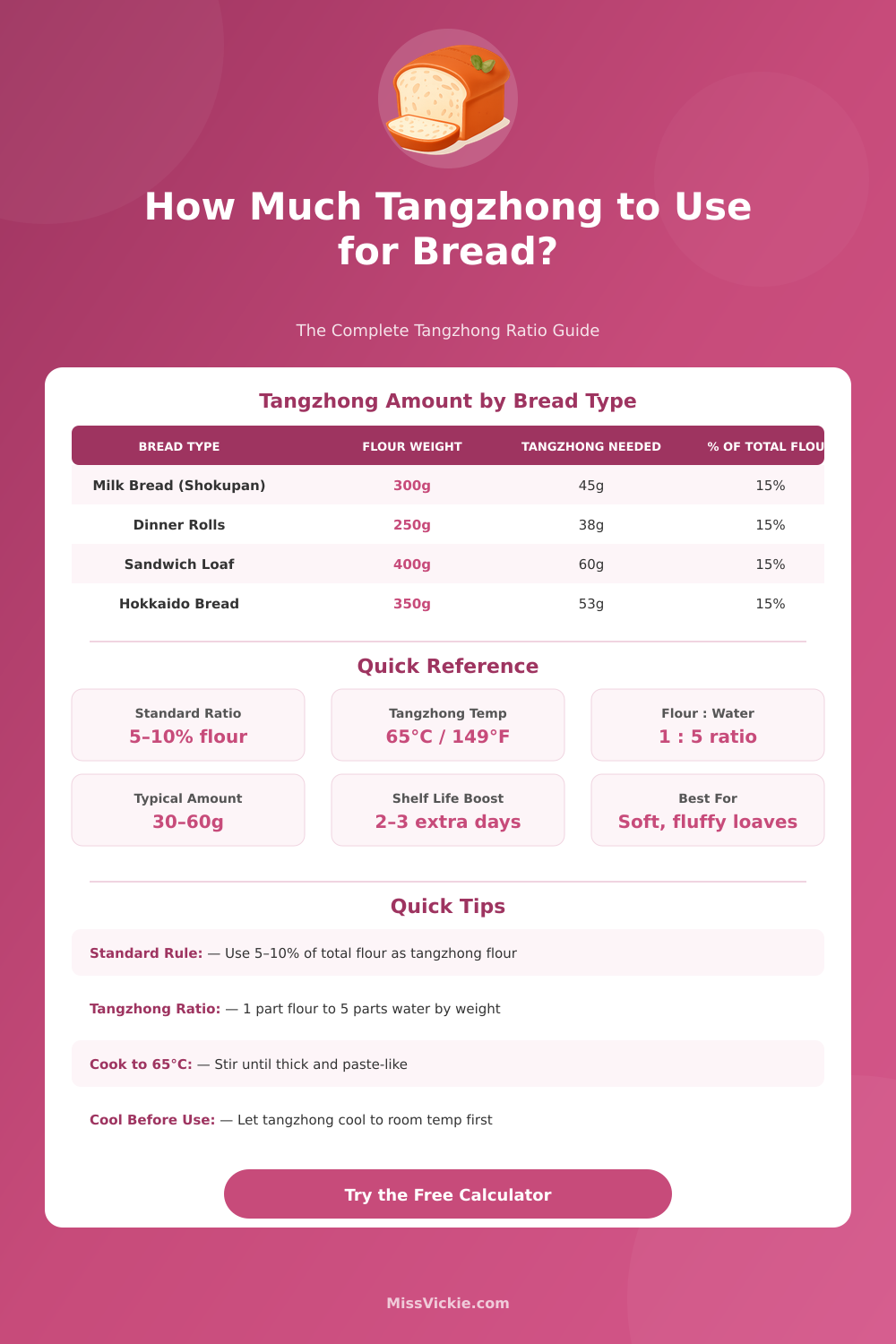
| Bread Type | Recommended % | Notes |
|---|---|---|
| Standard White Bread | 5–7% | Good starting point for most recipes |
| Milk Bread (Shokupan) | 7–10% | Higher ratio for ultra-soft, pillowy texture |
| Hokkaido Bread | 7–10% | Classic Japanese milk bread, very soft crumb |
| Dinner Rolls / Buns | 7–8% | Adds softness and extends freshness |
| Sandwich Loaf | 6–8% | Improves sliceability and shelf life |
| Pullman / Pain de Mie | 8–10% | Fine, even crumb suited to this style |
| Brioche-Style | 5–7% | Use lower end; butter already adds richness |
| Wholemeal / Whole Wheat | 8–10% | Higher ratio compensates for denser flour |
- 1Weigh out the calculated flour and water amounts precisely using a kitchen scale for best results.
- 2Combine flour and water in a small saucepan. Whisk until no lumps remain before applying heat.
- 3Cook over medium-low heat, stirring constantly with a spatula or whisk. Do not stop stirring.
- 4Heat to 65°C (149°F). The mixture will thicken and become a smooth, translucent paste that pulls away from the sides.
- 5Remove from heat immediately. Transfer to a clean bowl and cover with cling wrap pressed directly onto the surface.
- 6Let tangzhong cool completely to room temperature (or refrigerate up to 24 hours) before adding to your dough.
- 7Add the cooled tangzhong to your dough along with the remaining flour and wet ingredients as directed in your recipe.
Tangzhong is a method for baking that helps make bread moist, soft and fresh for more time. In the West you call it water roux. It comes from Asian baking and spread in Southeast Asia during the 1990s thanks to cookbook author Yvonne Chen, who wrote the book „The 65°C Bread Doctor“.
The technique has roots in Japanese yukone, also known as yudane.
Tangzhong: A Simple Way to Make Soft Bread
The process is simple. You mix a small part of flour with liquid from the recipe and cook it on the stove until it becomes a paste. The proportion usually is 1 part flour to 5 parts water or milk by weight.
The mix must reach around 65°C (149°F), when the starches in the flour gelatinize. After cooling you put the paste in the rest of the bread.
The secret of tangzhong is in the science. When flour cooks with liquid, the starch gelatinizes and can hold more moisture than normal. That process breaks the starches, which when cooked turn to sugar, so yeast feeds itslef more easily on them.
Like this you get soft bread with a fluffy crumb. Although the gluten changes, quite a lot stays to give structure to the bread, because only a little of the whole flour is used for the mix.
You make tangzhong usually with 5 to 6 % of the total flour in the recipe. But even up to 20 % can give even better dough. Commonly you start with 5 % flour and 5 times water.
This method works well for dinner rolls, long loaves and cinnamon rolls. It is the base of Hokkaido milk bread, also called Japanese milk bread, shokupan or pai bao. Every bit has rich milk and butter aromas.
Cinnamon rolls with tangzhong become light, fluffy and stay such for days. It helps also whole wheat bread not crumble after some days. Even Italian recipes, that dry out in one day, stay moist much longer.
Yudane is like it, a Japanese method for gelatinizing starch. The difference is that you pour hot water directly on flour and do not cook them together on the stove. Tangzhong requires only two ingredients and is a fast, easy wayfor better bread.