Guests, appetite, proteins, tortillas, toppings, and salsa
Taco Bar Calculator
Plan a taco bar by guest count, tacos per person, appetite, protein mix, tortilla style, toppings, salsa level, vegetarian share, kids share, and waste factor.
Load a realistic dinner, party, or event setup, then adjust any field to match your crowd.
Taco Bar Breakdown
Juicy, familiar, and fast. Plan a little extra raw weight because browning drains fat and moisture.
Shredded chicken stretches well, absorbs sauce, and works for mixed family crowds.
Rich pork shrinks more but gives a party-style taco bar a hearty anchor.
High yield and easy to reserve for vegetarian tacos without changing the rest of the bar.
Use less for street tacos and more for hard-shell or Tex-Mex style tacos.
Shredded lettuce looks voluminous, so weigh lightly and refill smaller bowls.
Fresh pico doubles as a topping and a mild salsa for guests avoiding heat.
Serve in squeeze bottles when possible so buffet use stays controlled.
| Guests | Standard tacos | Cooked protein | Tortillas with buffer | Salsa | Best setup note |
|---|---|---|---|---|---|
| 6 guests | 18 tacos | 2.25 lb / 1.0 kg | 22 tortillas | 3.5 cups / 830 ml | Use one protein and two salsa choices. |
| 12 guests | 36 tacos | 4.5 lb / 2.0 kg | 44 tortillas | 6.75 cups / 1.6 L | Two proteins keep the bar flexible. |
| 20 guests | 60 tacos | 7.5 lb / 3.4 kg | 72 tortillas | 11.25 cups / 2.7 L | Split mild and spicy salsa bowls. |
| 35 guests | 105 tacos | 13.1 lb / 6.0 kg | 126 tortillas | 19.75 cups / 4.7 L | Use smaller refill pans for toppings. |
| 50 guests | 150 tacos | 18.75 lb / 8.5 kg | 180 tortillas | 28 cups / 6.6 L | Label vegetarian protein clearly. |
| 75 guests | 225 tacos | 28.1 lb / 12.8 kg | 270 tortillas | 42 cups / 10 L | Stage backup tortillas away from steam. |
| Protein | Cooked yield from raw | Cooked portion per taco | Raw amount for 25 tacos | Best use |
|---|---|---|---|---|
| Ground beef, drained | 70% to 75% | 2 oz / 57 g | 4.3 lb / 1.9 kg | Classic hard-shell and Tex-Mex taco bars. |
| Shredded chicken | 72% to 78% | 1.8 to 2.2 oz | 4.2 lb / 1.9 kg | Family dinners, office lunches, and mild taco bars. |
| Carnitas or pulled pork | 62% to 70% | 2 to 2.5 oz | 5.0 lb / 2.3 kg | Hearty parties where pork is a main feature. |
| Carne asada or steak | 70% to 78% | 1.8 to 2.2 oz | 4.4 lb / 2.0 kg | Premium bars with smaller street tortillas. |
| Fish or shrimp | 78% to 85% | 1.7 to 2 oz | 3.8 lb / 1.7 kg | Lighter taco bars with slaw and crema. |
| Beans, tofu, or mushrooms | 85% to 95% | 2 oz / 57 g | 3.7 lb / 1.7 kg | Vegetarian tacos and mixed-diet events. |
| Item | Light bar | Standard bar | Loaded bar | Planning note |
|---|---|---|---|---|
| Tortillas or shells | 1.05 per taco | 1.10 per taco | 1.15 per taco | Corn tears more often, so keep a higher buffer. |
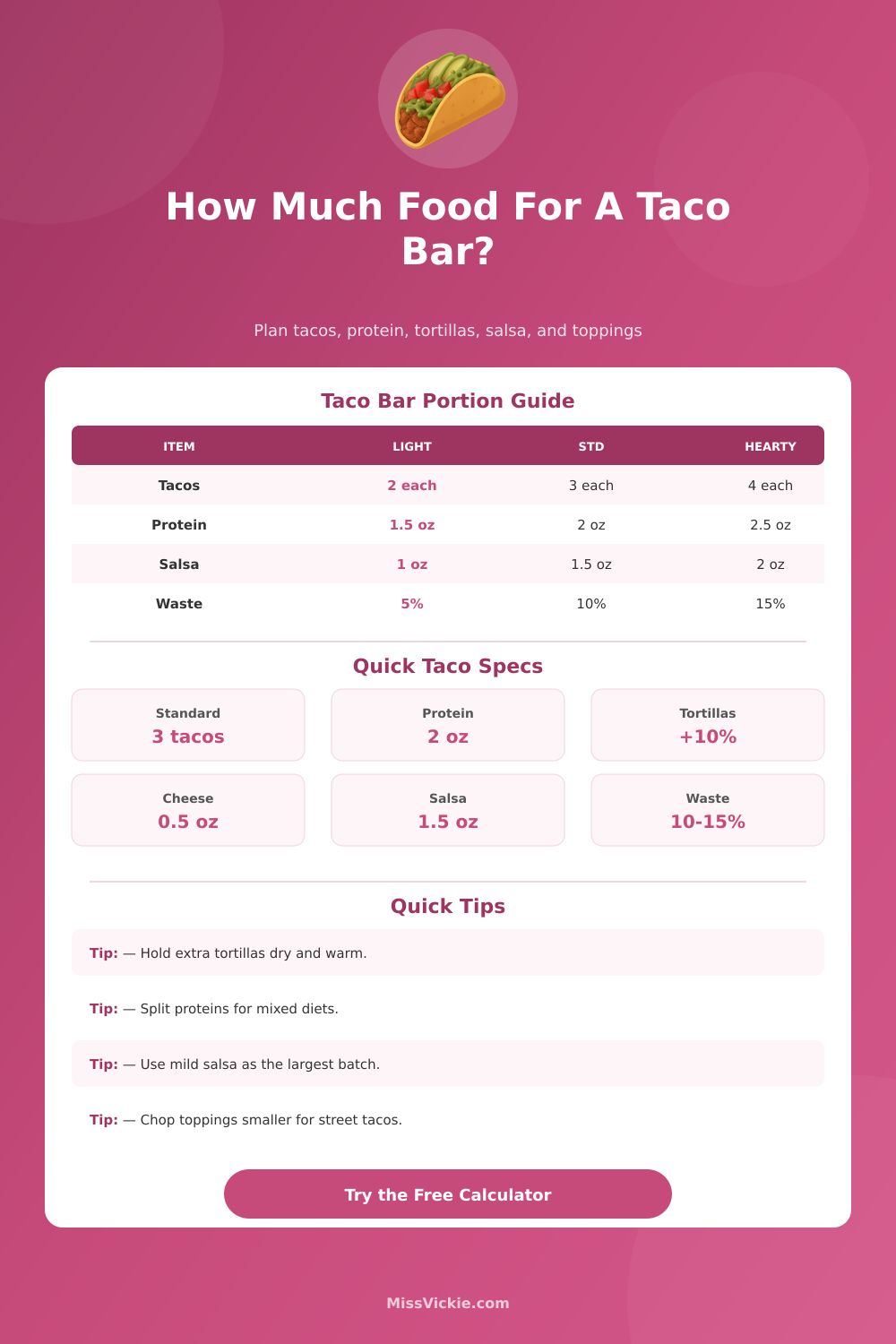
| Cheese | 0.25 oz/taco | 0.5 oz/taco | 0.75 oz/taco | Cheese use rises with hard shells and kids. |
| Lettuce or slaw | 0.25 oz/taco | 0.4 oz/taco | 0.65 oz/taco | Serve crunchy toppings in shallow refill bowls. |
| Pico or tomato | 0.3 oz/taco | 0.55 oz/taco | 0.85 oz/taco | Pico often counts as both topping and salsa. |
| Onion and cilantro | 0.15 oz/taco | 0.25 oz/taco | 0.35 oz/taco | Street tacos use more onion-cilantro than cheese. |
| Salsa | 1 oz/taco | 1.5 oz/taco | 2 oz/taco | Make the mild option the largest batch. |
| Mix style | Main split | Average raw yield | Best toppings | When to use it |
|---|---|---|---|---|
| Classic beef and chicken | 55% beef / 45% chicken | 74% | Cheese, lettuce, tomato, mild salsa | Balanced crowd with familiar taco choices. |
| Street taco trio | 40% steak / 35% pork / 25% chicken | 71% | Onion, cilantro, lime, salsa verde | Smaller corn tortillas and bold salsa. |
| Lean chicken and turkey | 65% chicken / 35% turkey | 77% | Slaw, pico, avocado, crema | Lighter lunches and fitness-minded groups. |
| Vegetarian bean and tofu | 60% beans / 40% tofu | 91% | Cabbage, corn salsa, pickled onion | Plant-forward parties and meatless meals. |
| Premium surf and steak | 40% steak / 35% chicken / 25% shrimp | 77% | Slaw, crema, lime, pico | Rehearsal dinners and smaller special events. |
When planning a taco bar, calculating the specific amount of food that you will needing to purchase is essential. Otherwise, you may find that you dont have enough food to feed all of you guests, or that you will purchase too much food. Many people will try to use there instincts to calculate an amount of food that they will need for there restaurant.
However, their instincts may not accurately reflect the amount of food that will be needed due to the fact that their instincts does not account for how the different types of food will behave during the restaurant, or how all of the guests will eat. To account for these different variables, a person can use a calculator to determine the exact amount of tortilla, meat, and toppings that will be needed for the taco bar. The calculator will use a variety of different inputs to determine the total amount of each ingredient that will be needed.
How to Plan Food for a Taco Bar
For instance, one of the inputs can be the appetite level that will be present at the restaurant; individuals who eat light lunches will require less food than individuals who is part of a late-night sports crowd. Another of these inputs can be the number of children that will visit the restaurant; young children will eat less food than adults. If each guest at the restaurant were to be assumed to be an adult, then individuals will end up purchasing too much meat and too much tortillas.
Another of these inputs can be the type of protein that will be used in the tacos; ground beef shrink more during the cooking process than does shredded chicken or beans. Additionally, beans do not shrink during cooking while ground beef does shrink significanty. Thus, an adjustment must be made in the calculation for the amount of ground beef that will be required for the restaurant.
The choice of tortillas that will be used at the restaurant will impact the number of tortillas that will have to be purchase. For instance, corn tortillas are more likely to tear than flour tortillas. Additionally, hard shells are more likely to break during transport of the tacos, or while the tacos are still in the box and being sold to the customers.
In these instances, a buffer for the number of tortillas can be added to the calculation to account for any that may break or tear. Additionally, the type of toppings and salsa that will be used can have an impact on the amount of each that will be require for the tacos. For instance, tacos that contain more cheese and lettuce will require more of these toppings than tacos that contain fewer of these ingredients.
Additionally, the type of salsa that is used will also impact the amount of salsa that is required. Finally, both the tortilla buffer and the waste factor for each ingredient will have to be included in the calculation of the amount of food that will be required to be purchase. Accidents will happen during the restaurant while the food is being prepare; some of the food may be dropped, for instance.
Additionally, some of the guests may consume more tacos than others, due to the number of tacos that they eat during their meal. Thus, to account for this waste, a waste factor will have to be included in the calculation. These factors will ensure that there is enough food to provide for the last few guests to eat at the restaurant.
Furthermore, by utilizing this calculator, the chef can view how each of these different variables will impact the total amount of food that must be purchased. For instance, if the waste factor is increased, the amount of meat and tortillas that must be purchased will increase. Additionally, if the share of the vegetarian tacos is increased, the amount of beans and tofu will have to be increase.
Lastly, this calculator will assist in the organization of the cooking process for the chef. For instance, if there is a significant amount of salsa that is required for the tacos, the chef will know to prepare the salsa first. Additionally, if there is a significant amount of protein that is required, the chef will know to prepare the protein first.
Thus, this calculator will remove the chefs guesswork when preparing the tacos, and allow the chef to prepare the amount of food that is required for each of the guest.