
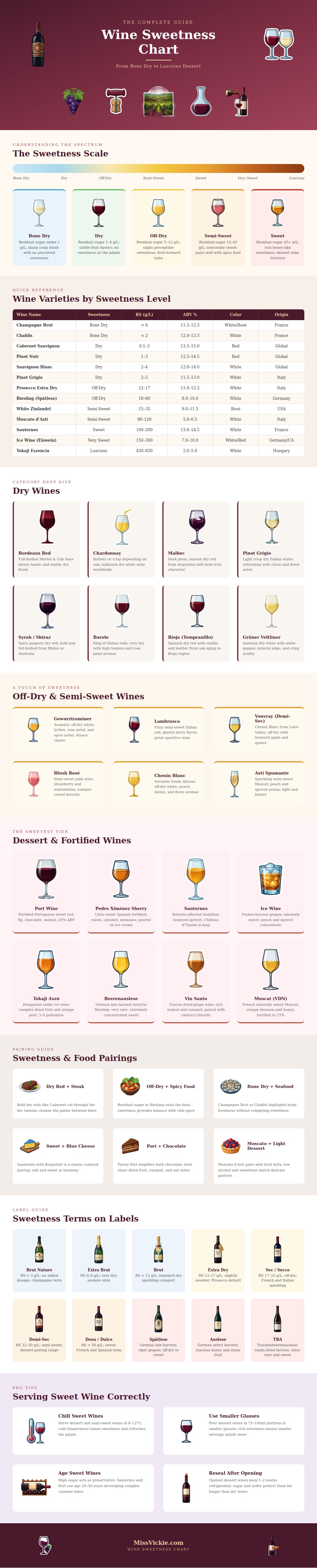
If you’re stuck on the wine shelf wondering about what’s going to taste good in your mouth, with labels claiming something complex but your tongue craving simple, don’t worry, it happens to everyone. What do I mean? Do I want my wine to be salty or sugary? Will it taste dry or not fruity at all? These are valid questions and they shouldn’t make you feel weird.
Here’s why: most people think dry means no fruit and sweet means syrup. That ain’t true. This puts that spectrum into an easy-to-understand chart based off residual sugar. This is the remaining sugar leftover after fermentation shuts down. (That’s the thing that determines the taste.) So, even though that bottle might say it’s dry, there may be lots of acidity and it’ll taste kind of tart. Or, if there’s a bit of residual sugar but a lot of natural acids, it can tastes crisp.
How to Pick Wine Using This Chart
From there, the chart starts at bone dry. This is like a glass of Chablis, which has almost no sugar and provides the crisp, sharp finish that many drinker love. The chart then moves all the way across to sweet dessert-style wines. In between, it shows you exactly how much sugar you’re drinking with each wine.
An off-dry wine is a good option at dinner parties because it pairs nicely with spicy foods. Alcohol doesn’t cool capsaicin as effective as sugar, and serving a dry Cabernet with Thai curry are going to clash in your mouth. That’s why we see an off-dry Riesling here. Look at that progression through semi-sweet choices such as Moscato d’Asti on the chart. This wine can handles spicy foods while standing up to more savory pork dishes, rich chocolates, and even blue cheeses. Match intensity of food with the intensity of the wine, and that balance will make the pairing a success.
Regional language differences make label reading difficult, too. In Champagne, “Brut” translates as dry, though Extra Dry is oddly just a little sweeter. Meanwhile, Germans use terms like Spätlese and Kabinett to describe how ripe their grapes are and how much natural sugar they contains. You don’t have to learn all those foreign words. Just know that these categories correspond to the sweetness scale; and the infographic will help you get your head around those, quicky.
Tokaji Eszencia, for instance, is so high in residual sugar (hundreds of grams per liter), that it’s closer to an aromatic concentrate than something you’d consider drinking. Also, how sweet a wine seems depends on serving temperature. Cold sweet wine are vibrant and refreshing; warm sweet wine is heavy and cloying.
According to the pro tips section, one easy way to adjust your perception: Chill dessert wines down to eight to twelve degrees Celsius. This will change how it feel. Pour small pours of these concentrated wines, as well (more bang for fewer bucks), flavor-wise, and avoid tiring your palate out with too much sugar all at once.
There’s nothing morally superior about drinking sweet versus dry wine. It should of been fun… Not perfect. So experiment: Have a sweet Sauternes one night and a bone dry Sauvignon Blanc the next. Pay attention to the finish and texture, and use the chart as a map toward finding the bottle that matches your mood at any given moment.
Whether you’re hankering for the warm honey taste of a late harvest white, or the crisp bite of a dry red, knowing their place along the spectrum takes the guessing out of picking a bottle. You will no longer hope for a good pour, but instead predict it. Confidence is very valuable.