Sweet Potato Microwave Cooking Time Calculator
Estimate microwave time for sweet potatoes using potato weight, count, diameter, wattage, skin pricking, wrap style, turn interval, desired texture, resting time, starting temperature, and batch spacing.
🍠Sweet potato microwave presets
Pick a common sweet potato size or batch, then adjust the real microwave wattage, spacing, wrap, and texture goal.
⚖Units
📏Potato size, count, and microwave power
💨Pricking, wrap, turning, rest, and spacing
Sweet potato microwave estimate
Timing breakdown
Even size and spacing make the estimate more reliable.
📋Microwave timing reference
For 4 to 5 ounces in a 1000 watt microwave.
For 6 to 8 ounces with a soft baked-style center.
Rotate batches to reduce cool undersides and hot spots.
Allow steam to finish the center before slicing the skin.
📊Sweet potato size and wattage table
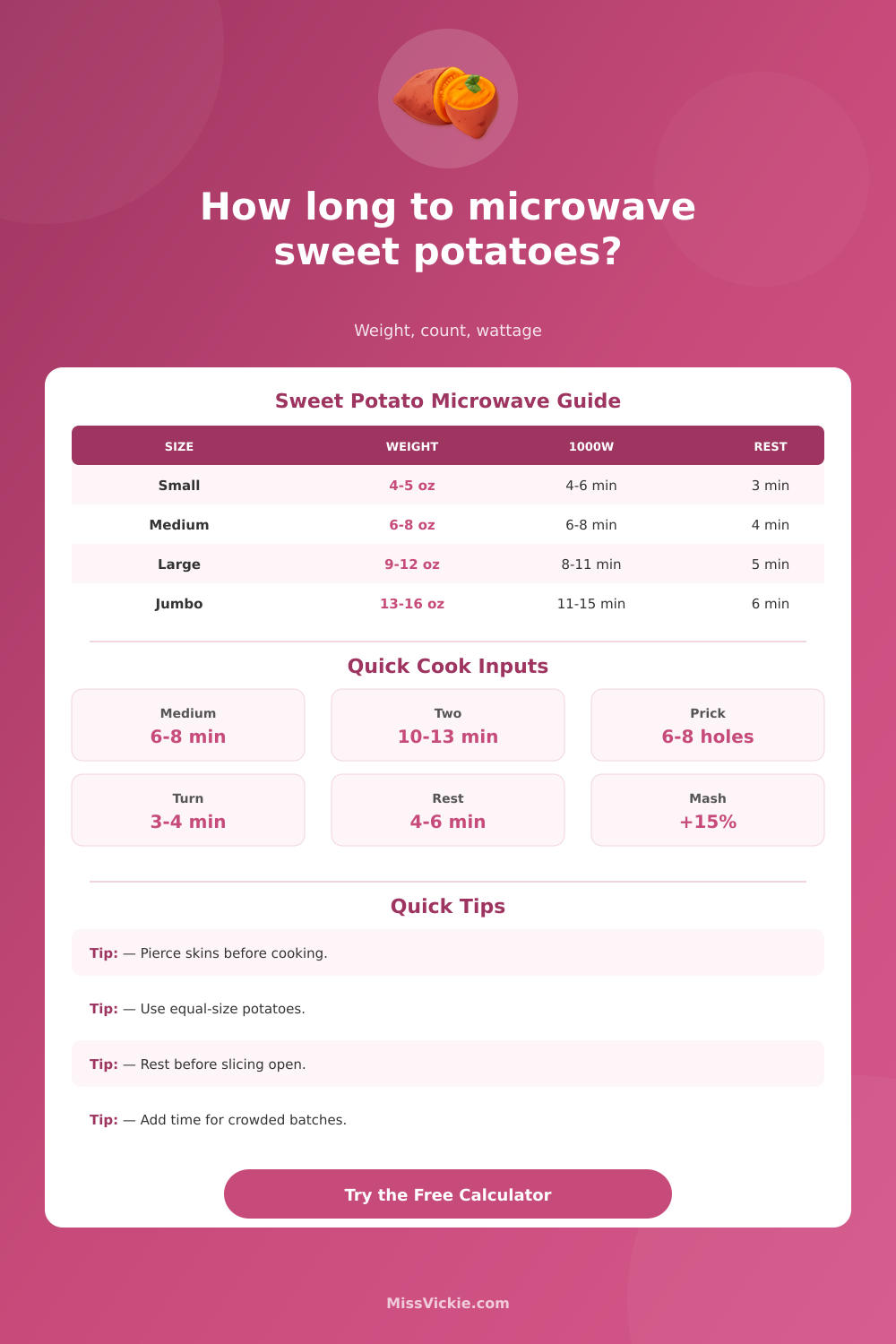
| Sweet potato size | Typical weight | Thickest diameter | 1000 watt cook time | First check |
|---|---|---|---|---|
| Small snack sweet potato | 4 to 5 oz / 115 to 140 g | 1.7 to 2.0 in / 4.3 to 5.1 cm | 4 to 6 minutes | At 4 minutes |
| Medium side-dish sweet potato | 6 to 8 oz / 170 to 225 g | 2.1 to 2.6 in / 5.3 to 6.6 cm | 6 to 8 minutes | At 5 to 6 minutes |
| Large stuffed sweet potato | 9 to 12 oz / 255 to 340 g | 2.6 to 3.1 in / 6.6 to 7.9 cm | 8 to 11 minutes | At 7 to 8 minutes |
| Jumbo mash sweet potato | 13 to 16 oz / 370 to 455 g | 3.1 to 3.6 in / 7.9 to 9.1 cm | 11 to 15 minutes | At 10 to 11 minutes |
⚡Adjustment guide for batches
| Adjustment | Timing effect | What it means | Best use | Check cue |
|---|---|---|---|---|
| 900 watt microwave | Add about 10 percent | Lower power heats the dense center more slowly. | Dorm, compact, and older ovens | Check early, then add 60 seconds. |
| Two medium potatoes | Add about 60 to 85 percent | More mass shares the same microwave energy. | Dinner for two | Swap positions when turning. |
| Touching potatoes | Add about 15 to 20 percent | Contact points shield each other from heating evenly. | Crowded plates | Separate and rotate at each turn. |
| Very soft mash texture | Add about 12 to 18 percent | The center needs to collapse, not just pierce tender. | Mashed sweet potatoes | Knife slides through with no firm core. |
💡Microwave sweet potato notes
Venting: Prick each sweet potato several times before microwaving so steam can escape through the skin.
Resting: A covered rest lets carryover steam soften the center without toughening the skin with extra microwave time.
Testing: Check doneness with a thin knife at the thickest middle. If it meets resistance, add 45 to 90 seconds.
Batching: Keep potatoes in a ring or with gaps when possible, and move outside potatoes toward the center when turning.
Sweet potatoes cook unevenly in microwave because their dense centers and thick skins trap heat different than a russet or a carrot. If you gets the timing correct, you avoid mushy spots and dry bits at the edges, no need for a half-dozen 30-second blasts. But how does one achieve this? It depends on size, how hot they are when first put in, and how many there is, because a larger amount take more time.
After entering your microwave wattage, thickest diameter, potato count, and potato weight, the calculator above do the math for you. It uses those four numbers as its core estimate, wattage affects speed, diameter shows the distance that heat must travel, and weight indicate how much mass requires heating. A 700-watt dorm microwave will take noticeably longer than a 1200-watt countertop one. This is why the tool automatically adjusts base time instead of making you guess the difference.
Why Sweet Potatoes Cook Unevenly
You know that pricking is important, right? It’s not just to prevent splitting (which can happen if there isn’t enough ventilation). It also prevents steam from building up too quickly and splitting the skin. We have plan for that. How often you prick the meat (and whether you use a cover or wrap) also affects moisture levels near the surface and the final texture, even if total cook time is about the same.
The effects of spacing and turning seem obvious once you pay attention: If potatoes is touching, or otherwise close enough for their contact points to block each other, those points aren’t getting exposed to the microwave energy, and their insides lag as a result. Turn things every couple of minutes, and you’ll move the cooler sides into hotter zones; the tool includes this change in its final guess. That evenness score it displays is actualy just an instant visual on how well (or not) your batch is laid out to work with the microwave’s own hot spots.
This matters more then you might think based off the weight alone: because potatoes from refrigerator are colder inside, the microwave need more time to catch up and start cooking them. The calculator will prompt you to enter your starting temperature, cold (as if straight from storage) or room-temperature potatoes (and adjust its calculation accordingly).
Don’t skip the rest time post-microwave, but do make sure to account for that time when setting expectations about how long things will take to soften up in there. Once the microwave turns itself off, all of the steam underneath the skin still keeps cooking and softening up the center for another few minutes. And so the tool include an additional suggested rest time depending on what kind of center you’re looking for. If you cut into something before it’s had enough time, the center will be slightly firmer then it should of been given just its cook time.
After testing several batch of potatoes with the calculator, you begin to get a feel for your typical potato size and your microwave. You have a solid baseline to go from but there’s always that last check, your own check with a slender knife at the potatoes’ thickest point. It’s that mix of calculation and checking the reality of the moment that makes it all less guesswork and more repeatable.