Sweet Potato Cooking Time Calculator
Estimate sweet potato cooking time for the oven, air fryer, boiling pot, or steamer from potato weight, count, diameter, cooking temperature, whole or cubed prep, foil, desired texture, starting temperature, and rest time.
🍠Sweet potato presets
Choose a cooking setup, then fine tune the sweet potato size, method, cut, wrap, texture, starting temperature, and rest window.
⚖Units
🔥Method, size, and temperature
🔪Prep style, foil, texture, start, and rest
Sweet potato timing estimate
Timing breakdown
Check the largest potato with a skewer or thermometer.
⏱Method reference cards
Best for caramelized skin and fluffy centers.
Fast dry heat for medium sweet potatoes.
Good for mash, puree, and baby food.
Gentler texture with less waterlogging.
📋Sweet potato cooking time table
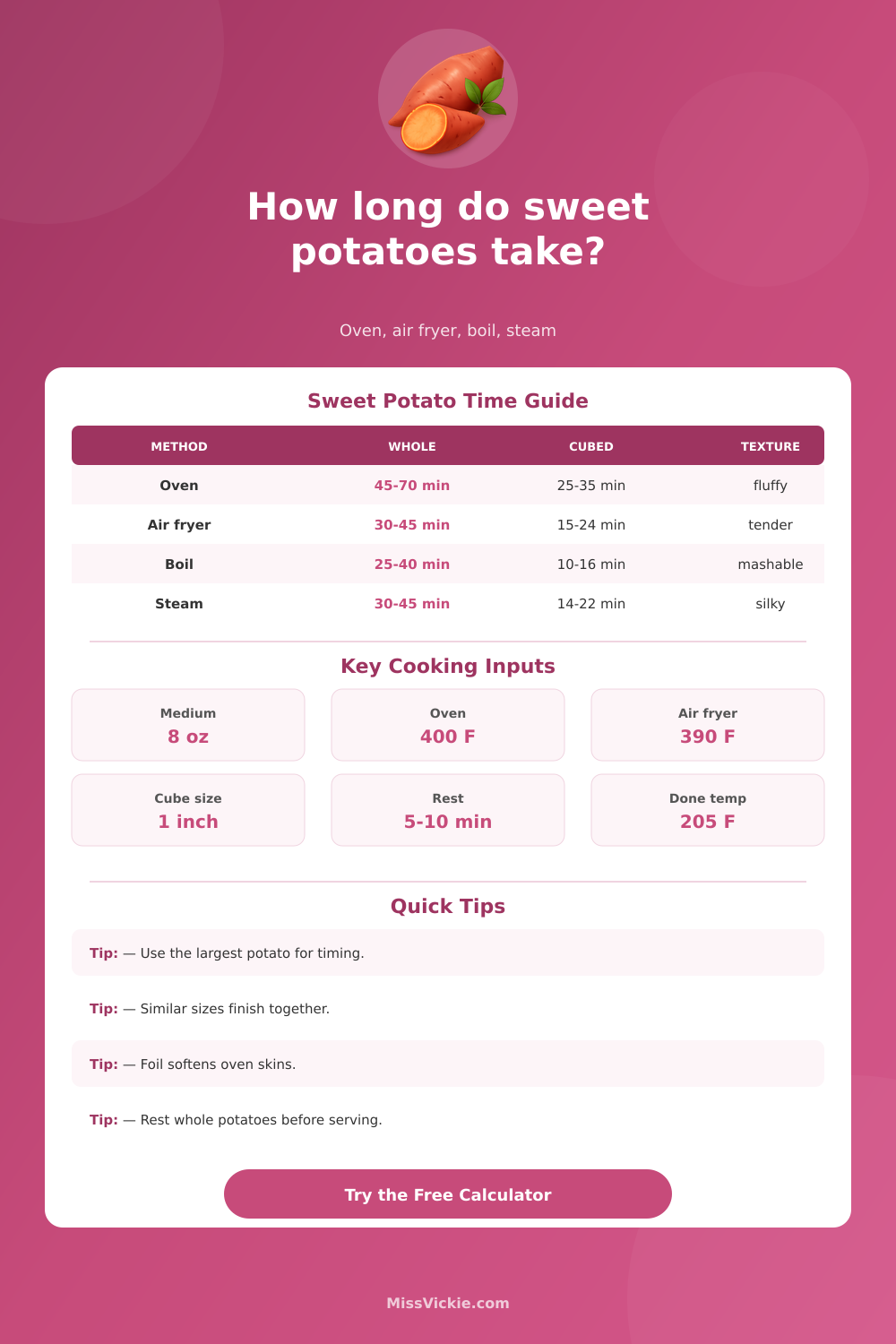
| Cooking method | Best prep | Typical timing | Texture target | Check for doneness |
|---|---|---|---|---|
| Oven bake | Whole, pricked, no foil or wrapped | 45 to 70 min at 400°F | Fluffy, caramelized, scoopable | Skewer slides through the thickest center. |
| Oven roast | 1-inch cubes, wedges, or halves | 25 to 35 min at 425°F | Tender with browned edges | Edges brown and centers crush easily. |
| Air fryer | Whole medium potatoes or cubes | 15 to 45 min at 380 to 400°F | Tender center, drier surface | Turn or shake once for even heat. |
| Boil | Whole, chunks, or peeled cubes | 10 to 40 min at a steady simmer | Moist, soft, mashable | Drain when a fork enters with light pressure. |
| Steam | Whole baby potatoes or cubes | 14 to 45 min over simmering water | Silky, not waterlogged | Keep lid closed and test the largest piece. |
📏Size and cut reference
| Sweet potato size | Approx weight | Approx diameter | Whole dry heat | Water or steam |
|---|---|---|---|---|
| Baby or mini | 3 to 5 oz | 1.25 to 1.75 in | 25 to 40 min | 18 to 28 min whole |
| Medium sweet potato | 6 to 9 oz | 2 to 2.75 in | 40 to 60 min | 25 to 35 min whole |
| Large sweet potato | 10 to 14 oz | 2.75 to 3.5 in | 55 to 80 min | 35 to 50 min whole |
| 1-inch cubes | Any size | 1 in pieces | 20 to 32 min | 10 to 18 min |
| 1/2-inch cubes | Any size | 1/2 in pieces | 14 to 22 min | 7 to 12 min |
💡Cooking notes
Whole potatoes: Time the batch by the heaviest, thickest sweet potato, not the average length.
Foil choice: Foil keeps oven skins soft and steamy; no foil gives more surface drying and browning.
Cubes: Keep cube size consistent. A mix of tiny and large pieces makes some pieces mushy before others soften.
Resting: A short rest helps whole sweet potatoes finish evenly and makes hot skins easier to handle.
The timing of sweet potatoes is variable; there’s no one-size-fits-all when it comes to cooking them. How they cooks up will depend on their shape and their size, which determines how fast the heat move through them. A “medium” potato might look straightforward. However, if you cube it for a sheet-pan dish, steam it for a puree, or bake it whole, any method could work well.
The best results ultimatey depend on how much the starches has gelled in finished product. Also, the bigger it is, the longer it takes for the middle to get hot. The calculator addresses that when you input real-world sizes for your food items. You won’t have to wonder if you should of added another half-inch. Will that make it take any longer?” You will know for sure, so you won’t have to wait for dinner just because you guessed wrong.
How to Cook Sweet Potatoes Perfectly
Thickness is why potatoes of the same weight won’t always cook at the same time: the thicker one is shorter and wider than the slimmer, longer one. Cooking is all about the cut style. Because cubes has more surface area, they’ll cook up faster, including browning on the outside while staying moist inside. On the other hand, whole potatoes will retain moisture within them (though you’ll need some patience if you’re looking for something soft enough to split in two). And then there’s foil; wrapping the potato in it creates a trap that holds on to steam and makes the skin softer; leaving the potato out in the open lets it dry out a bit and caramelize as well.
With this tool, you’re able to choose between these factors and have an estimated cooking time that reflects how you’d like to eat it. The time frame will depend on how many potatoes you’re boiling, but also how crowded your steamer basket is, which slows down heat movement because air and steam can’t circulate as well. Cold potatoes that are still in the fridge will takes longer for their cold center to get hot. Similarly, a full steamer basket, or a tray where the potatoes is touching each other, won’t allow as much air/steam to move so it take longer for everything to come up to temp. This calculator has all of this built-in so you don’t have to do any tricky math yourself.
The last control variable is texture preference. Do you want a silky puree (for soup) or do you like your vegetable cubes nice and firm with some chew to them? Do you reheat? Are they going into casserole that needs to be heated later? That’s all this comes down to: just a few minutes of cooking time.
Here’s where it gets money: The calculator makes you define variables, rather than trusting some generic package directions. It asks for the initial temperature, how much weight there is, what size cut, and (most importantly) how crowded a container of them will be. When you have all those details, the estimated cooking time is good enough that you can plan the rest of your meal around it. Sweet potatoes are no longer a variable; they’re a certainty.