Sugar Per Liter Of Tea Calculator
Calculate metric tea sugar by liter, tea type, hot or iced dilution, g/L sweetness target, syrup concentration, sugar form, serving milliliters, and batch cushion.
🍵 Metric Tea Sugar Presets
Choose a liter-based tea setup, then adjust brewed volume, final dilution, sweetness grams per liter, syrup strength, and serving size.
⚖ Liter Batch Details
Metric tea sugar plan
Your sugar plan appears here as grams, kitchen measure, syrup volume, and serving yield.
Batch Breakdown
Serving And Syrup Check
📏 Metric Sugar Quick Cards
📋 Sugar Per Liter Reference Tables
| Sweetness Style | Sugar Per Liter | Sugar In 250 ml | Best Tea Type | Use Case |
|---|---|---|---|---|
| Nearly unsweet | 0 to 15 g/L | 0 to 4 g | Green, oolong, jasmine | Use when tea aroma matters more than sweetness. |
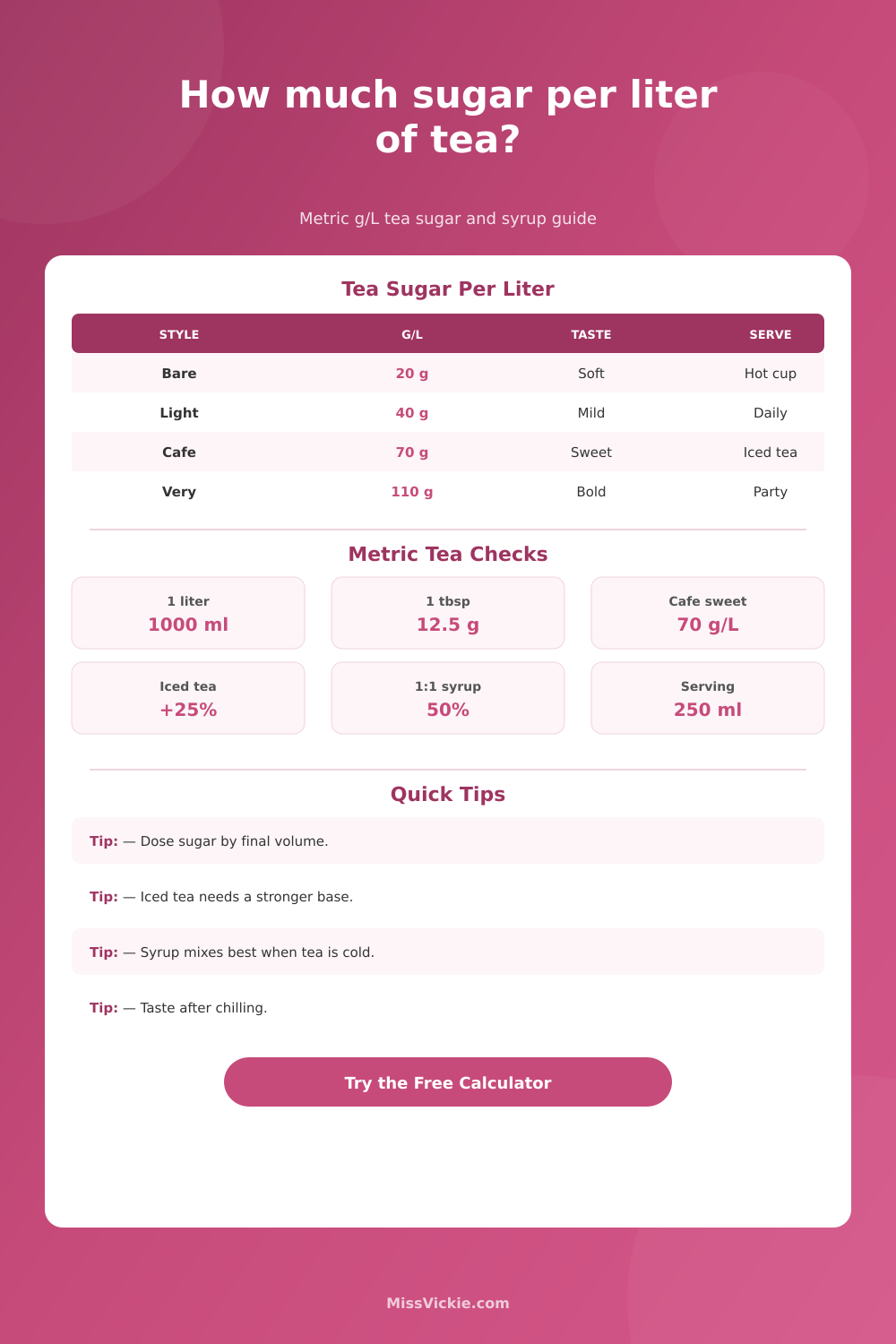
| Barely sweet | 20 g/L | 5 g | Hot black or rooibos | Good for warm mugs and everyday light pitchers. |
| Light sweet | 40 g/L | 10 g | Black, herbal, cold brew | Noticeably sweet but still tea-forward. |
| Moderate sweet | 55 g/L | 14 g | Black or jasmine iced tea | Balanced for chilled tea with small ice dilution. |
| Cafe sweet | 70 g/L | 18 g | Strong black tea | A familiar sweet iced tea or bottled-tea level. |
| Iced tea sweet | 85 g/L | 21 g | Strong black or fruit tea | Works when the glass will carry plenty of ice. |
| Very sweet | 110 g/L | 28 g | Chai, fruit tea, milk tea | Use for dessert-style tea, milk tea, or tart fruit blends. |
| Final Tea Volume | 20 g/L | 40 g/L | 70 g/L | 110 g/L |
|---|---|---|---|---|
| 500 ml | 10 g | 20 g | 35 g | 55 g |
| 1 liter | 20 g | 40 g | 70 g | 110 g |
| 1.5 liters | 30 g | 60 g | 105 g | 165 g |
| 2 liters | 40 g | 80 g | 140 g | 220 g |
| 3 liters | 60 g | 120 g | 210 g | 330 g |
| 5 liters | 100 g | 200 g | 350 g | 550 g |
| Sugar Form | Sugar Strength | Metric Measure | Liquid Added | Best Use |
|---|---|---|---|---|
| Granulated sugar | 100% sugar | About 0.85 g per ml | None | Dissolve in hot tea before chilling. |
| Caster sugar | 100% sugar | About 0.84 g per ml | None | Faster dissolving for warm tea corrections. |
| Raw turbinado sugar | 100% sugar | About 0.95 g per ml | None | Adds a light molasses note to black tea. |
| Honey | About 82% sugar | About 1.42 g per ml | Moderate | Best for hot tea or floral herbal blends. |
| Maple syrup | About 60% sugar | About 1.33 g per ml | High | Use when the maple flavor is welcome. |
| Simple syrup | 50% sugar | 1 g syrup gives 0.5 g sugar | High | Best for cold tea and glass-by-glass sweetening. |
| Rich syrup | 65% sugar | 1 g syrup gives 0.65 g sugar | Moderate | Use for iced tea bars with less extra liquid. |
| Tea Type | Default g/L Shift | Suggested Tea Per Liter | Dilution Note | Sweetness Advice |
|---|---|---|---|---|
| Black tea | 1.00x | 4 bags or 10 g loose leaf | Handles 15% to 25% ice well | Start at 55 to 85 g/L for iced tea. |
| Strong black tea | 1.06x | 5 bags or 12 g loose leaf | Good for heavy ice | Can support cafe or very sweet targets. |
| Green tea | 0.75x | 4 bags or 8 g loose leaf | Keep dilution light | Use lower sugar so bitterness stays quiet. |
| Oolong tea | 0.85x | 8 to 10 g loose leaf | Best hot or lightly chilled | Choose barely sweet or light sweet targets. |
| Herbal fruit tea | 0.90x | 5 bags or 12 g herbs | Fruit acidity may need more sugar | Tart hibiscus often fits 55 to 85 g/L. |
| Chai or milk tea | 1.15x | 12 to 14 g tea and spice | Milk softens sweetness | Use 70 to 110 g/L for a cafe-style drink. |
📝 Serving, Sugar, And Syrup Notes
Little dilution, so dose sugar close to the cup's finished drinking volume.
Measured ice melt increases final liters and lowers sweetness if ignored.
One gram of 1:1 syrup contributes about half a gram of sugar.
Calories per serving are estimated from added sugar only.
💡 Metric Tea Measuring Tips
Metric sugar estimates use common kitchen references: granulated sugar is about 0.85 g per ml, a level tablespoon is about 12.5 g, and added sugar contributes about 4 calories per gram. Taste tea after it is cold because sweetness and bitterness shift with temperature.
When most people attempt to sweeten their iced tea at home they do it wrong. They dissolves sugar into a pot of hot tea, then pour it over ice, letting the cubes melt and dilute the drink. Because the ice melts in the drink, it ends up watered down and weakly sweet. There was no problem with their stirring; the problem was thinking that amount of sugar would be correct for final volume.
This online calculator remedies that, it takes into account the volume of the final drink, and doses the sugar accordingly. It do all the maths; you don’t need to guess about the additional volume contributed by milk/ice.
How to Use the Tea Sugar Calculator
But not all teas is equal when it comes to weight. Some are heavy (like black tea) and others is delicate (green tea). Add too much sugar and you’ll lose what makes that kind of tea unique. Asking about the kind of tea you’re drinking helps the tool know how to tune the base line sweetness target to leaf. Pick a strong black tea and it knows you can takes more sweetness. Go with green and it knows you want less and it tugs back on that target to preserve balance.
Sweetness doesn’t just contribute flavor, though; it also hide other flavors. The other factor here is dilution. For hot tea, there’s hardly any dilution at all; the volume in the mug is the volume in the cup. When you’re drinking iced tea though, it get diluted. Adding enough ice to a glass will dilute it by upwards of a quarter, and maybe even more. To take that into account, the calculator takes total amount (including melted ice) as the liter and calculates the sugar from there. That may seem like splitting hairs, but it alters ratio completely. What you’re really doing is sweetening something that hasn’t been poured.
What about using granulated vs. What about using syrup? That also change the consistency of the tea. In a hot tea, dry sugar will dissolve nicely. But if the tea’s cold, that sugar will simply sink to the bottom and become gritty. (The calculator has an option to swap out for simple syrup or sweeter concentrates, and it accounts for amount of water inside the syrup. Fifty percent syrup will add more liquid to the mix; sixty-five percent syrup won’t.) As it goes through this process, the calculator notes how much extra water was contributed, and uses that to adjust resulting tea’s sweetness to match your target. So if you’ve got some thin syrup and pour it in expecting it to be solid sugar, you would of accidentally dilute your tea.
On the page, they break it down into sweetness by style in the reference tables. Twenty-ish (barely sweet) will knock the edge off of a bitter steep. Seventy-ish (cafe style) is typical of what you’d find in a bottled tea. A hundred and ten (very sweet) is more like a dessert blend, or if you’re mixing with milk. All those numbers are benchmarked for what your palate’s expecting from the tea.
Want consistency at a party? Making a pitcher for yourself? The calculator has that covered. It’s a backup, a buffer option for accounting for extra tastes, or even spillage.
Sweetness registers different at different temperatures: It’s sweeter when it’s cold. So if something was just right hot, it could be cloying cold, and the tips section of the tool is a reminder: Taste after cooling. Your palate decides; the tool provide the structure.
To begin, use the preset for your objective, a five-liter party batch requires different inputs from a daily, one-person hot pot. The calculator will tell you whether you have enough for the number of people you expected and convert it all into the number of tablespoons of sugar, total grams of sugar, calories per serving and so on. It updates instantly if you change the strength, swap some sugar for honey, or want a bit more lemon acidity. That’s what planning the drink looks like before you start boiling up the water.
Tea doesn’t need to be sweet, but if you’re going to add sugar, it should be consistant. You don’t want the first cup to taste different then the last. The calculator eliminates all of the guessing about that chemistry so you can concentrate on the brew time and the leaf itself. Hot water and good tea are still necessary, but you do not need a scale to measure sugar into a melting pitcher. Pour it. The maths’s been done for you.