Sugar Per Gallon of Sweet Tea Calculator
Estimate sugar for sweet tea by finished gallons, sweetness style, sugar type, tea strength, ice dilution, lemon addition, serving size, dissolve method, chill loss, and calories per glass.
🍵Sweet tea presets
Choose a familiar pitcher, party urn, or porch-style tea batch, then adjust the gallons, sweetness, sugar, lemon, ice, and serving size.
⚖Batch units
🫖Batch size, sweetness, and sugar
🧊Ice, lemon, chill loss, and glasses
Sweet tea sugar estimate
Batch breakdown
Balance note appears after calculation.
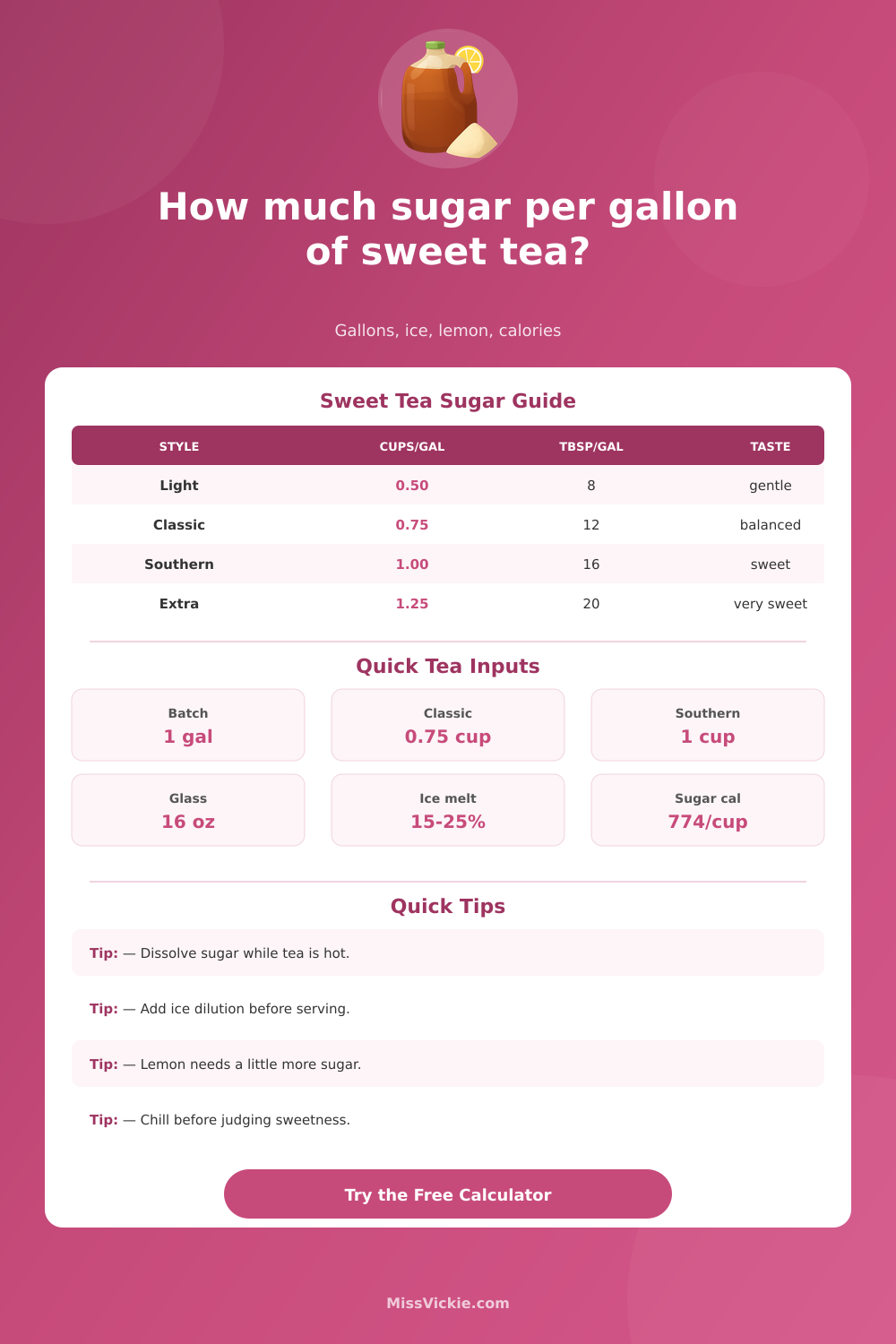
📏Sweetness guide per gallon
Good for mild tea, unsweetened-tea drinkers, and lemon-free pitchers.
Balanced for most iced black tea served cold with moderate ice.
The familiar full-sweet gallon when using strong black tea.
Best for party dispensers, heavy ice, tart lemon, or bold tea.
🥄Sugar and syrup conversion table
| Sweetener | Approx weight per cup | Relative sweetness | Calories per cup | Sweet tea note |
|---|---|---|---|---|
| Granulated white sugar | 200 g | 1.00 | 774 | Clean flavor and the standard sweet tea baseline. |
| Organic cane sugar | 198 g | 1.00 | 766 | Slightly rounder flavor, but measures like white sugar. |
| Superfine sugar | 190 g | 1.00 | 735 | Dissolves faster, especially in warm tea. |
| Turbinado sugar | 205 g | 0.92 | 793 | Adds molasses notes and may need a little extra volume. |
| Light brown sugar | 213 g packed | 0.96 | 823 | Works for spiced tea but darkens the pitcher flavor. |
| Honey | 340 g | 1.25 | 1034 | Use less volume than sugar; floral flavor is noticeable. |
| Agave syrup | 336 g | 1.35 | 1024 | Sweeter by volume, easy to blend into cold tea. |
| Maple syrup | 322 g | 0.70 | 840 | Use for flavored tea; maple taste will come through. |
🧊Ice, lemon, and chill adjustment table
| Adjustment | Typical amount | Effect on sweetness | Calculator response | Kitchen cue |
|---|---|---|---|---|
| Light ice | 10 percent melt | Small dilution | Adds a modest sugar buffer | Good for porch glasses served right away. |
| Normal ice | 18 percent melt | Noticeable dilution | Raises pitcher concentration | Best default for 16 ounce iced glasses. |
| Heavy ice | 28 percent melt | Large dilution | Targets a sweeter pitcher | Useful for outdoor parties and hot weather. |
| Classic lemon | 1/4 cup per gallon | Tartness masks sugar | Adds a lemon balance factor | Stir lemon in after sugar is dissolved. |
| Chill loss | 2 to 5 percent | Concentrates tea slightly | Reports brew-start volume | Top off with cold water after chilling if needed. |
📋Common batch reference
| Finished batch | Classic sugar | Southern sugar | 16 oz glasses | Good use |
|---|---|---|---|---|
| 1 gallon | 3/4 cup | 1 cup | 8 glasses | Family pitcher or dinner tea. |
| 2 gallons | 1 1/2 cups | 2 cups | 16 glasses | Small cookout or meal prep tea. |
| 3 gallons | 2 1/4 cups | 3 cups | 24 glasses | Large dispenser or picnic jug. |
| 5 gallons | 3 3/4 cups | 5 cups | 40 glasses | Party cooler, church meal, or BBQ line. |
| 10 gallons | 7 1/2 cups | 10 cups | 80 glasses | Event urn or concession batch. |
🔢Calories and serving guide
Approximate sugar calories in a classic 3/4 cup per gallon tea.
A tall glass from a classic pitcher before extra lemon syrup.
Approximate sugar calories at 1 cup sugar per finished gallon.
One finished gallon yields eight 16 ounce servings before ice melt.
💡Sweet tea measuring notes
Hot tea dissolves cleaner: Direct-dissolve sugar while the tea is hot, then add cold water to reach the final gallon mark.
Syrup changes volume: Simple syrup is easier to blend into chilled tea, but the calculator reports both sugar cups and syrup cups.
Ice changes the glass: A pitcher that tastes perfect without ice can taste weak after 20 minutes in a full glass of cubes.
Lemon needs balance: Add lemon after the sugar dissolves, then chill before making the final sweetness call.
Until you serve sweet tea to more than two people, it sounds like a trivial recipe: boil some water, pour over some tea bags, throw in some sugar and lemon… then what? When pouring it for dozens, you need to figure out how much sugar goes into a gallon of sweet tea. How does melting ice affect that? Does adding lemon change things? The answer is yes, to all of those questions. That’s why we built this little number crunching friend.
The inputs is important: each one can adjust the output. Sugar is adjusted depending on strength of the tea, amount of ice and amount of lemon. Melting ice will dilutes the drink, which means you need more sugar at first. Strong teas requires more sugar to balance out their flavor. Light teas require less sugar to prevent an overly flat taste. And lemon contains acid that masks sweetness, but our tool compensates by increasing the sugar goal when you add it.
How to Use the Sweet Tea Calculator
A lot of folks make a batch that’s good up front, but weakens with time. Why? Ice takes time to melt. What’s right at the counter becomes thin after sitting in a glass with some cubes for 20 minutes. That’s why there’s an ice setting. It’s designed to make up for dilution.
It matters what kind of sugar you’re using too. Some dissolve cleanly (white). Others offer a familiar taste (white again). And others have unique flavors and are sweeter (honey / agave). One cup of honey isn’t equal to one cup of sugar. The calculator accounts for that, so you’ll know what to use.
The last one is chill loss. When you transfer it to serving containers, some of that liquid gets lost to evaporation (or otherwise just goes to waste). It all adds up with large batches. With this tool, you’ll be able to account for it and know exactly how much will get served compared to what you planned.
There are quick reference tables on the page that help you compare tea styles easy. How do extra sweet, southern, classic, and light teas differ? What about between different types of sweetener? It’s all here: calorie and weight data per type of sweetener. At a glance you can tell how much you need for a two-gallon or five-gallon batch.
Taste is subjective, but that’s not what the numbers represent. A little sweet or a lot? That varies from person to person. Depending on how many people are consuming the tea, where they’re drinking (a large outdoor party vs. Whether you are serving a small pitcher indoors or using ice also impacts your sugar requirement.
Run it through the calculator a couple times and the inputs becomes intuitive. You can tell which settings matter most to you and which ones can stay at their default. It saves you time in planning versus guesswork and having to fix things later. You should of used this sooner, because it makes planning much more comfortabley.