🍬 MissVickie sugar spoon math
Grams to Tablespoons Sugar Converter
Convert grams of sugar into tablespoons, teaspoons, cups, and weight equivalents with sugar-type-aware settings for level, packed, sifted, and humid kitchen conditions.
Pick a real kitchen scenario, from cookie dough to frosting and topping sugar, then the calculator fills the fields and runs the spoon math automatically.
Choose the sugar style, the spoon standard, and the way your kitchen packed the measure so the result stays practical for real recipes.
These kitchen averages help the converter translate grams into tablespoons with realistic sugar densities instead of a single one-size-fits-all guess.
| Sugar type | Grams per tbsp | Grams per cup | Best note |
|---|---|---|---|
| Granulated white | 12.5 g | 200 g | Standard baking sugar |
| Caster sugar | 12.5 g | 200 g | Fast-dissolving crystals |
| Superfine sugar | 12.4 g | 198 g | Very smooth texture |
| Light brown sugar | 13.8 g | 220 g | Usually packed lightly |
| Dark brown sugar | 15.0 g | 240 g | Deeper molasses weight |
| Powdered sugar | 7.5 g | 120 g | Light and airy when sifted |
| Demerara sugar | 12.5 g | 200 g | Coarse finish for topping |
| Turbinado sugar | 12.5 g | 200 g | Raw-style crystal sugar |
| Sanding sugar | 11.9 g | 190 g | Decorative crystal sugar |
| Coconut sugar | 12.5 g | 200 g | Dry sugar with caramel note |
Different kitchens use different spoon standards. This table shows why the same grams can land on slightly different tablespoon counts.
| Standard | Volume | Teaspoon link | Typical use |
|---|---|---|---|
| US tablespoon | 14.8 mL | 3 tsp | Common baking tool |
| Metric tablespoon | 15 mL | 3 tsp | Simple ml-friendly math |
| Australian tablespoon | 20 mL | 4 tsp | Larger regional spoon |
| Teaspoon baseline | 4.9-5 mL | 1 tsp | Small adjustment measure |
If you already know the spoon count, these benchmark rows help you back into grams without losing track of the sugar type.
| Grams | Granulated tbsp | Brown tbsp | Powdered tbsp |
|---|---|---|---|
| 25 g | 2 tbsp | 1.8 tbsp | 3.3 tbsp |
| 50 g | 4 tbsp | 3.6 tbsp | 6.7 tbsp |
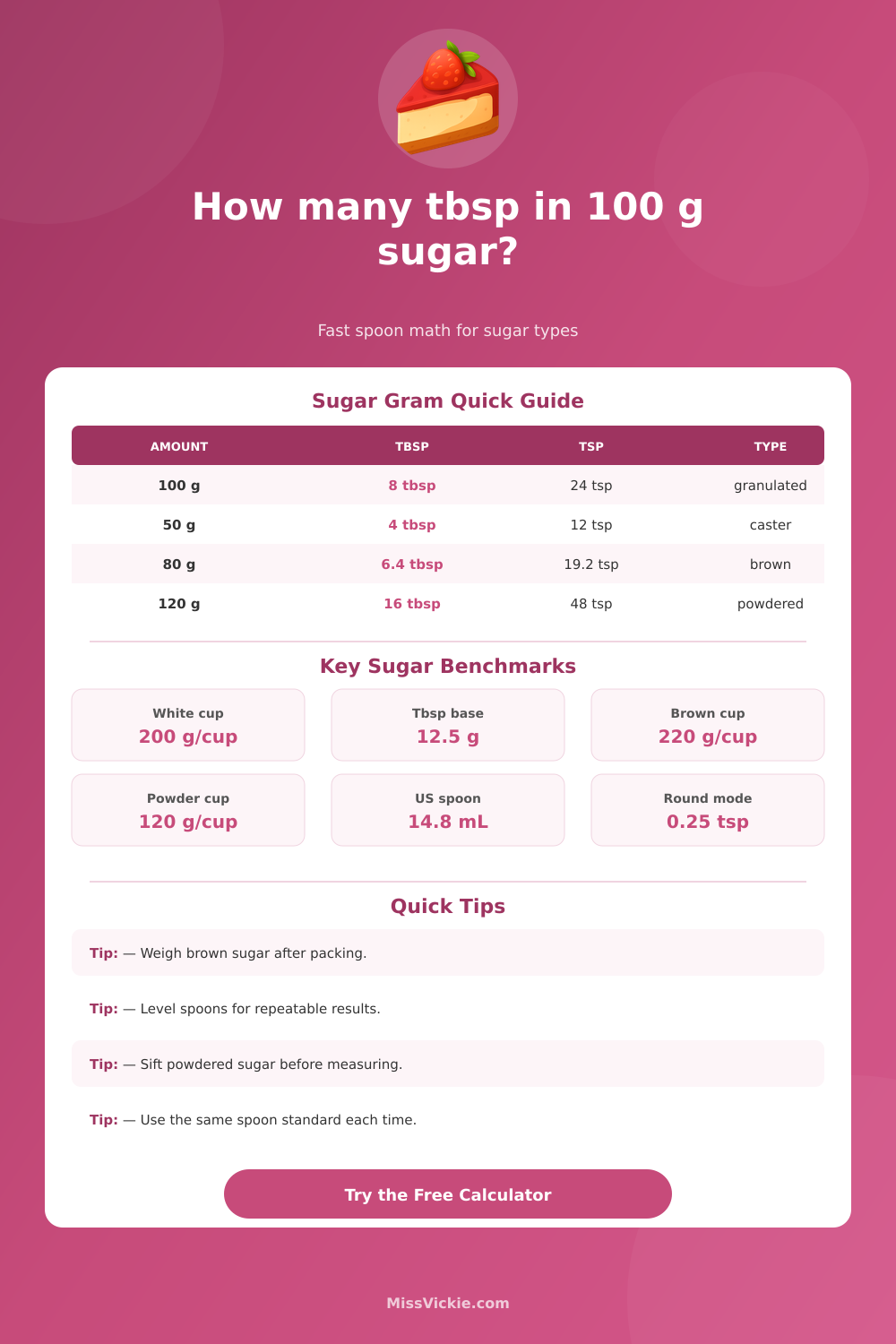
| 100 g | 8 tbsp | 7.3 tbsp | 13.3 tbsp |
| 150 g | 12 tbsp | 10.9 tbsp | 20 tbsp |
| 200 g | 16 tbsp | 14.5 tbsp | 26.7 tbsp |
Packing, sifting, and humidity can move the teaspoon math a little. This table shows the direction of the adjustment before you calculate.
| Style | Density shift | Tablespoon shift | Best for |
|---|---|---|---|
| Leveled | Baseline | Stable | Most recipes |
| Lightly packed | +4% | Slightly lower | Loose spooning |
| Packed | +10% | Lower count | Brown sugar bowls |
| Sifted | -8% | Higher count | Powdered sugar work |
| Heaped | +18% | Highest count | Decorative topping |
This quick comparison helps you choose the right sugar before the calculator converts the grams into tablespoons for the recipe you are building.
Best default for cakes, cookies, and general baking because the spoon math stays predictable.
Finer crystals dissolve quickly, which makes sponge batters and syrups feel smoother.
Usually packed, heavier, and better for chewy texture, caramel notes, and crumbly tops.
Airy and soft, so the tablespoon count rises fast when you convert from grams.
When converting grams to tablespoons, it is important to understand the different densities of a various types of sugar. The density of a sugar is the weight of that sugar in a specific volume. The density of sugars change according to the type of sugar that is measured.
For instance, a tablespoon of granulated sugar will not weigh the same then a tablespoon of another type of sugar. In order to understand how many gram are in a tablespoon of sugar, it is first necessary to identify the type of sugar that is being measured. Granulated sugar is a common type of sugar that people use in many recipes.
How Many Grams Are in a Tablespoon of Sugar
Granulated sugar has a consistent density when the spoon is leveled. Brown sugar is more denser than granulated sugar because it contains more moisture. Therefore, if the cook packs the brown sugar into the spoon, the spoon will weigh more grams of brown sugar than if the brown sugar is not packed into the spoon.
Powdered sugar is more lighter and takes up more volume in the spoon than the other types of sugars. Thus, one hundred grams of powdered sugar will fill more tablespoons than one hundred grams of granulated sugar. The way that the spoon is used will also impact the weight of the sugar.
For instance, if the sugar is to be measured with a leveled spoon, the weight of the sugar will be consistent in most recipes. However, using a packed method with the spoon will pack the sugar, which is often used with brown sugar. If the cook does not pack the brown sugar into the spoon, the density of the sugar will be less and it will weigh less gram per tablespoon.
Powdered sugar should of sift to ensure it isnt clumped together. When you sift it, the sugar will be consistent in the spoon. The size of the spoon that is used to measure the sugar will differ according to the country and system of measurements.
A tablespoon in the United States contains 14.8 milliliters of liquid, but a tablespoon in the metric system contains 15 milliliters of liquid. Other systems of measurements use larger spoons. Using a larger spoon will require fewer tablespoon of sugar than if a smaller spoon is used.
Using the wrong size spoon for the recipe will lead to incorrect volume of the sugar being measured. Additionally, the weight of the sugar will change with the humidity in the air. If the air is humid, it will contain more moisture.
This moisture can make the brown sugar clump together, which will make the brown sugar denser. Therefore, more gram of brown sugar may be required to account for the change in density caused by the humidity. The texture that the sugar will contribute to the food being prepared can influence the way in which the sugar is measured.
For instance, granulated sugar will help the food to maintain structure, which is beneficial for batters. Granulated sugar will also help the batter to contain air pockets. Brown sugar will provide chewiness to the food that contains that type of sugar.
Brown sugar will contain chewiness due to the moisture in the sugar. Powdered sugar will help to create a smooth texture in foods like frostings. The powdered sugar will be smooth because the sugar is ground into fine particle.
It is important to ensure that the type of sugar and the way it is measured takes into consideration the different types of sugars. For instance, many people make the mistake of assuming that one tablespoon of any sugar will weigh the same gram as other sugars. One tablespoon of any sugar is not equal to the same number of grams as other sugars.
It is important for the baker to ensure that the baker measures the density of the sugar that is used in the recipe. Additionally, it is important to ensure that the spoon with which the sugar is measured is leveled. If the baker wants to measure the weight of the sugar in grams, it is best to use a scale to measure the sugar.
Using a scale will provide more precision to the weight of the sugar than using a spoon to measure the sugar. Precision in the measurement of the sugar will ensure the best result with the recipe. Thus, precision in measuring the sugar will ensure consistent results in baking.